



‘Real organised crime’
Vandals exploiting soft penalties for telecoms sabotage, Flow boss insists
Vice-president and general manager of Flow Jamaica Stephen Price has renewed his call for tougher penalties on vandalism, warning that repeat offenders are deliberately targeting critical telecom sites because the current fines and short custodial sentences make sabotage a profitable risk.
“I think the challenge is that it is real organised crime. If you see the case that was just reported in the news yesterday (Tuesday), this person has been arrested three times and will face the court in another parish again, and when this happens, the same people, they do the cost benefit analysis and say, this fine, I can pay this fine, or I can serve this three months, and I’m back out, and I’m going to make money by the kind of work I do by stealing batteries, et cetera. I think we just have to get really, really serious about this because this is a national issue,” he said, during Wednesday’s sitting of the Public Administration and Appropriations Committee.
Price argued that the scale of the problem now goes far beyond nuisance theft, describing the repeated attacks on diesel supplies, fibre lines, and tower equipment as a coordinated assault on the country’s essential systems. He stressed that outages caused by vandalism are not merely technical setbacks but events that cut Jamaicans off from vital services.
“It is ridiculous. I mean, even the cut that JPS got recently in terms of the sawing down of the [utility] pole, that took down telecommunication services, as well. We have to bring it to the level of state terrorism. It’s an attack against the State and infrastructure of the State in terms of keeping people connected. People can’t call the police, people can’t call fire, ambulance, none of those things when this happens; can’t access education. So I think we are set under any kind of emergency mechanism that is open to the Government and to the House of Parliament, that we act on that with urgency,” he added.
Price disclosed that Flow loses roughly US$1 million worth of equipment every year to theft, but said the wider fallout is far more severe.
“If you now put that [US$1 million annual loss] into revenue terms, over the past five years, about somewhere around US$10 million worth of impact from customer outage, in terms of time for restoration and those kinds of things, and if you multiply that on the customer side, in terms of the impact to them, then you have the multiplier effect as well, which continues from there,” he explained.
Digicel executives shared similar concerns, noting that their own losses run even higher in years without major storms — and are likely to surge to unprecedented levels this year.
Chief Executive Officer Stephen Murad told the committee that Digicel typically absorbs US$3 million to US$4 million in annual losses from vandalism during non-hurricane years, but with attacks increasing sharply since Hurricane Melissa, the company now fears the final figure for 2025 may be its worse.
Murad cautioned that the growing scale and frequency of sabotage have left the company bracing for a financial hit far greater than what its existing systems and budgets were built to withstand.
“Imagine you get restored, you’ve been waiting for weeks on end and all of a sudden Flow or Digicel come along and restore you, and then it could be five minutes, it could be whatever, minutes, hours, and that is taken down — that’s heart-wrenching,” he said.
The committee also heard that Jamaica’s rapid shift towards digital health, online education, and mobile-based commerce makes the threat even more severe. Flow’s Director of Technology Operations Michael Brown underscored this point by referencing the widespread outage on September 3 during the counting of ballots for the general election.
“I am almost certain most, if not all, the members here are aware of the outage on the network on September 3rd. That was an act of vandalism… where 40 per cent of our capacity, on-island capacity, was impacted, so it is a threat to national security and that’s how we view it,” he said.
Committee members pressed both companies on the potential for improved policing and technology-based prevention. Member of Parliament (MP) for St Catherine North Western Damion Crawford asked whether Jamaica could adopt best practices from other jurisdictions or establish a dedicated infrastructure protection unit within the police force, similar to the praedial larceny team.
Price noted that the telecoms already maintain strong partnerships with the Counter-Terrorism and Organized Crime Investigation Branch and the wider Jamaica Constabulary Force, but insisted the problem has escalated beyond what current enforcement measures can contain.
Delroy Williams, MP for Clarendon Central, queried whether technologies such as trackable batteries or tamper-resistant equipment could mitigate losses, but telecoms officials cautioned that such tools remain expensive and difficult to deploy at scale.
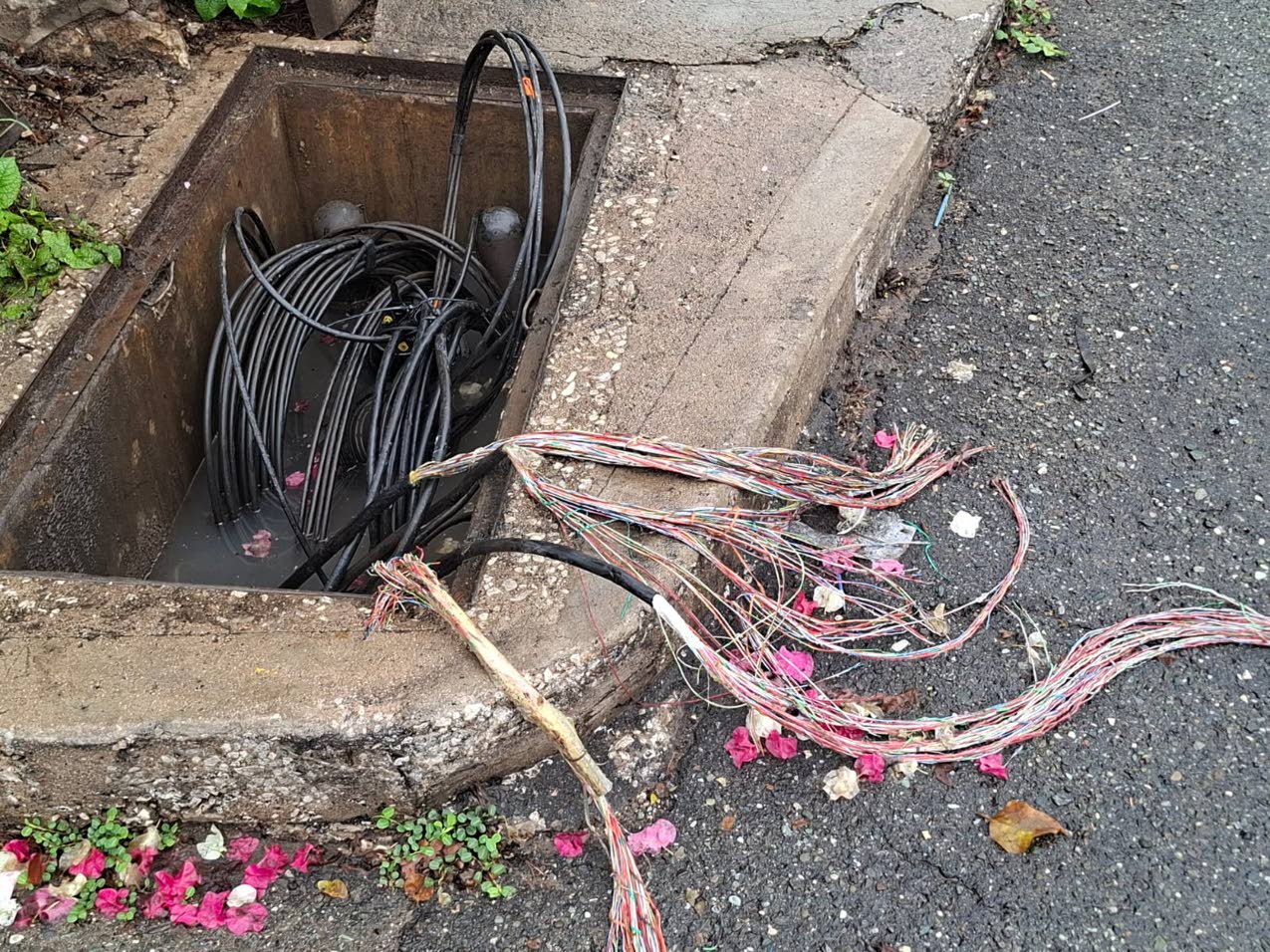
A section of Flow cable damaged by vandals in Cassia Park, St Andrew, in October.


