A cultural perspective on Jamaica’s mental health condition
THE Jamaican psyche is a fortress. It is built on the bedrock of resilience, fortified by the mantra “wi likkle but wi tallawah”, and guarded by a cultural stoicism that demands we “tek bad tings mek laugh”. Yet, as we survey the socio-economic landscape of 2025, navigating the devastating aftermath of Hurricane Melissa while battling a crime monster that refuses to sleep, we must ask ourselves: Is this fortress protecting us, or is it becoming our prison?
For too long, mental health in Jamaica has been shrouded in silence, comedy, and shame. To truly heal our nation — not just from the physical debris of a hurricane, but from the psychic debris of history — we must dissect the cultural narratives that hold us back. We must trace the line from the hull of the slave ship to the corridors of Bellevue, and finally, to a future where mental wellness is a birthright, not a punchline.
Slavery
We cannot speak of the Jamaican mind without speaking of the Jamaican past. The genesis of our mental health crisis does not lie in modern stressors alone, but in the foundational trauma of chattel slavery. Scholars like Dr Joy DeGruy, in her seminal work on post traumatic slave syndrome (PTSS), argues that the adaptive behaviours enslaved Africans developed for survival — hyper-vigilance, suppressed anger, and the normalisation of trauma — have been passed down through generations. In the Jamaican context, Professor Frederick Hickling, a pioneer in Caribbean psychiatry, famously argued that the colonial experience created a “psychohistoriographical” wound. The plantation was a pressure cooker of terror, where showing vulnerability meant death. Today, that survival mechanism looks like emotional unavailability. We are a people who learned to disconnect from our pain to survive it, but what saved our ancestors is now suffocating their descendants.
Mad culture
Our cultural lens for viewing mental illness is often distorted by media and entertainment. Consider the 1991 film The Lunatic. While a cinematic classic, it reinforced a specific archetype: the “madman” as a village fixture — eccentric, hypersexualised, and ultimately a figure of curiosity rather than a human being in need of care. This media portrayal bleeds into reality. In our communities, the mentally ill are often viewed as “characters” in the unscripted drama of street life. We watch them. We do not see a medical crisis; we see a spectacle. This desensitisation allows us to coexist with profound human suffering on our sidewalks without demanding systemic intervention.
Nuh laugh!
Walk into a festival competition or a local play, and you will inevitably see the trope of the “mad” character. They enter the stage, hair unkempt, speaking in non-sequiturs, and the audience erupts in laughter. In Jamaica, “madness” is a comedic genre. This cultural reflex — to laugh at mental instability — is a defence mechanism. As noted in Arthur Newland’s anthropological work on Jamaican subcultures, humour is often used to neutralise fear. If we laugh at the “madman”, he cannot hurt us, and we do not have to acknowledge that he could be us. But this laughter has a cost. It trivialises the experience of schizophrenia, bipolar disorder, and psychosis, turning distinct medical conditions into a monolith of “foolishness”.
Madeeks
The vocabulary of stigma: “mad gyal” and “mad bwoi” language is the carrier of culture, and our language regarding mental health is weaponised. The labels “mad gyal” or “mad bwoi” are thrown around playgrounds and workplaces with reckless abandon. These are not clinical terms; they are tools of social exclusion. When a person is labelled “mad” in Jamaica, they are effectively stripped of their agency and their humanity. This labelling theory, extensively studied in sociology, suggests that once the label is applied, the community interprets all future actions of that person through the lens of the label. If a “mad bwoi” speaks the truth, it is dismissed as raving. This stigma creates a wall of silence; who would admit to struggling with depression if they know the penalty is to be branded a social pariah?
Mad house
“Mi wi tek yuh dung a Bellevue fi two tins a malt.” We have all heard it. We have perhaps even said it. It is a threat, a joke, and a cultural idiom all wrapped in one. But unpack the horror within that statement. It suggests that a person’s freedom can be traded for a pittance (two tins of malt) and that Bellevue Hospital is not a place of healing, but a punitive destination — a warehouse for the unwanted. This expression reveals a deep-seated lack of seriousness about psychiatric care. It frames the mental hospital not as a sanctuary, but as a dungeon. Furthermore, it highlights the tragic reality of Bellevue’s capacity. As Dr Aggrey Irons, another titan of Jamaican psychiatry, has frequently highlighted, the resources available for public mental health are vastly insufficient for the population’s needs. The institution is overburdened, leading to the visible crisis of mentally challenged individuals roaming the streets, vulnerable to abuse and, at times, posing a danger to themselves and others due to lack of medication and care.
Wi rough
Mahatma Gandhi said, “The greatness of a nation can be judged by the way its animals are treated.” If we hold this mirror up to Jamaica, the reflection is unsettling. We often treat our domestic animals with harshness — stones thrown at dogs, neglect of livestock. This lack of empathy is not isolated; it is systemic. It begins in childhood. Our parenting style is often authoritarian and physically punitive. We confuse fear with respect. Scholarly articles on adverse childhood experiences (ACEs) in the Caribbean context link harsh physical discipline to higher rates of anxiety and aggression in adulthood. When we teach children that love looks like a beating, we wire their brains for conflict and silence their emotional expression. We are raising a nation of people who do not know how to be gentle, because gentleness was never modelled for them.
Mi gud mon!
“How yuh do?” “Mi alright man, just a gwaan hold it.” This interaction is the Jamaican script. We are forced to cope. The socio-economic pressure, exacerbated now by the post-hurricane crisis, demands that we keep moving. There is no space for grief. The “strong black woman” or the “gallis man” archetype forbids weakness. Research published in the West Indian Medical Journal has discussed the high rates of undiagnosed depression in Jamaica. We function while depressed. We go to work, we MC events, we attend church, all while carrying a crushing weight. This “high-functioning depression” is dangerous because it often ends in sudden collapse — be it a stroke, a heart attack, or a psychotic break.
Wi warify
We ask why our crime rate is so high, why conflict resolution seems impossible, why a fender bender turns into a stabbing. The answer is untreated trauma. We are a nation with an anger management problem because we are a nation with a grief management problem. Violence is often a tragic expression of unmet psychological needs. When a young man feels voiceless, marginalised, and economically castrated, and he lacks the emotional vocabulary to process these feelings, he turns to the language of the gun. The crime monster is not just a policing issue; it is a mental health crisis.
Teach us
We cannot wait for adulthood to fix this. Mental health education must be integrated from the kindergarten level. We need guidance counsellors in rural districts who are as active as the ones in uptown St. Andrew. We need a curriculum that teaches emotional intelligence alongside mathematics. Teachers and community leaders need to be trained to spot the signs of early-onset mental illness. Is that child “stubborn,” or are they showing signs of ADHD or trauma? Without education, we misdiagnose symptoms as behavioural problems, punishing the child for their illness.
Gwaan betta
We must retire the word “madness”. It is a lazy word. It lacks nuance. We need to start speaking of “chemical imbalances”, “trauma responses” and “neurological conditions”. We need to integrate therapy into the corporate world. EAPs (employee assistance programmes) should be mandatory, not optional. We need to normalise therapy in the church, moving away from the idea that prayer is the only medicine, and embracing the idea that God provides doctors and therapists as agents of healing.
Weh wi deh now?
Finally, we stand in the wreckage of Hurricane Melissa. Many have lost roofs, livelihoods, and hope. The psychological impact of a natural disaster often hits three to six months after the event—right about now. We need a massive, long-term social campaign. Not just handouts of zinc and tarpaulin, but “psychological first aid.” We need mobile mental health clinics going into the hardest-hit parishes. We need a government strategy that treats mental infrastructure as critically as physical infrastructure. The socio-economic crisis we face is severe, but the crisis of the mind is the true threat to our future. If we can stop laughing at the “madman” and start caring for the human; if we can stop beating the “badness” out of our children and start loving the greatness into them; if we can trade our stigma for support—then, and only then, will we truly be “out of many, one people.” One healthy, whole, and healed people.
Krystle Daley Thompson is a brand strategist and communications professional with a strong foundation in Language, public relations, and business administration.
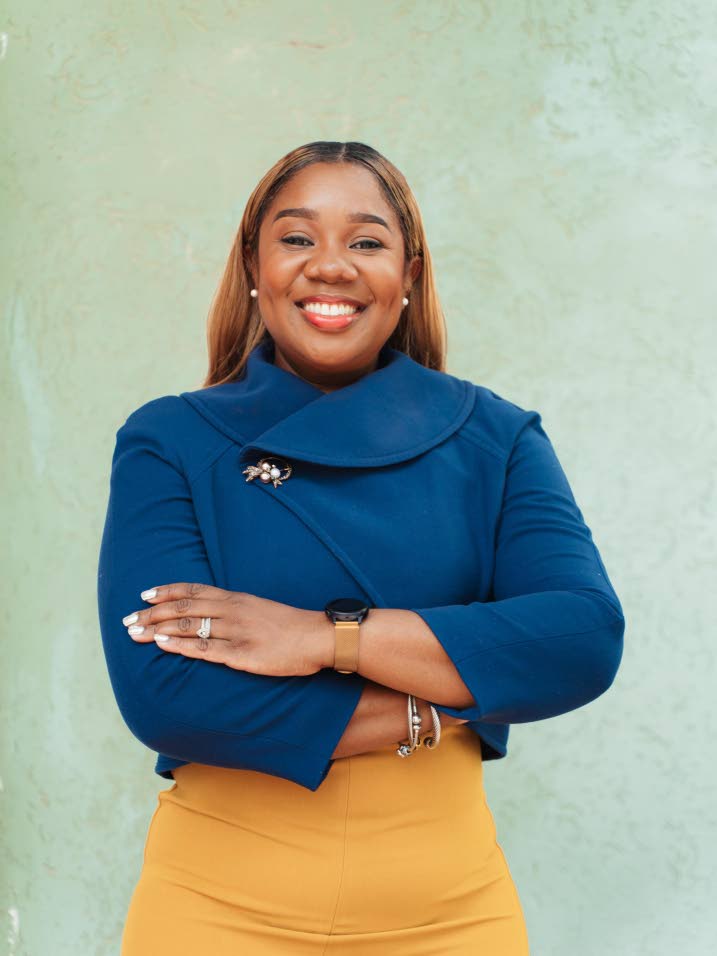
Krystle Daley Thompson.