



Men on a mission
KEVIN Brown didn’t expect to cry. Not after three decades in security and law enforcement. Not after living through Hurricane Gilbert. But standing in Westmoreland, looking at an elderly man perched on the remains of his home, he felt the tears rise before he could swallow them back. That moment would redefine everything; his mission and his masculinity.
Brown and friends Arnaldo Martin, brand manager for Red Stripe Flavours and Malta; and Davin Ellison, human resources service delivery & rewards manager, stepped out of their nine-to-five roles and into a deeper sense of responsibility. Leading quietly and showing up when it mattered, they went to the west as part of Red Stripe’s mixed-gender relief committee. They didn’t wait for instructions or for a perfect plan. They raised their hands early. They leaned in. They insisted on helping. Their decision to step forward, unprompted and unpolished, became the first sign that this would be more than a logistics exercise. It would be a test of heart.
Where the work really began
Before the first care package was loaded onto a truck, the three men had already spent days planning. They met with community leaders, coordinated with the Office of Disaster Preparedness and Emergency Management and the police, checked routes for landslides, prioritised vulnerable households, and helped shape care packages designed to restore dignity.
Their approach was meticulous, but it was also deeply human. They talked about families who had lost everything, about how to reach isolated communities, about safety for volunteers travelling through unstable terrain. Every decision reflected purpose rather than protocol.
Still, nothing they planned in Kingston fully prepared them for what they would feel once they reached the people they were planning for.
“Boy son, my condition really bad.” The elderly man’s voice still echoes for Brown, Red Stripe’s security manager. The man was sitting quietly on a piece of plywood, all that remained of the home he’d lived in for decades. When he looked up and spoke those six words, something inside Brown gave way.
“I felt the tears come immediately,” he said. “And I didn’t hide it. People think men don’t feel these things. But seeing him like that… it cut right through me.”
His tears didn’t weaken him. They clarified everything, why he volunteered, why he stepped into the mission without hesitation, why this work mattered on a deeply personal level.
“We must do this for Jamaica,” he said. And this time, the words were lived.
A sense of urgency that became something deeper
For Martin, the mission began long before he reached Westmoreland. The storm had hit people he knew, neighbours, friends, relatives. When the committee explored delaying the trip to fine-tune logistics, he pushed back.
“When the need is so great, seventy per cent is better than zero. Action is needed.”
That urgency shaped everything that followed. But it wasn’t until he stood in Whitehouse listening to a soft-spoken man explain how he was rebuilding from almost nothing that the emotional gravity took hold.
“I felt survivor’s guilt at times,” Martin admitted. “But that interaction reminded me that support is not only money. It’s time, presence, effort. Sometimes it’s just showing up and listening.”
What began as urgency became empathy. What began as logistics became connection.
“If you can, then you should.”
For Ellison, the emotional impact came slowly, almost quietly. It began while packing the simplest items; toothbrushes, soap, tarpaulin.
“It hit me that some families were starting from zero,” he said.
That realisation sharpened at the first distribution stop, where tension and fear ran high. “People were scared, hungry, exhausted,” he recalled. “That wasn’t anger. That was trauma.” He stepped in calmly, reorganising the process, speaking softly, steadying the space so that aid could be distributed safely and respectfully.
Growing up in St Elizabeth anchored him in a simple principle: If you can help, you should. “Not everyone has a Davin,” he said quietly. “So if I can help create many Davins through coordinated support, I will.”
Later, when warm food and music finally allowed residents to exhale, he watched gratitude soften faces hardened by days of uncertainty. “That moment,” he said, “told me the work was worth it.”
A mirror for Jamaican masculinity
Westmoreland offered its own lesson about Jamaican manhood. Not the loud, public version often celebrated, but the quiet one. The kind that appears in service, tenderness and steady presence.
Three men stepped forward not because they were required to, or because it was their job description, but because something in them felt called to rise. And when they stood before people who had lost everything, they did not respond with machismo or emotional distance. They responded with tears, with patience, with listening, with structure, with problem-solving, with tenderness. They responded with the kind of masculine leadership rarely captured in headlines.
A woman in Auldayr put it plainly. “When dem come, it never feel like handout. It feel like people who understand.”
Understanding, connection and presence are not qualities often associated with Jamaican men in public narratives, but they were the heartbeat of this mission.
The three did not serve for applause. They served because the moment demanded it. They served because they felt the weight of other people’s losses. They served because their country needed them fully, emotionally and without reserve.
And what they walked away with was a shared truth: When men choose empathy over distance, presence over posturing, and service over spectatorship, Jamaica feels it.
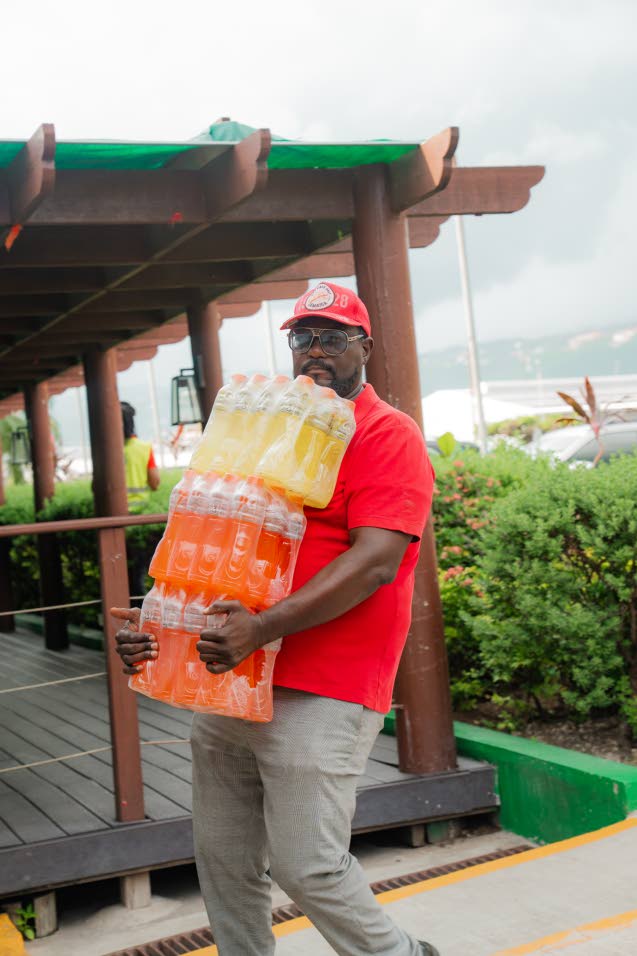
Security Manager Kevin Brown helps to move cases of Gatorade to the area where care packages are being assembled.
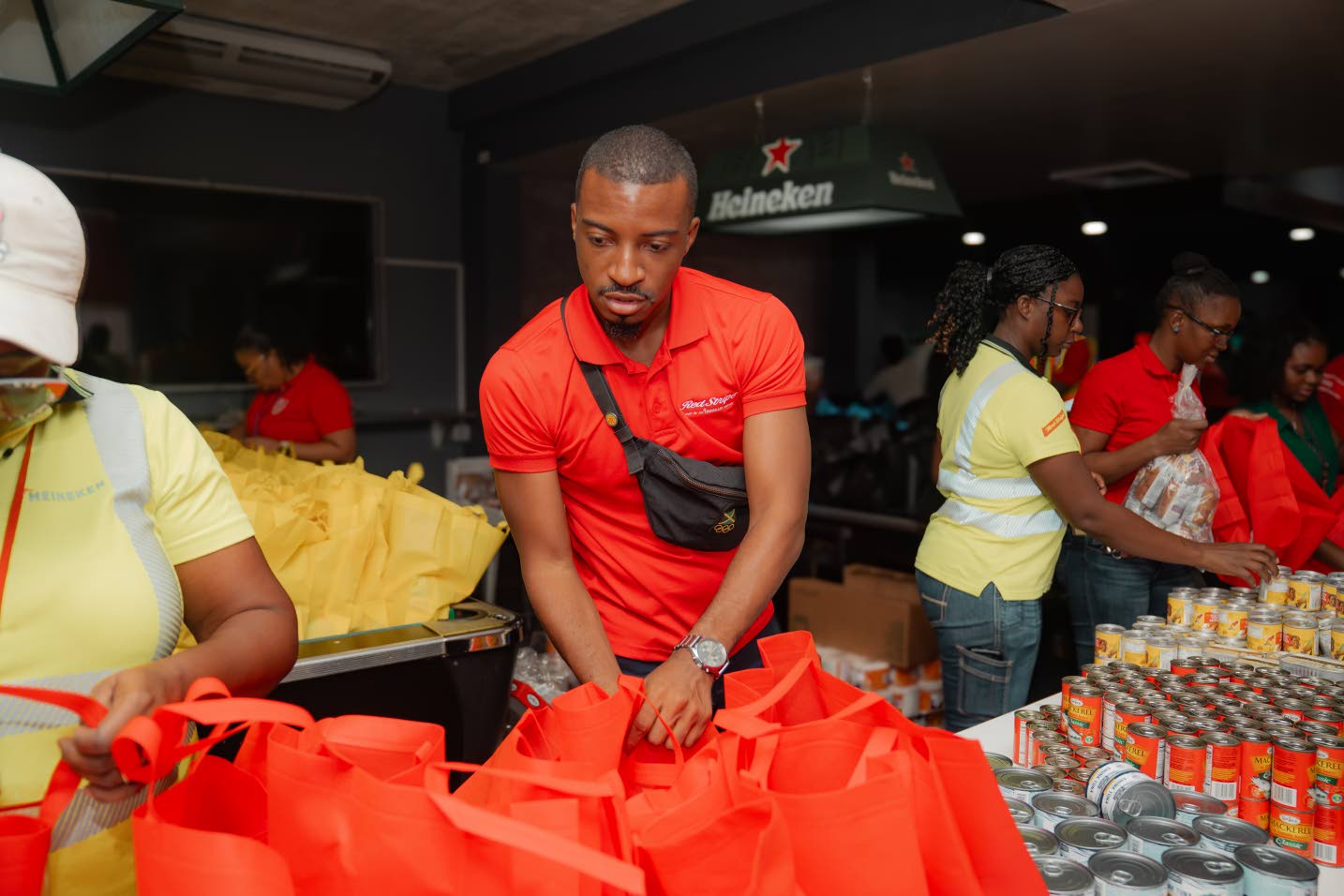
Brand manager for Red Stripe Flavours and Malta, Arnaldo Martin, joins the Red Stripe volunteer team in packing care packages.


