



Racing against the sunset
Westmoreland residents adapting to life without electricity but urge speedy restoration of service
THE familiar glow of light from household bulbs has been largely absent in Westmoreland since Hurricane Melissa tore through sections of Jamaica on October 28.
But while residents in a number of districts describe the extended outage as miserable — given that they battle mosquitoes, worry about safety, pay to charge their phones, and lose income — they say they understand the challenge the Jamaica Public Service Company (JPS) is facing as it works to restore electricity. However, they are urging the power company to speed up restoration as some of them have turned to solar lamps, generators, flashlights, and candles for light.
Last Tuesday the Jamaica Observer spoke with Percival Gordon at his home in Farm District while he prepared a meal using light from a solar lamp.
“It isn’t normal, it’s wicked. Right now we are suffering. It’s just strong mind and strong heart we have to have and just do [our] thing. It’s not easy. It’s not pretty on [us] down here,” he said.
Gordon shared that he and his girlfriend had a two-bedroom house that was destroyed by the Category 5 hurricane, leaving them with little to nothing. However, with some assistance, they were able to construct a room to lay their heads.
He said that after the storm they mainly used candles to get by, but have since purchased a solar lamp and a flashlight as alternative lighting sources.
“I still cook my pot,” Gordon said. Pointing to the solar light, he added: “This won’t serve any time, and when it dead we are in darkness, so we have to buy candles sometimes. We have a flashlight and the battery all dead, so when this [solar lamp] dead it’s pure darkness in here until morning.
A solar light attached to a house in Whitehouse, Westmoreland, shines bright last Tuesday night.
(Photos: Garfield Robinson)
“Sometimes I buy two candles, three candles, all a pack of candles we have to buy; they don’t last — probably about three days — and about $400 for it. It nuh pretty,” he shared.
“We have to just keep on going and hope for the best. The whole place dark, only moonshine, and we see a little light from the people because sometimes people put on them little solar light outside,” added Gordon.
A fisherman by trade, he said he goes to sea a few times each week to catch dinner as he’s tired of the canned goods they have been living on since the storm passed.
Maxine Johnson, who lives in Belmont, said she and her children have also grown tired of canned food, but with the help of World Central Kitchen — a non-governmental organisation that provides food relief in disasters — they are able to diversify their meals.
“We eat the canned food in the morning and we eat the World Central Kitchen [meals] in the evening,” she told the Sunday Observer, noting that that has been their routine since the organisation started distributing food in the parish.
Another routine, she added, is the rush to get home before sunset. Johnson said before the hurricane she left work at 7:00 pm. Now, she leaves at 4:30 pm or 5:00 pm to get what little sunlight she can before turning to her candles.
Another resident, Javier Stewart, was seen making his way through the dark with the aid of a flashlight. He had lost the race against the sunset.
“I just came in and I started to cook. The rain stopped me where I work. I wanted to reach earlier, before the place gets dark, but I couldn’t manage,” he told the Sunday Observer, adding that he does not feel safe walking home at night.
Stewart said he bought the flashlight because he is not always able to get home before sunset.
“We just have to gwaan face it for now because they said the current [electricity] is not coming back for now. We just have to gwaan face it… Sometimes I’m just over by my friend with the solar light until I’m ready to go. The only other thing is that the mosquitoes bothering us [but] we just have to gwaan face it for the time,” he said.
According to a recent update from the Jamaica Public Service (JPS), as of December 7 electricity had not been restored to approximately 88 per cent of its customers in Westmoreland. Power has been restored in some northern and southern sections of the parish, while other communities are projected to receive electricity later this year, going into 2026.
Winston Hamilton, a resident of Whitehouse, is hoping that he will not have to wait that long as the absence of electricity is causing him to lose income, given that he uses power tools for his job.
He said that to make matters worse, his house was destroyed by the hurricane and he cannot afford to fix it. Now, he is staying with family members who have a generator and solar lights.
“Light is an essential part of the business. If light no deh about, the place lock down — and we can’t afford for the place to lock down because a problem that. Some of the time, man will all come rape because of the darkness, so the light is essential and we need it,” he told the Sunday Observer.
“We want light, because without light nothing can [happen]. Work has to stop, business places lock down. It can’t work out — we need light,” he stressed.
Hamilton noted that while some residents can afford a generator, others like himself are not able to do so and are using candles, solar lamps, or flashlights.
He acknowledged that there is a lot of work for JPS to do but urged the company to speed up the process.
Another resident, who identified herself only as Susie, said that charging her mobile phone to stay connected and use as another light source is a difficult task.
“It has been hectic. We have to walk and beg people who have generators to charge our phone. The little solar lights them nuh really serve long but they help a lot… some of them have power banks that can charge your phone but the power bank don’t work that much. The light [on the solar lamp] works better; it just gives your phone a couple of minutes, and then it stops charging… When you charge it with electricity, it works better, like when you charge it on a generator,” she shared.
“We just have to live with the darkness for a while. It’s going to be long but we just have to live. To the amount of people who have solar light, sometimes when you look, you think [electricity] deh here,” she added, noting that residents are adapting.
Sharon Walcott said she has had similar issues trying to power her devices, but has found different ways to pass the time.
“Sometimes we sit down out here with little fire until late. We used to make up a big fire heap there,” she said, pointing to a spot in the community. “We sit down out here until 11 o’clock and come in.”
Walcott, though, said that on other days she goes inside her house before sunset.
“We will wait until the light comes back because we know JPS is doing them best. I wish them good luck because we know them a work hard and them a go continue to do them work. We ask them to just try and help we,” said Walcott.
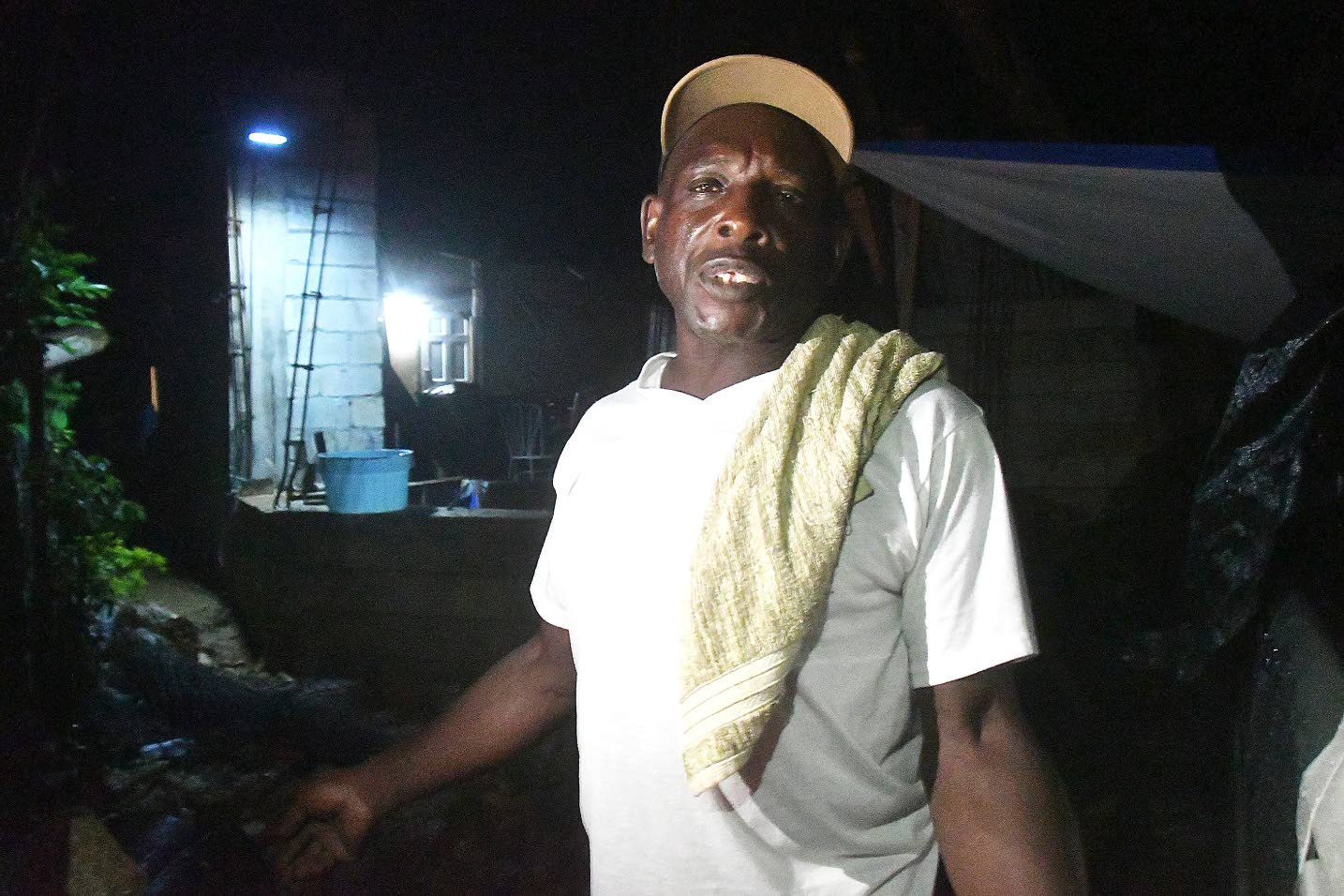
Whitehouse resident Winston Hamilton laments the absence of electricity in his district as it is affecting business.
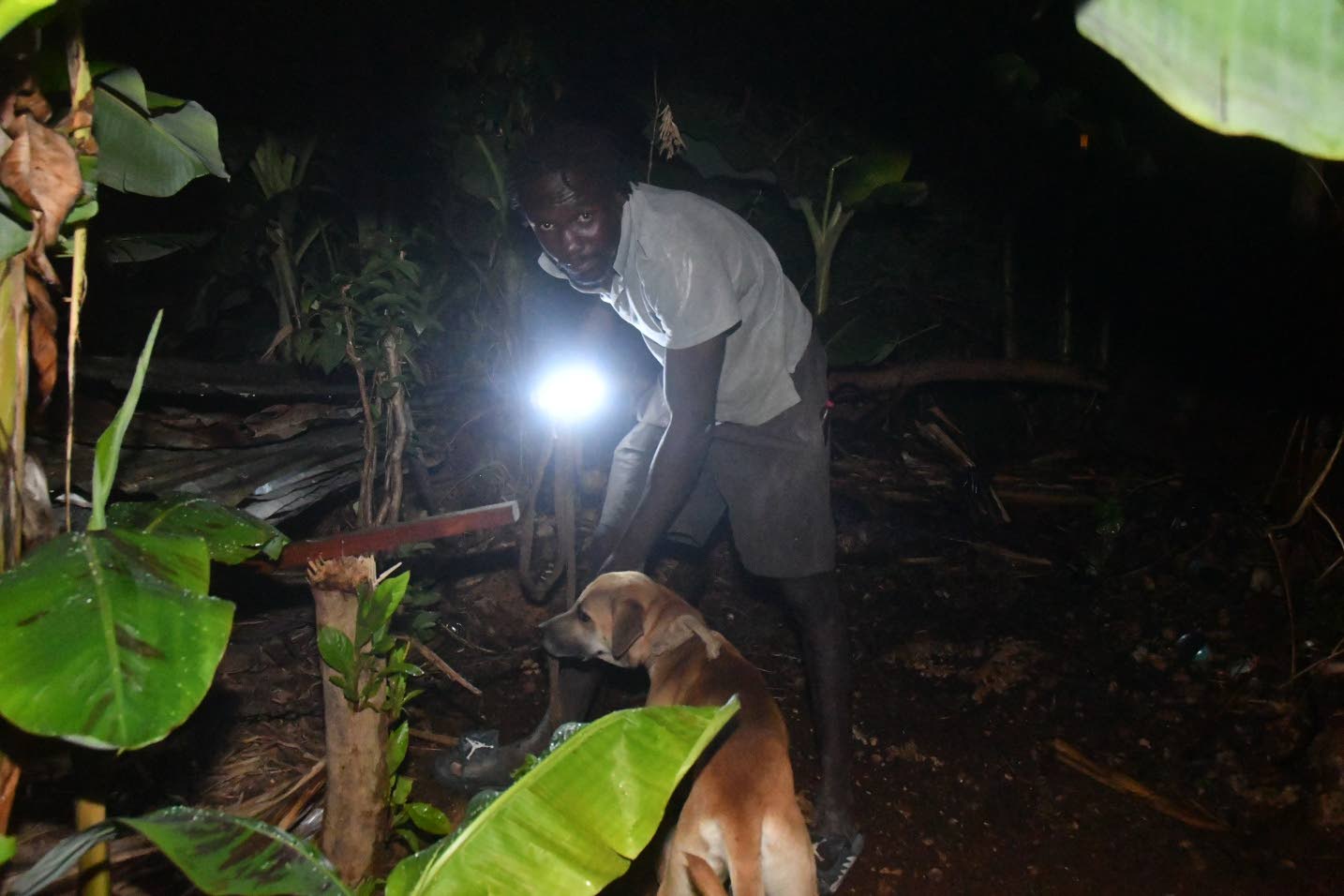
Javier Stewart, accompanied by his dog, uses a flashlight to make his way through the darkness in Farm District, Westmoreland, last Tuesday night.

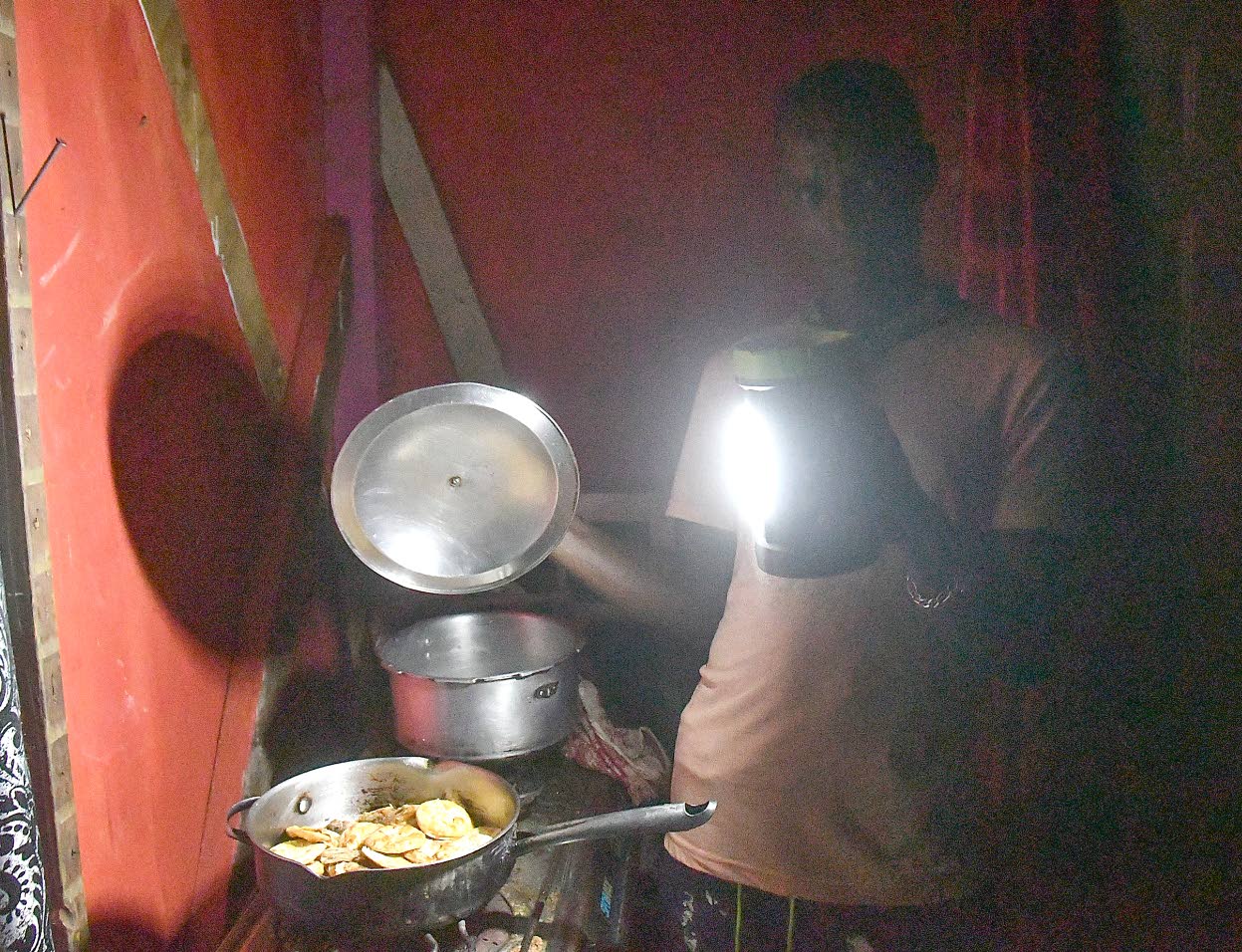
Percival Gordon, a resident of Farm District, Westmoreland, uses a solar lamp to help him see as he prepares a meal last Tuesday night.


