



‘A deep horror hit me’
Melissa’s savagery stuns Jamaican lineman back home on voluntary mission to help restore electricity
IN the 20 years engineer Christopher Bryan worked with light and power company Jamaica Public Service (JPS) before migrating to Canada in 2012 he was part of every team restoring electricity connection after major weather events. But nothing from those experiences prepared him for what he saw in the aftermath of the terror that was Hurricane Melissa when it ploughed into Jamaica on October 28.
“Viewing from Canada was impactful… but then when I came on the ground, the show element [edited social media content] disappeared. There was no soundtrack, no nothing. This is the raw, unedited version, and you look at people and you see the distress before they even say anything to you. You see it and the story is painted in so many ways. You see the zincs crumpled — not just blown off, they are reeled up and crumpled up like somebody wrapped them up and threw them aside, so you can’t even pick them up to say you are going to use them back,” Bryan told the Jamaica Observery in describing the stark difference between viewing the devastation from his now home in Canada and seeing it in person.
He said though comfortably ensconced in his own life and career there, he could not resist the pull to return home voluntarily to offer his services, as his former employer faced the daunting task of restoring power to hundreds of thousands of Jamaicans after the Category 5 storm made landfall on Jamaica’s south-western coast.
Several conversations later with the light and power company Bryan, who took unpaid leave from his job in Canada, landed in Jamaica on Sunday, November 16, ready to do what he had done following Hurricane Ivan in 2004, Hurricane Dean, 2007, and Hurricane Sandy in 2012.
On a foray into St Elizabeth and Westmoreland two days after landing in Jamaica, the seasoned engineer, gutted by what he saw, knew he had made the right decision.
Christopher Bryan about to enter his brother’s motor vehicle to go to work with JPS.
Speaking with the Observer after 10 days working tirelessly to return power to communities on the island’s southern end as project manager for a team of men, Bryan shared searing memories of scenes which will remain with him forever.
“Going through St Elizabeth, just looking at the landscape, it was really distressing and devastating. Brown, brown, brown [vegetation stripped bare of green leaves]. But the people were my concern; the ladies that were on the street with their children, the rubble behind them showed where they once had business, or lived or dwelled. They were there with their children on their shoulders, sleeping on the street. I was driving at approximately 50 miles per hour and ladies were literally coming towards the vehicle in order just to get someone to stop,” he said.
For Bryan, going through the area at nightfall — which made the devastation grimmer — was added impetus to do everything necessary to at least push the darkness to the periphery of what was left of communities.
“If you bring food to them there is no place to sleep, generally, there’s no father, and now there’s no house — so there is no protection. I’m saying, you can go and abuse anybody. It was an open field… Jesus have mercy. I thought about my family, I thought about my girls, and the tears welled up inside me. Mi a drive but mi a tell yuh, mi feel sad that day,” he told the Observer.
“A deep horror hit me and I said, ‘My God, I’m really glad that I came with the heart [to help].’ Because I’m telling you, if this don’t solve real quick this can turn into like the things we watch on TV about Africa — we can see it just getting like that. So, that was heart-wrenching for me and so I took that in coming from that side,” the married father of two girls shared.
The following morning, Bryan felt to work with a will.
“I woke up Wednesday morning [November 19] and I was off to duty for JPS. I got my brother’s vehicle and I turned up for work in Manchester. By the time I got up there, Spalding had light. Percy Junor Hospital was without light but Spalding town, they had restored power. I started from Spalding square, and for the rest of that entire week I worked my way to Cave Valley in St Ann and beyond.
“We lit up Cave Valley; Alexandria was lit, we had the hospital there lit; and then we moved over into Manchester where we were working in Walderston until we got to a place called Race Course,” Bryan told the Observer.
For the man who had spent 17 days after Hurricane Ivan giving oversight to the team assigned to the six kilometres of distribution circuit stretching from Harbour View in St Andrew to Norman Manley International Airport, and weeks in Portland after it was devastated by Hurricane Sandy, the output needed for the post-Melissa restoration bout was next level.
“Dean wasn’t bad; it was disorganised, the impact to the people was more scattered. Sandy, that was a very serious impact but it was concentrated; it decimated Portland and then spread out a little bit across the rest of the island. Hurricane Beryl [July 2024] brushed against the tail of St Elizabeth and western Jamaica. Now when Melissa landed there, that is why I know this is so distressing, because the system was already shaken up by Beryl — just like trying to recover and probably about 80 to 85 per cent recovered — and Melissa comes with a more devastating impact,” he reflected.
“Melissa has taught us that the systems we build must not just be robust but also must carry the risk of insurance [because] things just get more expensive. This is teaching us a lesson [about] how to build stronger homes,” he said while noting that, in his opinion, JPS had learnt its lessons well from its experience with previous catastrophes.
“So you’re seeing a more agile JPS; I’m seeing a more methodical or strategic JPS, even under pressure. So, like the politicians and different people are ridiculing JPS saying, ‘Two poles broke and we can’t get no light’… but JPS has to be deliberate in bringing customers back on line,” Bryan said, explaining that engineers have had to rebuild entire systems in order to restore connections safely. That has contributed to JPS taking a longer time to restore electricity to some communities.
Not to be forgotten or minimised, he said, is the sacrifice of the workers themselves who are just as impacted by all the variables normal citizens experience after a storm.
“When Ivan came I had two children — one was a baby — and I didn’t have light for about 17 days while I was restoring [power elsewhere]. My wife was home — no water. The sacrifice was tremendous, because while I’m out there working, I am going home to darkness,” he shared.
He remembers all too well also that while he undertook restoration works in Jamaica in the aftermath of Hurricane Sandy, his family — who he had just returned from settling in Ajax, Canada — were facing the effects of the system which had moved on from Jamaica.
“I left my family in Ajax. That hurricane went all the way north, it travelled very, very, very far; people were surprised. It was ridiculous to reach that far. It was really a phenomenon. My family, I remember, they said they were locked in watching this thing coming. It was an emotionally challenging time. Plus, I was separating from the company after 20 years,” he shared.
“It has been that kind of atmosphere that I came up in, in terms of restoring the country. So it has always been a case of selflessness and [that] ‘for the greater good’ philosophy always, when it comes to restoration. Always putting everything into it, and always coming up with solutions,” Bryan, who has now chalked up 175,200 hours — equalling 7,300 days or 20 years and two weeks of official service time with the utility company — told the Observer.
In the aftermath of Hurricane Melissa JPS’s capacity was bolstered by an additional 300 overseas workers to speed up power restoration, with the target being 90 per cent restoration this month and full recovery by January 2026.

Christopher Bryan poses with a grateful JPS customer in Manchester after her power was restored.

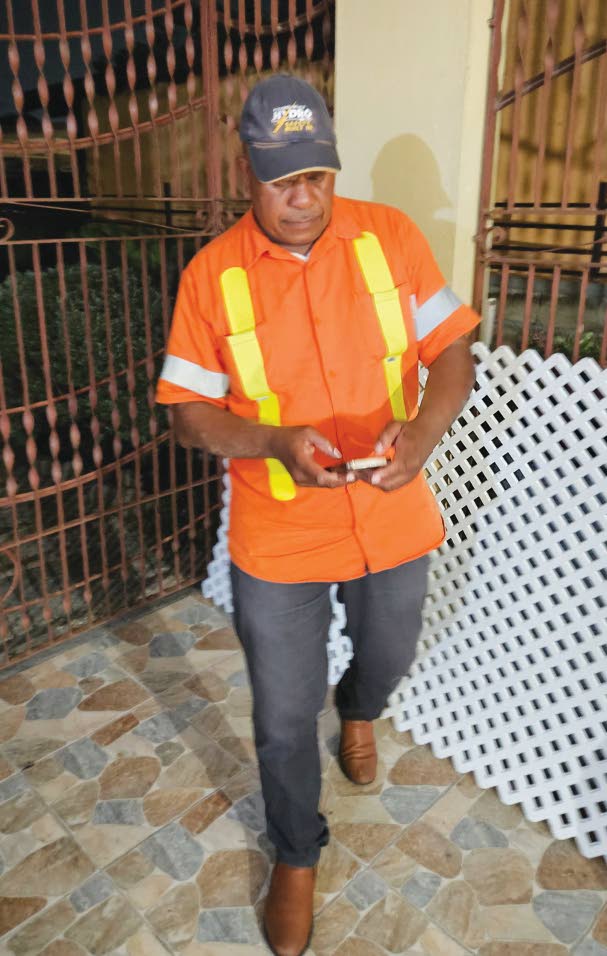
Christopher Bryan leaving St Andrew to get his first view of the damage wreaked on his homeland by Hurricane Melissa.


