



Beating the odds
Public health measures, Jamaicans’ response, blunt post-Melissa disease threat
LOCAL health authorities are breathing a sigh of relief as the outbreak of leptospirosis, reported in the aftermath of Hurricane Melissa, has settled down, while other vector-borne illnesses, which usually follow weather systems such as this, are trending lower than feared.
According to the health authorities, the lower-than-anticipated numbers reflect strengthened pre- and post-Melissa planning and a more informed population.
Jamaica’s Chief Medical Officer (CMO) Dr Jacquiline Bisasor-McKenzie told the latest meeting of the Jamaica Observer Press Club on Monday that the leptospirosis outbreak — first declared on November 21 — had seen no increase in new cases in recent weeks, despite the environmental disruption that typically drives post-hurricane outbreaks.
The United States Centers for Disease Control and Prevention (CDC) has repeatedly warned that major weather events significantly impact the spread of vector-borne diseases which are transmitted by fleas, ticks, and mosquitoes carrying pathogens whose populations heavily depend on weather, with major disruptions like hurricanes usually causing expansions in their geographic ranges.
Meanwhile, leptospirosis, which is spread from infected animals (like rodents, dogs, and cattle) through their urine contaminating water or soil, and then contracted by humans through contact, is a major danger in communities where flooding has been recorded.
But Bisasor-McKenzie told Observer editors and reporters that most ongoing cases of leptospirosis in Jamaica are those that were linked to early exposure in the immediate aftermath of the storm that struck on October 28, with numbers steadily tapering off since then.
“The hurricane would have been week 44 [of the year], and it would have been in weeks 46 and 47 that we have seen most of our cases, and then we started tapering down in week 48… So far, since week 50, we have not seen any new cases at all,” said Bissasor-McKenzie.
She pointed out that leptospirosis has an incubation period of approximately three to 21 days and argued that the absence of new cases suggests reduced ongoing exposure, which she credited to the quick response from authorities to eliminate risk factors in vulnerable environments.
“Most of the reports that we are getting, or still having, are cases that would have already started symptoms and therefore infected very early in the aftermath of the hurricane, which right away says that cleaning-up activities are taking place, we are getting rid of some of the solid waste and therefore conditions are improving in terms of solid waste management; the water is drying up and people are not surrounded by a lot of water,” said Bisasor-McKenzie.
The CMO also reported a low trend in other vector-borne illnesses such as dengue, Zika Virus (Zik-V), and chikungunya, which she said was an impressive feat, especially given the circumstances created by the Category 5 storm.
“We’re testing for dengue, we are testing for Zika, we are testing for Chikungunya and we have no increase in cases of any. No Zika at all. Certainly, if we are seeing dengue cases, it’s very few that we are seeing; definitely way below what we would expect routine for this time of year, and certainly during the aftermath of a hurricane,” Bisasor-McKenzie pointed out.
She added that seasonal respiratory illnesses were also on the low end of the scale which is linked to Jamaicans learning how to navigate and curb the spread through experience garnered from the Covid-19 pandemic.
“It is also clear that our population has learned the lessons coming out of Covid-19. You are still seeing elderly persons wearing masks, you still see people — when you go into a crowded atmosphere — still wearing masks, and I think that is showing up because we’re not seeing the increase in respiratory illnesses that we would expect to see at this time of year. This is a time of year when we are usually spiking with the flu season. We are not seeing an increase in the number of cases.
“So I think that’s one of the lessons learned coming out of Covid, and certainly enhanced now coming out of Hurricane Melissa, especially in conditions where we expect that there’s a lot of overcrowding and there are many unsanitary conditions, clearly the population is much more knowledgeable in terms of infection prevention and control because it is showing in our numbers and our surveillance has not stopped,” said Bisasor-McKenzie.
Additionally, Minister of Health and Wellness Dr Christopher Tufton told the Observer Press Club that he believes the public health sector has also adopted better policies due to the experience of the COVID-19 pandemic and the dengue outbreak of 2018-2019.
“Our response to vector-, food-borne and water-borne diseases has been bolstered significantly by the additional posts that have been created in the areas where we attempted to right-size the personnel, hiring more people, and putting more equipment on the ground,” said Tufton.
“I believe our permanent team has doubled at the parish level throughout the country, and our temporary workers, many of them, have given assistance both in the community and the water treatment. Significantly, our public health inspectors have almost gone up by 200 per cent. So we now have over 500 public health inspectors and just under 1,000 vector control workers,” added Tufton.
He argued that the low numbers now being recorded is evidence that sustained investment, surveillance, and public education are paying off.
But Tufton was quick to point out that continued vigilance will be necessary as the recovery from Hurricane Melissa continues.
“It really is about nudging people to be more aware of their environment, the steps they need to take, the mask-wearing, the flu shot, protecting the water sources, the food, and we’re seeing those results. Not to say that you won’t have risk and you won’t have another outbreak, because that’s the nature of these things.
“The truth is, we have a policy that’s worked — policy of environmental health, vectors, flu, and the food and water-borne illnesses have worked, starting largely with more people, more training, more equipment and a more alert population,” said Tufton.

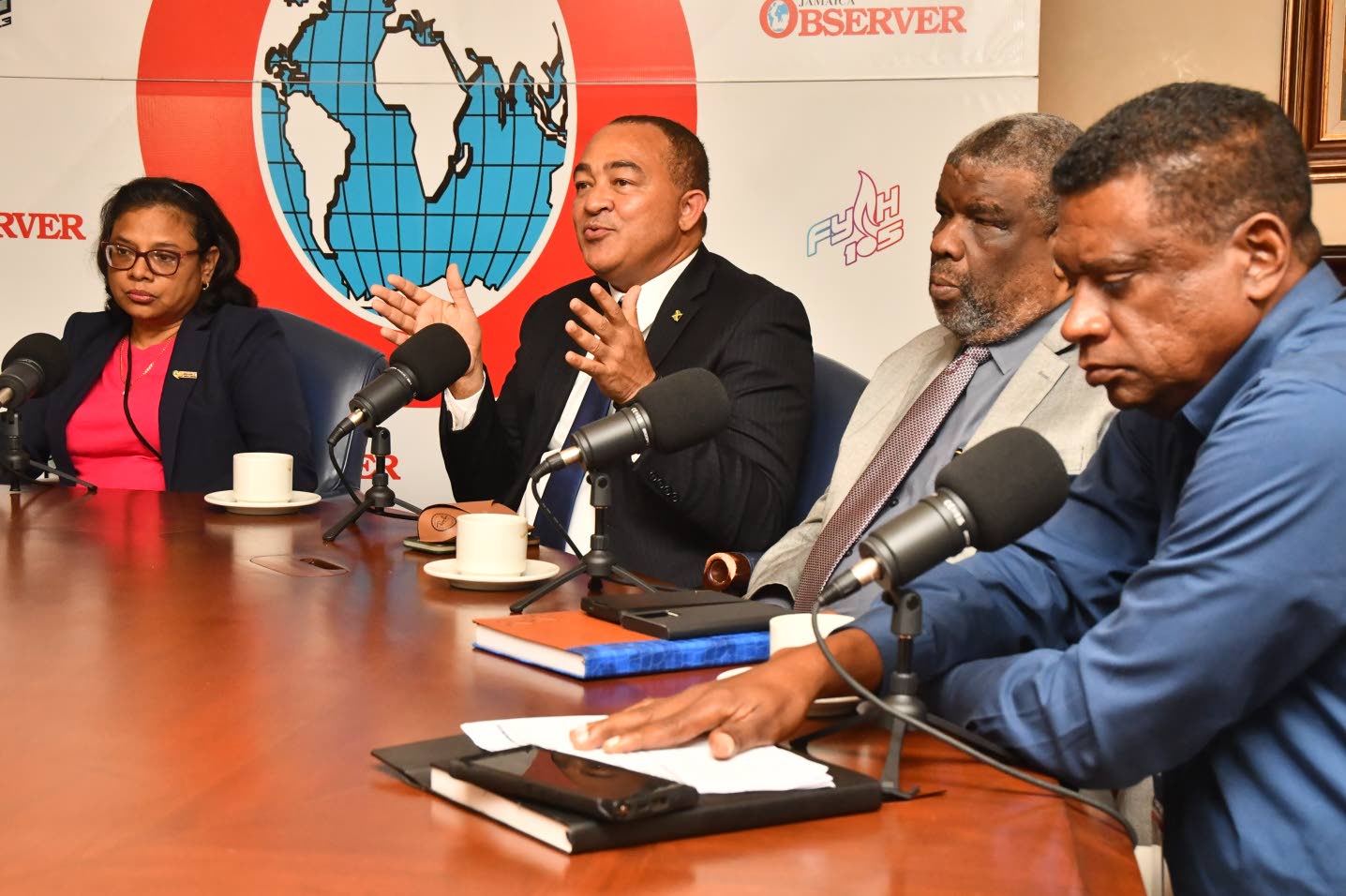
Health and Wellness Minister Dr Christopher Tufton (second left) speaking during the latest meeting of the Jamaica Observer Press Club on Monday. Flanking him are (from left) Chief Medical Officer Dr Jacquiline Bisasor-McKenzie; the ministry’s Permanent Secretary Errol Greene; and Courtney Cephas, executive director of the Ministry of Health and Wellness Foundation. (Photo: Naphtali Junior)


