Rebuilding history
TWO prominent architects with expertise in historic buildings have cautioned that trained professionals must be engaged in the very early stages of the clean-up and restoration of heritage sites as the country moves forward in the aftermath of Hurricane Melissa.
And, while not minimising the strength and magnitude of the Category 5 storm, they also pointed to lack of maintenance as one reason the damage to heritage sites — including churches, courthouses and schools — was so extensive.
“We need to do a professional analysis and survey of the buildings, done by a competent heritage professional — that’s the first thing,” registered architect and conservationist Pat Green told the Jamaica Observer’s Real Estate on the Rock last week.
“My concern is that it is possible that bulldozers are going in to go and scrape up everything, and that shouldn’t happen…That’s why we, the professionals, need to be on the ground to give professional advice to the salvaging, to the clearing of the environment, et cetera…It’s valuable knowledge, technology, and reusable materials.
“We’re talking about sustainability? That’s what we do,” insisted the independent consultant who has for many years written extensively about the importance of Jamaica’s heritage sites.
Green’s comments were in line with those made by preservation architect Sarah Ann Hodges. She is co-founder of Kingston 10 Architects (K10A) which, according to its website, “contributes to heritage conservation policy and planning, and collaborates closely with fabricators and specialists to include local knowledge and expertise in the making of buildings”. Hodges shared her views on the first steps to be taken when handling heritage sites damaged by Hurricane Melissa.
“It depends [on] how bad the damage is. In a lot of cases, where it’s just roof damage, the most important thing would be to get something to cover over the roof and prevent any further rain getting in or deterioration.
It’s [also] important to literally pick up the pieces, to collect the timbers. In the case of churches, there are all sorts of commemorative stones and the tiles — we need to collect all the material and not let it get taken away and used elsewhere,” she told the Sunday Observer.
Both experts spoke of the architectural and historical lessons these structures can yield, and the opportunity for the younger generation to grasp knowledge that needs to be passed down.
“In doing the assessment one would also include what is called salvaging, because a lot of the material in heritage can be reused, and that’s what we do — we salvage. There are certain stones and bricks, and also it gives us an opportunity to go into the guts of the building to see how it was initially constructed, so it becomes a teaching tool,” explained Green.
There is a misconception, she said, that the bricks used to build many of the country’s historic buildings came from England by ship, and many of the structures are viewed as remnants of slavery that can now finally be replaced.
“My research in the history and development of Jamaican and Caribbean architecture is that the buildings were actually designed by us, not just built. The craftsmanship was done by Jamaicans using local material, and it is a testament of the craftsmanship and ingenuity of our people. We can look at this and begin to learn about ourselves and maybe even identify who was the bricklayer or who was the stonemason in the community — it’s probably somebody right there, their grandfather or great grandfather, who built it — and let them feel a sense of pride and ownership,” she said.
Green stressed that, where possible, salvaged material should be reused in the rebuilding process, as has been done in the past after other natural disasters in Jamaica and other countries around the world. She pointed to the damage caused to a number of brick churches by the 1907 Kingston earthquake and the consequent rebuilding, which included salvaged material plus reinforced concrete. As Hodges explained, that is one of two approaches to take when rebuilding.
“One way would be to preserve the ruin, to actually consolidate the ruin — and that may have to be done to some of these churches — and build a new building. For instance, you can keep the existing stonework where it’s still standing and then build another building within that so that it kind of takes the form of the original building, but using modern materials, but you can [still] see what’s original from what’s new. That’s one of the principles of conservation: You want the old to be recognised as old and the new to be recognised as new when you put them together.
“In other cases you can build it back the way it was, but stronger, with better connections, and maybe some reinforcement within the structure,” Hodges added.
In looking at the damage wrought by Hurricane Melissa on October 28 she spoke of the importance of maintenance and Jamaicans’ cavalier attitude to taking care of the country’s buildings.
“Everybody loves their car — maintains it and changes the oil, and fixes the front end and polishes it, and details it and looks after it — but they really don’t do that to their buildings. They just expect buildings to look after themselves, and then they get surprised when they mash up,” she said with a wry chuckle.
“We need to look at other historic structures in light of what’s happened to these ones that Melissa took out so that when there’s a future hurricane, it’s not going to do the same to the rest of our historic churches and houses. We need to do some maintenance and some retrofitting to preserve future heritage, but I guess we need to fix what we have here first,” Hodges added.
Green also spoke out strongly on the importance of maintenance and the dangers of using inferior material such as ply and untreated lumber — both fodder for termites.
“They have just deteriorated, so the first breeze blow, they must go [get destroyed]. It’s inevitable because the repair and maintenance of these structures has not taken place over the years, and if they do, they use inferior building materials — things that deteriorate overnight — especially in isolated environments in the country. The termite treatment is not taking place and the building falls down,” she told the Sunday Observer.
“So what we’re seeing is a testimony of a lack of maintenance and ongoing care — for whatever reason. I’m not blaming anybody because a lot of our craftsmen have become senior craftsmen, they have migrated to other countries, so we don’t have the carpenters who have the knowledge…It’s not a blame game, it’s just speaking the reality of what has happened,” Green added.
She said the problem has persisted for years.
“From the 1980s people were falling through the floorboards in the courthouses, and these are our 18th and 19th century buildings!” exclaimed an appalled Green.
She made it clear that she was in no way downplaying the strength of Hurricane Melissa, one of the strongest Atlantic storms to make landfall in recorded history and which lingered over sections of the country, pummelling it with 185-mile-per-hour winds and causing widespread flooding.
“The point is that the extent of the loss could have been further mitigated had we undertaken ongoing maintenance and good building practices. Our historic architecture actually teaches us the techniques of resilience construction,” Green insisted.
As she looks ahead to what will become of the country’s history-rich buildings during the rebuilding phase, she is still full of hope. Once there is the will, she said, we can rebuild in a matter of years.
“If we look at what happened in the 1907 earthquake, by 1912, 1915, a number of buildings were rebuilt. After the 1951 Hurricane Charlie a number of places were rebuilt,” she said, also pointing to the rebuilding of Belize City in Belize after Hurricane Hattie in 1961.
“It happens all the time, it’s just the will, if you have a will to do it,” concluded Green.
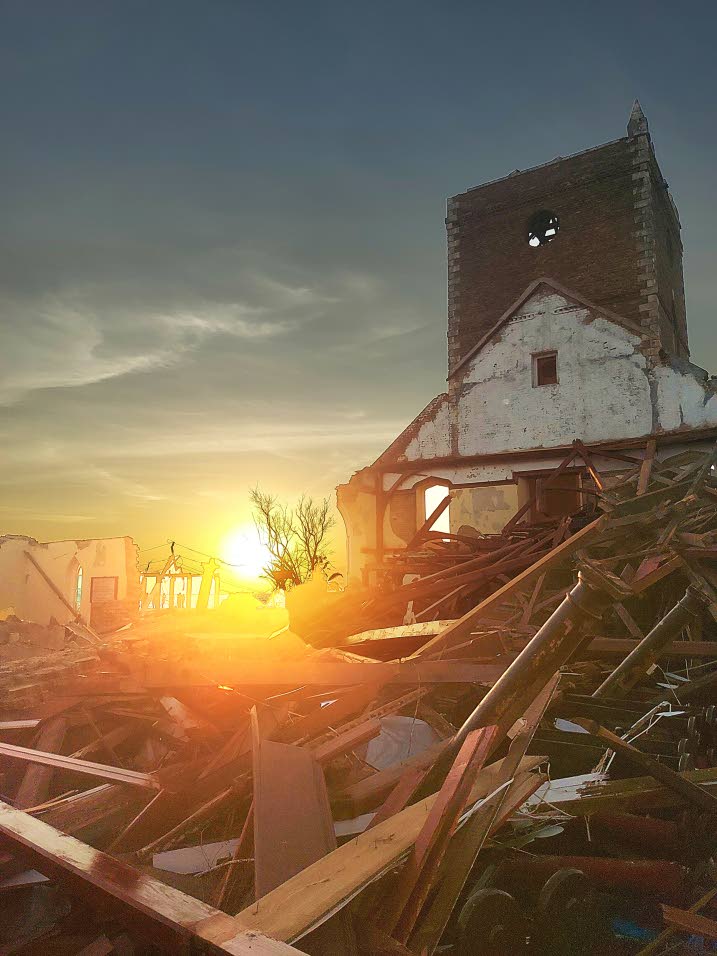
The sun sets in the background of what’s left of St John’s Anglican Church in Black River, St Elizabeth, a day after the devastating Hurricane Melissa made landfall in Jamaica and wrecked parishes in the west of the island on October 28. (Photo: Garfield Robinson)