



‘Leaving no child behind’
Regional conference ends with call for children to be central to recovery and resilience in the Caribbean
MORE than 220 children, researchers, educators and policymakers from across the region converged at the 20th Annual Caribbean Child Research Conference (CCRC) in Jamaica as the nation rebuilds after the devastation of Hurricane Melissa.
The milestone event, held recently at The University of the West Indies (The UWI) Regional Headquarters, delivered a clear call for children to be placed at the centre of recovery, resilience and long-term development across the region.
The conference celebrated outstanding achievements by youth researchers and writers across the Caribbean in three competitions.
Jamaican Jihan Gidwani of the Heinz Simonitisch School placed first in the essay competition while students from Trinidad and Tobago — Jeremel Job, Bishop’s High School and Aameliah Ramiah, Esperanza Presbyterian Primary School — topped the research and poetry competitions, respectively.
Held under the theme ‘Leaving No Child Behind: Bridging Gaps for Marginalised Children in the Caribbean’, the conference focused on issues of equity and child participation made more urgent as communities continue to recover from the impact of Melissa, which struck the island on October 28.
Professor Aldrie Henry-Lee, conference chair, emphasised the importance of its long-standing mission at a time of significant challenge.
“The CCRC remains the region’s leading platform for research, dialogue, and advocacy focused on improving the lives of Caribbean children and youth,” said Henry-Lee.
“Our deliberations this year are especially important as we advocate for systems that safeguard children’s rights. We also extend heartfelt solidarity to all affected by Hurricane Melissa, particularly the children whose daily lives and learning were disrupted,” added Henry-Lee.
Olga Isaza, UNICEF Representative for Jamaica and the Eastern Caribbean, noted the conference’s unique tradition of elevating children’s voices and placing them at the heart of the research and policy conversation.
“This conference has translated the Convention on the Rights of the Child into lived reality by ensuring children not only learn about their rights but also speak for themselves,” explained Isaza.
“Recovery will only be truly successful if children and young people are placed at the centre of planning, decisions and investments,” Isaza emphasised.
She also underscored UNICEF’s continuing support of Government partners in restoring child-focused services — education, health, nutrition, water, sanitation and hygiene, as well as psychosocial care and protection for affected communities.
Research papers were presented by the children and adolescents, along with essays and poems focused on topics ranging from climate change and education equity to mental health, justice reform, and child well-being.
On the second day of the conference participants were engaged in a hurricane relief outreach activity for Great Faith Basic School in St Ann, providing care packages to teachers and students as well as learning materials and supplies for a Safe Relaxation Corner to support students’ emotional recovery.
The 20th anniversary of the CCRC concluded with a shared commitment to elevating children’s voices, strengthening systems, and building a Caribbean where children’s rights are protected.
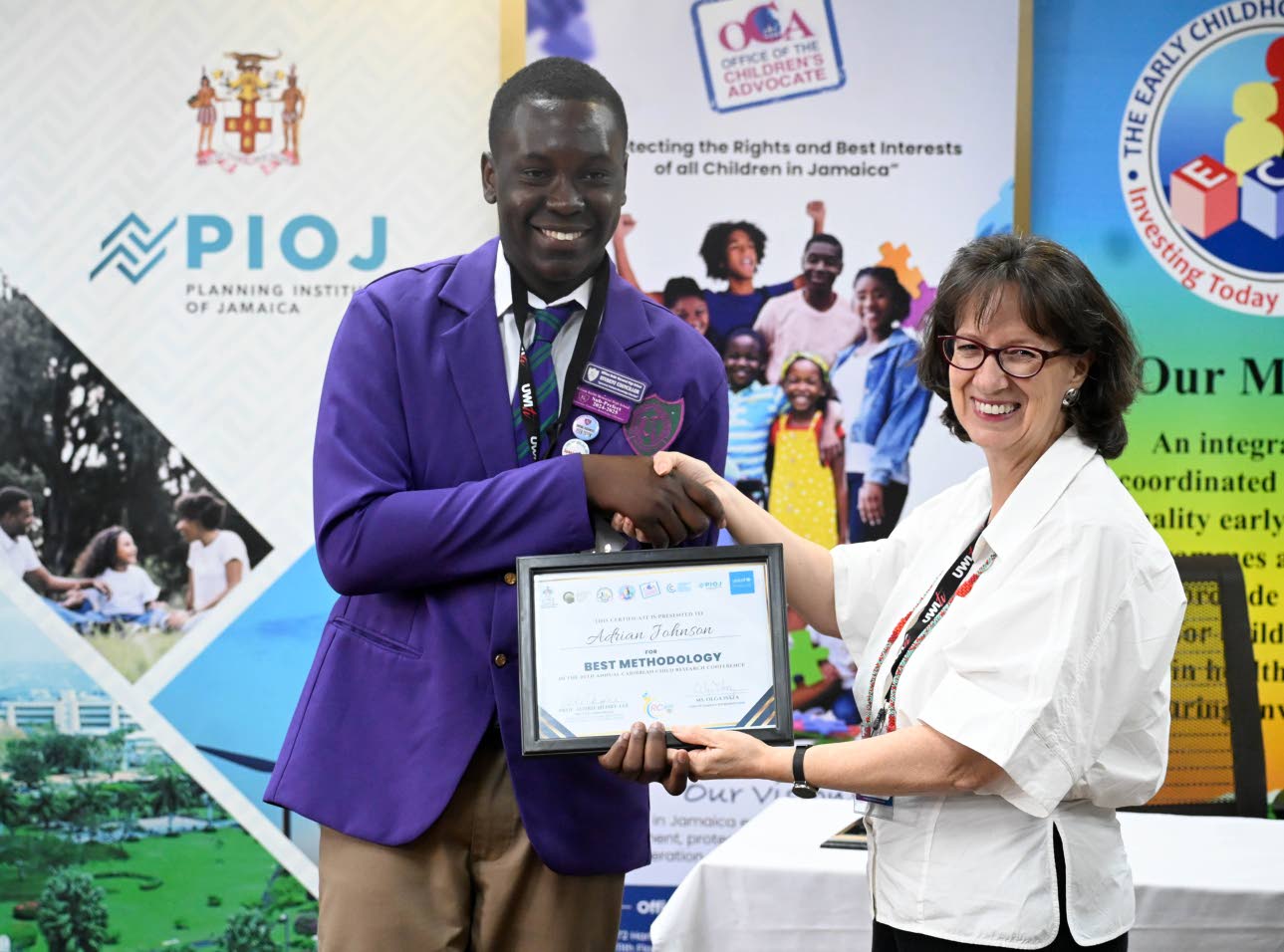
For his research paper, Adrian Johnson (left), student at William Knibb Memorial High School in Jamaica, receives his certificate for Best Methodology from Olga Isaza, UNICEF Representative for Jamaica and the Eastern Caribbean, during the recent Caribbean Child Research Conference held at The UWI Regional Headquarters.


