



Container homes: Reckless shortcut or miracle cure?
EVERY few years, Jamaica returns to the same uneasy conversation: Should container-built homes play a role in our housing future?
The question resurfaces whenever pressure builds — after a hurricane, during an affordability crunch, or when the gap between supply and demand becomes impossible to ignore. Professional bodies urge caution, commentators raise alarms, and headlines harden positions.
The public is left with the impression that container homes are either a reckless shortcut or a miracle cure. Neither view is true, and neither does Jamaica any favours.
We are not having this conversation in theory. We are having it on an island shaped by heat, humidity, salt air, seismic movement, and increasingly volatile weather. Climate change is no longer something we prepare for one day; it is already here.
Designing homes today means designing for stress — stress on materials, on infrastructure, and on families. It also means accepting a simple truth: The Jamaica of the next 30 years will not behave like the Jamaica of the last 30. Rainfall patterns are changing, storms are intensifying, costs are rising, and the need for dignified, affordable housing is not slowing down.
That is the context in which container homes must be judged — not as an idea, but as a product and, more importantly, as a system.
I have spent over two decades working across construction, development, and large-scale project delivery. I have seen traditional block-and-steel done brilliantly — and disastrously. I have seen prefabrication succeed and fail. I have seen innovation praised one year and condemned the next, often for reasons that have little to do with engineering and everything to do with fear.
So, when I hear calls to simply, “Avoid container homes,” I feel compelled to slow the conversation down — not to dismiss professional concerns, but to restore balance and technical honesty — because the truth is uncomplicated.
There is nothing wrong with container homes if they are done properly. And, there is everything wrong with container homes if they are done cheaply, lazily, or without standards. Both truths can coexist.
Why caution matters
The professional bodies urging caution are not wrong. Their concerns are rooted in history.
After World War II, many countries rushed to solve housing shortages with prefabricated solutions. Britain’s post-war prefab estates are a well-known example. Some worked, many did not. Over time, problems emerged: Corrosion, moisture, poor insulation, ventilation failures, and structural fatigue. Those buildings became long-term liabilities.
Professionals remember this history. Now place it inside Jamaica’s environmental reality: An untreated steel box becomes an oven; humidity accelerates corrosion and mould; salt air attacks exposed metal relentlessly; hurricanes test every fixing; seismic movement punishes poor detailing.
If we get this wrong, the consequences will last generations.
Where the debate goes wrong
The mistake we keep making is treating “container homes” as a single thing; they are not.
A shipping container is simply a steel structural box. Steel itself is not foreign to Jamaican construction — we use it every day in reinforcement, beams, columns, and hybrid frames. The container is merely a form, not a failure.
To dismiss container homes outright is like dismissing concrete because someone once poured it badly. We have all seen houses that lean, crack, trap heat, and we quietly ask how they ever passed inspection. The material did not fail — the execution did.
A poorly designed container home will perform badly. A well-designed one — properly treated, insulated, ventilated, reinforced, and anchored — can perform exceptionally well. The difference is not ideology, it is specification.
The human reality
There is another truth we cannot ignore. When families have nowhere to live, debates about materials fade quickly. After storms pass and headlines move on, people are still sleeping under compromised roofs or relying on relatives already stretched thin.
No one is suggesting we lower standards or scatter poor design across the landscape. But dignity does not come only from perfection. It comes from shelter, safety, and stability.
And this is where Jamaica’s character matters. We are a small island with deep resolve. We adapt, we build, we improve over time.
Ending the year with balance
This is not a debate with villains and heroes. The professionals are right to demand standards and long-term thinking. The Government is also right — if it chooses wisely.
Container-based housing, done properly, can form part of a broader solution. They are not the answer, not the solution, but one of several tools we should not discard prematurely. Instead of saying, “No,” we should be saying, “Show us the designs, the specifications, the engineering.”
As this year closes, Jamaica stands where it often has — between tradition and possibility. If we approach new ideas with care, standards, and confidence, we can build homes that respect our climate, our people, and our future.
Container homes are not the threat; poor standards are. I have faith in Jamaica’s ability to get this right. The question is not whether container homes are perfect, it is whether we are willing to explore affordable, well-designed options with care and intelligence, rather than fear. If we can do that, Jamaica can build homes that are not only strong enough for our climate, but accessible enough for our people.
Dean Jones is founder of Jamaica-Homes.com and a realtor associate. With master’s degrees in Building Surveying and Communication Design, as well as a strong foundation in real estate law and construction, he provides expert guidance on residential, luxury, commercial, and investment properties.
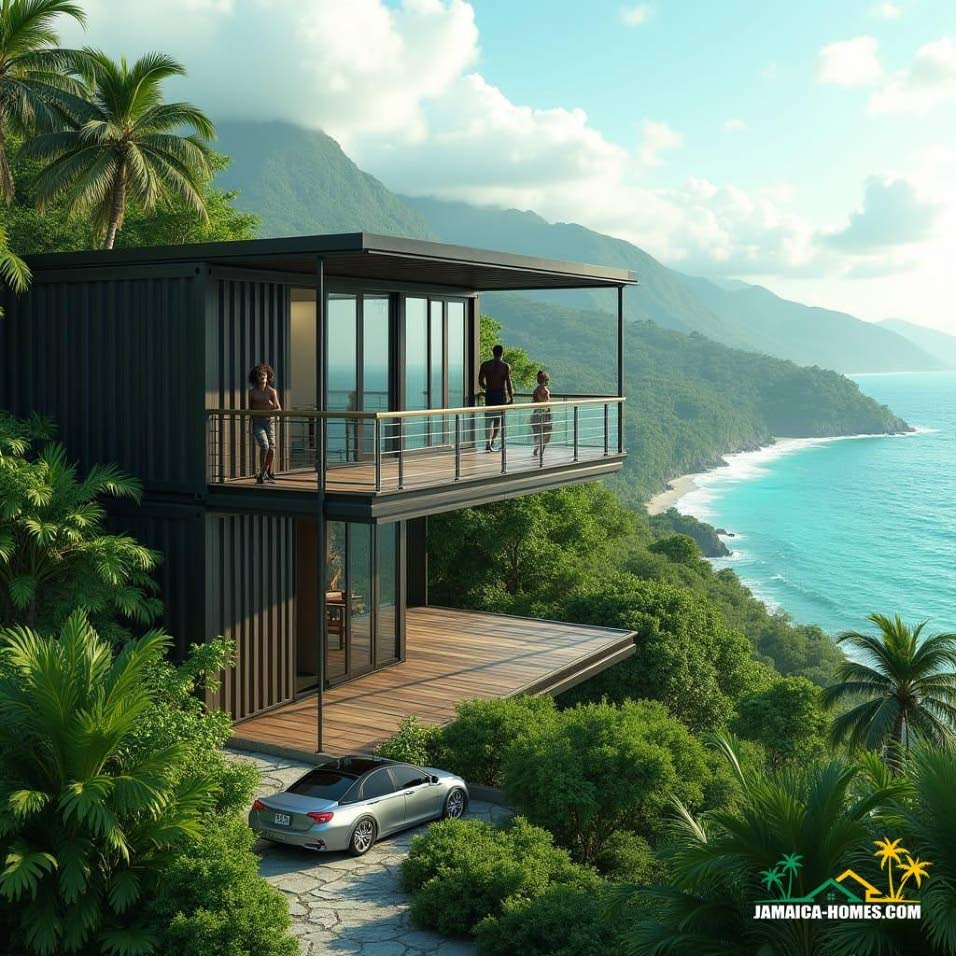
Jamaica-Homes.com render of a two-storey container home with ocean view

Render of a modern container home

Architectural renders by Jamaica-Homes.com of modern container homes and hybrid structures


