Government eyes placing parts of electricy grid underground
Move costly but necessary, says Holness
Standing before a convoy of newly arrived utility trucks bound for western Jamaica, Prime Minister Dr Andrew Holness revealed that Cabinet-level discussions are under way with Jamaica Public Service (JPS) to place parts of the electricity network underground to strengthen resilience and support the Government’s ‘build forward better’ strategy.
Speaking at the JPS Hunt’s Bay Power Plant on Friday morning, Holness said the move forms part of a broader effort to ensure that Jamaica’s electricity system is not only restored after Hurricane Melissa, but redesigned to better withstand future storms.
“Every crisis provides us with an opportunity, and the opportunity does not come in just standing up the light pole and making the reconnection to the homes. The opportunity comes when we look at the poles that we are putting up and say: How do we put up stronger poles?… How do we introduce microgrids? How do we put some of our lines underground? — a discussion which we have started at the Cabinet level with the JPS,” he said.
He acknowledged that strengthening the grid in this way would not come cheaply, noting that preliminary costings had already been presented to the Government, but said the debate must weigh financial outlay against the consequences of repeated disruption.
“The costs have come in, [and] no doubt the costs are high. But sometimes you have to compare high costs with high loss — what is it that we lose by not having resilience in the grid?” he said.
He argued that the impact of prolonged power outages goes far beyond inconvenience, affecting hospitals, security services, businesses, and overall economic activity, and said this reality had shaped the Government’s approach to post-hurricane recovery.
The prime minister was speaking as 175 additional specialised vehicles were officially handed over to JPS.
The new fleet includes bucket trucks, diggers, pole trailers, and support units that will reinforce ongoing restoration work, particularly in communities still awaiting the return of electricity.
With this latest handover, the total number of specialised vehicles deployed since Hurricane Melissa struck on October 28, 2025 has increased to 247, significantly expanding the operational capacity required to complete restoration.
Holness said the Government’s strategy for recovery had been deliberately anchored in restoring electricity, describing it as the foundation on which wider national recovery rests.
“The Government’s strategy for restoration lies heavily on the restoration of electricity. So we are driving recovery and restoration by driving the recovery of the electricity sector. And you can see that that strategy has been deliberate, it has been instrumental, and the strategy has worked,” he declared.
According to the prime minister, electricity restoration has reached about 90 per cent islandwide, with recovery in the most affected parishes approaching 70 per cent. He described the response as creditable, particularly when measured against the lengthy restoration timelines seen in other jurisdictions following major storms.
Holness also used the occasion to defend the Government’s decision to facilitate a US$150-million loan to JPS to speed up grid repairs, a move that has attracted criticism. However, he insisted that electricity must be treated as a public good.
“The point is that, although the JPS is a private company, with public interest, the JPS provides a public service. In effect, the JPS provides a public good, and that public good cannot in any way be disrupted. It is the foundation on which we have growth, it is the foundation for security, and it is the foundation for your daily convenience, and therefore, the Government must do everything in its power to ensure that our electricity grid is up and running effectively. So we took a decision to support the provision of a public good,” Holness explained.
He said the financing support was intentionally separated from ongoing negotiations over JPS’s operating licence, which is currently being renegotiated, stressing that the public interest would be protected in both processes.
Beyond electricity restoration, the prime minister linked the country’s post-hurricane response to broader signs of economic resilience, pointing to recent data from the Planning Institute of Jamaica showing growth of more than five per cent in the last quarter.
Holness said resilience is the defining feature of Jamaica’s recent recovery efforts, arguing that it does not occur by chance but through deliberate policy choices and long-term planning.
“Resilience requires the application of intelligence, meaning it requires deliberate decisions, deliberate actions, deliberate structures. It requires planning, and therefore, the reason why you are seeing the economy displaying resilience, it is because the Government that you elected took decisions that contributed, that set the pathway that resulted in resilience,” he declared.
As restoration efforts move into what he described as “the last mile”, Holness said the Government’s decisions were being guided by citizenship rather than cost-benefit calculations.
He noted that the rebuilding phase now presents an opportunity to strengthen critical corridors in both western Jamaica and Kingston to ensure faster recovery when future storms strike.
“The strength of the recovery is not just to restore, it is to build forward, not to build back. We are going to be building Jamaica forward and we are going to be building Jamaica better than it was before,” declared Holness.
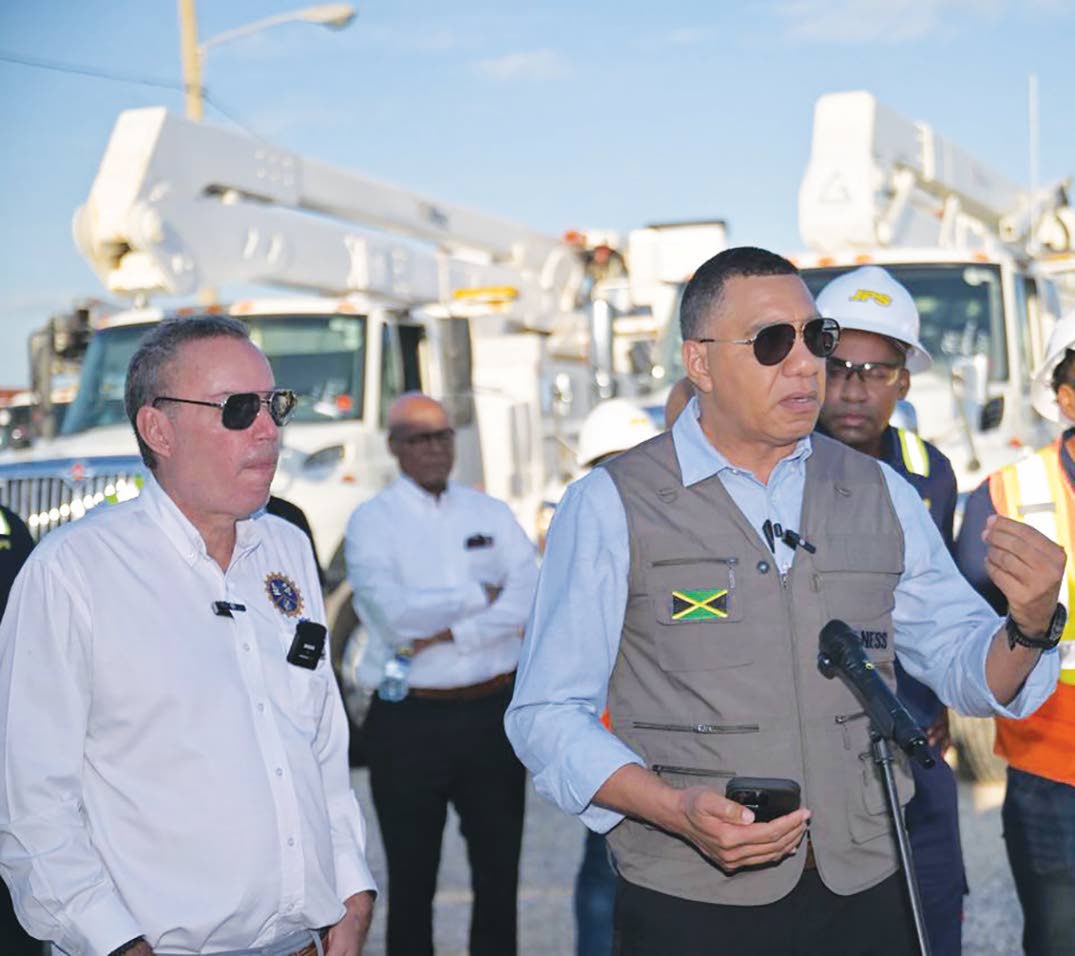
Prime Minister Dr Andrew Holness speaking at the handover of 175 additional specialised vehicles to Jamaica Public Service Company at the company’s Hunts Bay power plant on Friday morning. He is flanked by Energy Minister Daryl Vaz (left) and JPS President and CEO Hugh Grant. The vehicles were brought in to help speed up electricity restoration works in the aftermath of Hurricane Melissa which hit sections of Jamaica on October 28, 2025.