House-hunting in 2045
If a Jamaican child is born today, by the time he starts to think about owning property in the years 2040 to 2045 the world he steps into will hardly resemble the one we’re in now.
He won’t go house-hunting the way we understand it. He will grow up in a world where property exists in two layers at once: the land and concrete you can touch, and a digital, intelligent layer wrapped around every building, street, and community.
From early childhood, that young Jamaican is surrounded by artificial intelligence (AI). Schoolwork is guided by adaptive tutors, entertainment is personalised, even career guidance is partly shaped by predictive systems that analyse skills and interests.
By his teens, he’s used to walking through fully interactive 3D versions of buildings and neighbourhoods — not just for fun, but as part of everyday life. Every serious property in Kingston, Montego Bay, or Portmore has a living digital twin — a constantly updated virtual copy that shows not just how the home looks, but how it behaves, how it uses energy, what it costs to maintain, how it might flood in a major storm, and how the afternoon light hits the veranda in October.
Our young Jamaican has grown up playing inside these simulations. When he finally looks at property for himself, he is not impressed just because a house has a nice gate and a big grille. He wants to know its risk profile, its income potential, its carbon footprint, its digital rating.
BUYING A PIECE INSTEAD OF A WHOLE
One of the biggest changes that’s already taking shape today is tokenisation — turning real-world assets like buildings into digital tokens that can be owned fractionally and traded more easily. Major firms and analysts already project that tokenised real estate will reach into the trillions of US dollars globally by the mid-2030s.
By 2040, that will no longer be cutting-edge finance; it will be the norm. So for a 19-year-old Jamaican in 2044, his first step into property ownership may not be a full lot in St Catherine or an apartment in Kingston. It may be a two per cent stake in an apartment block in a New Kingston smart city zone or five per cent of a small eco-villa development in Portland, held as digital tokens backed by a legally recognised land title.
He will be able to start investing in small fractions from his teens; build a portfolio of different properties — some in Jamaica, some abroad — see real-time performance: Rental yields, occupancy, price movement; and exit quickly if he needs cash, because his stakes trade on regulated digital markets.
Smart contracts and invisible paperwork
Today, a simple property transaction in Jamaica can grind through months of manual paperwork, face-to-face meetings, bank queues, and anxious phone calls. But around the world, real estate players are already experimenting with smart contracts — digital agreements on blockchain that execute automatically when conditions are met, reducing delays, fraud risk, and human error.
By the time our 2040 teenager is ready to buy or sell, he will expect instant identity verification, secure digital signatures, automated transfer of funds once all checks pass, and land registry updates that happen in minutes — not months. The land title itself may live as a secure digital record tied to that property’s twin and to the tokenised pieces that people own. Lawyers still exist — but their work is more about complex dispute resolution and structuring major deals, not chasing paper at the title’s office.
AI AS THEIR LIFELONG PROPERTY ADVISOR
Today, a buyer leans heavily on a human agent, a banker, a lawyer, and assorted friends. In 2040 to 2045, they will still matter, but there will be another constant presence: An AI advisor that has been with that young Jamaican since childhood. This advisor knows his financial history and risk tolerance, his career trajectory and income potential, his family situation and long-term goals, and his values.
Our young Jamaican doesn’t look at 20 random listings and hope one feels right. Instead, he tells his AI advisor: “Find me three properties in greater Kingston that fit my budget, can withstand a Category 5 hurricane, have good rental potential, and will benefit from future transport upgrades.” The AI advisor searches public data, government plans, digital twins, market forecasts, and legal records, then comes back with a short list supported by hard evidence. The human agent is still crucial but now they are less of a salesperson and more of a specialist guide, negotiator, and emotional anchor in a high-stakes decision.
THE NEIGHBOURHOODS THEY INHERIT
By 2040 to 2045, Jamaica’s urban spaces will be different too. Locally, there is already public discussion about smart cities and digitally managed infrastructure in areas like New Kingston and Montego Bay, with experts arguing that such projects could ease traffic, support new businesses, and make more efficient use of land. Layer on global trends — sensor-packed buildings, AI-controlled traffic systems, smarter energy grids — and it’s reasonable to expect that at least parts of Kingston, Montego Bay, Portmore, and maybe Spanish Town will function as Caribbean smart districts by 2040. Not Dubai-level gloss, but zones where buildings are designed with digital twins from the start; energy use is optimised automatically; security is managed through integrated camera, access, and monitoring systems; and flood-prone or hillside areas are developed with far stricter risk modelling. Combine this with innovations inspired by people like Elon Musk — tunnels easing traffic, new forms of urban transport, and underground or elevated systems to reclaim surface land from parking and congestion — and you can imagine a Jamaica where getting from Portmore to New Kingston or from Montego Bay’s outskirts to downtown is much less of a daily war.
For the young property buyer, location is no longer just near the urban centre or near school, it’s about being plugged into stable broadband, efficient transport, resilient utilities, and community data.
CLIMATE REALITY AS A CENTRAL FACTOR
One thing that will absolutely shape real estate in Jamaica for that young buyer is climate. He would have grown up through more intense hurricanes, stronger rainfall events, longer droughts. He will remember Hurricane Melissa and whatever came after. He will be less sentimental about sea view and more concerned about storm surge maps.
Because digital twins integrate environmental modelling and sensor data, he will be able to see, on his phone, how a proposed home handled previous storms, how close flood water came, how the roof design performs at high wind speeds, how heat-resilient the design is. Insurance pricing will reinforce the lesson: Poorly sited or badly built properties will simply become too expensive to insure. That Jamaican 19-year-old in 2044 may be the first generation that treats climate resilience not as an add-on, but as a non-negotiable baseline of property value.
What stays the same
For all the change, certain fundamentals of Jamaican real estate will still hold. People will still dream of owning a “piece a yaad”. Family land will still matter. Emotional ties to certain districts, parishes, and communities will remain powerful. Renting versus owning will still be a tension. Gentrification, affordability, and land politics will still exist — just playing out on a smarter, more connected stage.
And the heart of it will still be the same: Security, dignity, a place to call your own.
The difference is that in 2040 to 2045 a young Jamaican stepping into that world will have more tools, more information, and more options than any generation before. But only if the country chooses to build the infrastructure, the policy frameworks, and the education to match the technology.
If Jamaica does the work, that child born today could reach adulthood in a nation where real estate is more transparent and efficient; climate risk is taken seriously in every building decision; digital and physical wealth are connected, not separated; the Diaspora can invest with confidence; ownership is not just for the few who can navigate the maze, but for the many who grew up with intelligent systems guiding them.
That future is not guaranteed, but it is entirely believable and, looking at where the world is already heading, increasingly likely.
Dean Jones is founder of Jamaica-Homes.com and a realtor associate. With master’s degrees in Building Surveying and Communication Design, as well as a strong foundation in real estate law and construction, he provides expert guidance on residential, luxury, commercial, and investment properties. He may be contacted at dean@jamaica-homes.com.
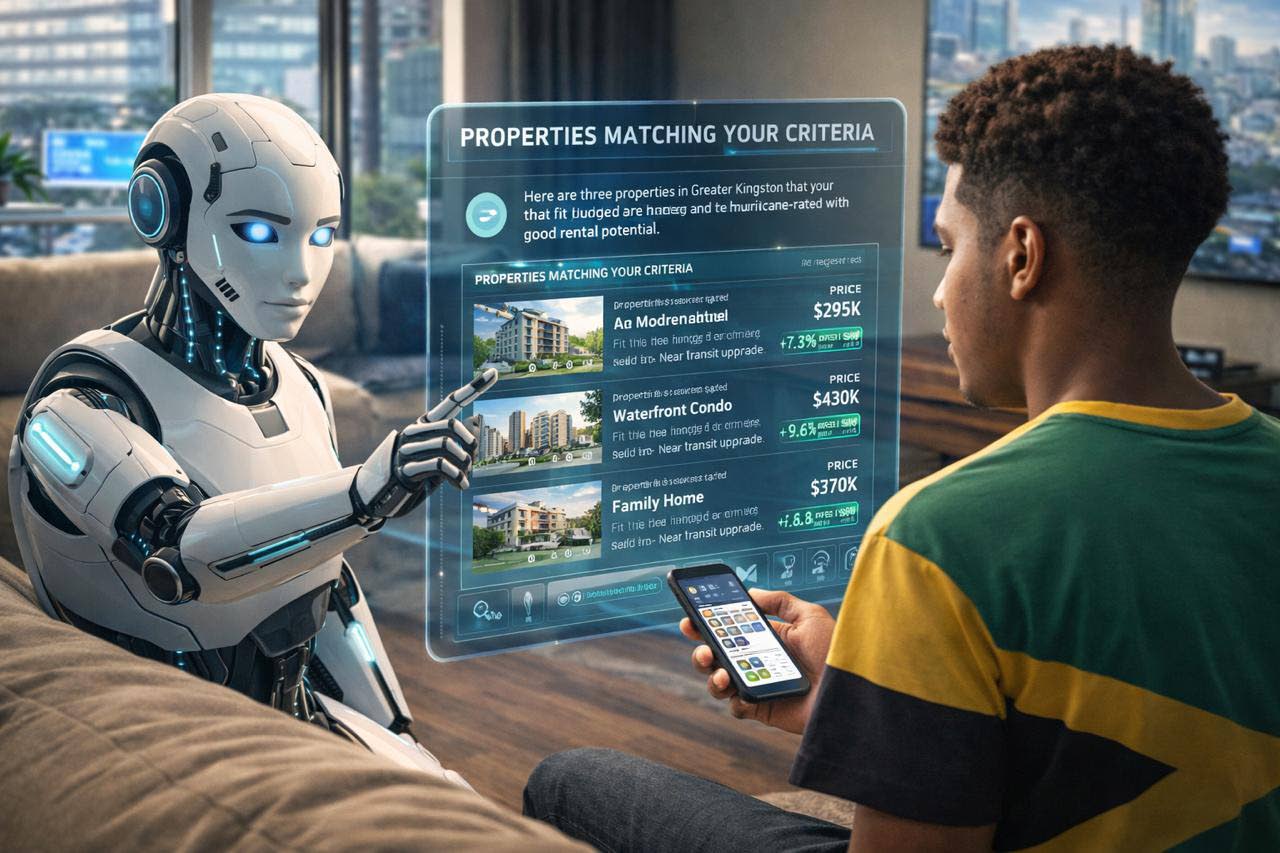
AI-generated image of a future Jamaican buyer reviewing a neighbourhood through augmented reality, revealing energy use, flood risk, and long-term performance data over real homes.
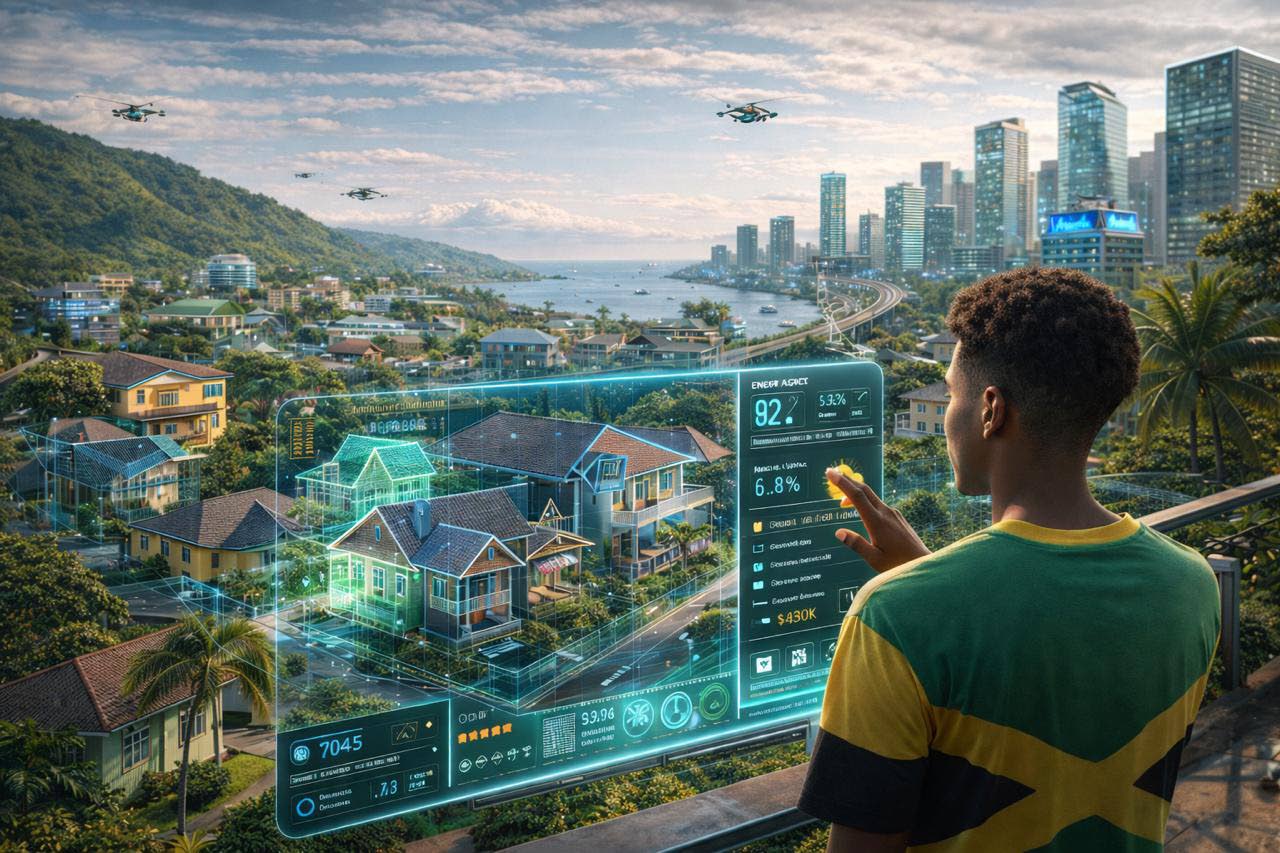
AI-generated image of a young Jamaican overlooking a familiar neighbourhood layered with subtle digital overlays, showing how physical homes and intelligent data now exist side by side.