



Objection, Your Honour
Champagnie opposed to Justice Robinson’s position on appeal reform
Prominent defence attorney Peter Champagnie, King’s Counsel, has described as “a misstep” and “retrograde” a recent call by celebrated jurist and former judge of the International Court of Justice Patrick Robinson for “an end to the legal oddity of the possibility of a decision of the chief justice being overturned by the Court of Appeal”.
Robinson, also a former president of the United Nations International Criminal Tribunal, made the call in a column published on January 4, 2026, in the Sunday Gleaner.
His comment was framed against the background of a 2025 decision by Jamaica’s appellate court which quashed a murder conviction on the ground that the presiding judge, Chief Justice Bryan Sykes, “had descended, quite extensively, into the arena to elicit evidence that ought to have been left to the prosecution”.
Robinson, in an analysis of the common law adversarial legal system, otherwise called the accusatorial system — followed in Jamaica — and the civil law inquisitorial legal system, concluded that, “the chief justice is the chief judge of Jamaica and is, therefore, chief among all judges, including those in the Court of Appeal”. As such, he said, “it should not be possible for a Jamaican court to overturn a decision of the chief justice”.
But Champagnie, while paying homage to Robinson’s legal acumen, which he described as “impressive”, said his conclusion that “it should not be possible for the Court of Appeal to overturn a decision of the chief justice is, quite frankly, a misstep” and “an abomination to any democratic State that adheres to the tenets of an independent judiciary”.
“Justice Robinson’s position was no doubt influenced by the recent decision of our Court of Appeal in the case of Stephenson (Conroy) v R [2025]. In that case, the Court of Appeal overturned a murder conviction based on the chief justice’s approach in the case. Whether one is inclined to agree or disagree with the decision of the Court of Appeal, it represents an instance of a kind of ‘peer review’ which is applied in other professional disciplines geared towards accuracy in treating with any subject matter,” Champagnie stated in a letter of the editor of the Jamaica Observer.
“Therefore, to argue, as Justice Robinson did, that we must put an end to ‘the legal oddity of the possibility of a decision of the chief justice being overturned by the Court of Appeal’ on the basis that the chief justice is chief among all judges, including those in the Court of Appeal, cannot serve as a valid premise to advance such a position,” the noted attorney went on to argue.
“While the Judicature (Appellate Jurisdiction) Act allows the chief justice to be a member of any panel of the Court of Appeal, Section 3(1)(b) of the Act provides that he shall not sit in such a court unless there are at least four other judges sitting, and unless he has been invited to sit by the president of that court. The wording of this provision clearly affirms the independence of that court vis-à-vis the powers and office of the chief justice,” Champagnie said further.
“I do not share the view of Justice Robinson, and that is with greatest of respect to this jurist of great eminence. I am of the view that this is a misstep and it would be a retrograde step to have a situation where a chief justice’s decision is not subject to appeal — and I am not talking about the personalities, I am not talking about our current [chief justice], let us be clear — can’t have that,” Champagnie told the Observer during a follow-up interview.
He, in the meantime, said it is “perfectly permissible in law for a judge presiding in a trial to ask questions himself or herself of any witness that is giving evidence”.
“Normally this is done to clear up any issue that the tribunal may have, or any issue that the tribunal is of the view is in need of some clarification or elaboration. What is not permissible, however, is for the judge to now descend into the arena and to now effectively conduct a cross-examination of a particular witness on behalf of either the prosecution or the defence,” the experienced attorney pointed out.
“It is permissible for the judge to ask questions, and normally what obtains in practice is that when a judge asks questions in the way of clarification or elaboration, the judge then allows either side to ask questions on any matter arising from the questions asked by the judge, and that is something that is entirely permissible. That is something that is entirely normal,” he added.
In the case referenced by Robinson, Conroy Stephenson, the former accused — following a trial in the Home Circuit Court between February 4 and 11, 2019, before Justice Sykes sitting with a jury — was found guilty of murder stemming from an alleged shooting in Seaview Gardens in 2014.
On April 12, 2019, he was sentenced to 16 years’ imprisonment, without eligibility for parole before serving 10 years. Stephenson, in appealing his conviction, argued that the “verdict was unreasonable, having regard to the evidence” and that “the jury failed to have proper regard to the case for the defence”.
The Appeal Court, in delivering its ruling last December, said it found “no merit” in the first ground of appeal raised by Stephenson but said “owing to the extensive interventions by the learned chief justice during the cross-examination of the witnesses for the defence” it “found that ground of appeal two was meritorious and determined that the applicant was denied a fair trial”.
“As a result, we concluded that the conviction should be quashed. It was our further determination that a retrial would not be the appropriate outcome in the particular circumstances of this case,” it said in acquitting Stephenson.
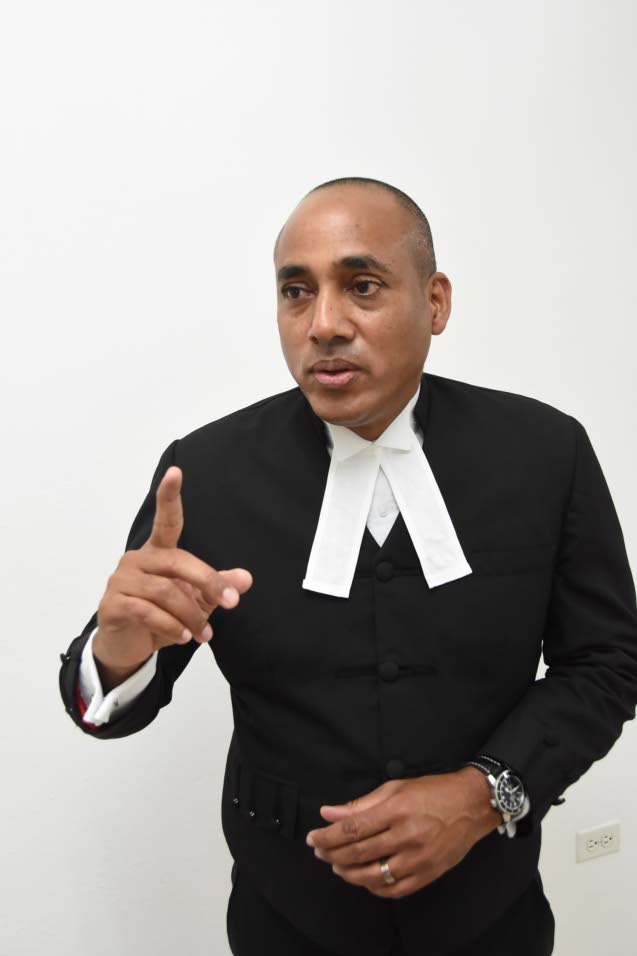
CHAMPAGNIE… I do not share the view of Justice Robinson, and that is with greatest of respect to this jurist of great eminence


