



Tourism’s triple five targets blown off track but sector resilient
Bartlett says investment remains strong despite growing uncertainty
Jamaica’s ambitious plan to welcome five million visitors, generate US$5 billion in tourism earnings, and add some 5,000 new hotel rooms in 2025 was thrown off track as a series of disruptive events left the sector short on projected targets, even as its investment momentum remains strong.
Minister of Tourism Edmund Bartlett, speaking with the Jamaica Observer following the launch of National Blue Mountain Coffee day last Friday, said the country would have comfortably met these goals had it not been for the fallout from back-to-back catastrophic weather systems, compounded by other events.
“Two things hurt us the most. First, it was [Hurricane] Beryl, which upended the flow during 2024, and then came [Hurricane] Melissa in 2025. We were pretty much on track to deliver on our targets, but we lost nearly half a million visitors,” he told the Business Observer.
Preliminary estimates now suggest total visitor arrivals for 2025 will be about 4.5 million, with tourism revenues projected at roughly US$4.6 billion — well below the original “5x5x5” or “triple five” target set at the start of the planning cycle.
That trajectory was derailed first by Hurricane Beryl-related disruptions and later by the passage of Hurricane Melissa, which had a particularly severe impact on the accommodation and food services industry. The storms forced temporary closures across the sector and significantly reduced operating capacity.
Melissa alone, having dealt a “significant blow” to the sector, currently sees about 30 per cent of room stock remaining offline. While some properties are expected to return to service in February, overall capacity is projected to reach only about 80–85 per cent by mid-year and roughly 90 per cent by November.
The powerful storm, said to be largest on record, left behind widespread destruction, particularly across western parishes and billions in reconstruction costs as it caused damage equivalent to an estimated 41 per cent or nearly half of the country’s gross domestic product (GDP).
When combined, both events resulted in the loss of nearly half a million visitors across the two years, pushing the five-million visitor milestone out of immediate reach. Data from airport operator Grupo Aeroportuario del Pacífico (GAP) show that Jamaica recorded 524,000 fewer passengers in 2025, marking the largest annual decline since the COVID-19 pandemic, as Hurricane Melissa battered the island’s tourism sector.
Since emerging from the depths of the pandemic — which severely debilitated the industry — a confluence of adverse events has further continued to constrain growth. These include extreme weather disruptions as well as the negative spillover from a level 3 travel advisory issued by the US.
For the first half of 2025, tourist arrivals fell 4.9 per cent to 2.2 million, a decline that industry stakeholders have partly attributed to recent shifts in US immigration policy under the Trump Administration.
Still, Bartlett struck an optimistic tone, insisting that while growth has temporarily slowed, Jamaica’s long-term tourism ambitions remain firmly intact.
He said that while the five-million visitor goal was not attained, some new performance indicators have been established under a revised strategy which sees the sector now targeting eight million visitors and US$10 billion in tourism earnings by 2030, anchored by plans to deliver a more innovative, diversified and differentiated tourism product.
“As an industry we have our eyes fixed on making the next five-year period, one of serious growth, development and inclusive tourism,” he said while noting that as part of that framework, plans are also being put in place to make the tourism sector more resilient to future shocks — whether they be human or natural in origin.
While tourism growth strategies pursued between 2000 and 2019 were largely successful, new threats — ranging from climate instability to geopolitical tensions — now pose serious challenges. This is particularly concerning given Jamaica’s heavy reliance on the United States, which accounts for more than 70 per cent of visitor arrivals and remains at the centre of ongoing global disputes.
Despite these headwinds, Bartlett said the sector’s investment pipeline remains robust and that Jamaica is pressing ahead with plans to add thousands of new hotel rooms, reinforcing confidence in the destination’s long-term prospects.
Among the projects expected to come on stream is the first 500 rooms of the new Unico property, now slated for a mid-year opening after delays caused by recent disruptions. Several mega projects are also scheduled to break ground this year, including the Palladium development in Hanover, Moon Palace Grand, and Harmony Cove in Rose Hall.
Other major developments advancing through construction or approval stages include the luxury multi-tower Pinnacle project, the island’s first casino at the Princess resort, and several large-scale expansion projects expected to add more rooms to Jamaica’s growing accommodation stock.
“The good news is that for tourism, our investment energy continues to be as strong as ever,” Bartlett said while adding that neither recent weather events nor ongoing geopolitical tensions have dampened investor confidence, underscoring enduring faith in Jamaica as a tourism destination.
As resilience also becomes a central pillar of recovery and expansion, Bartlett said new hotel constructions are being designed to better withstand extreme weather and seismic risks.
“The way in which we construct new hotels will certainly have to reflect this level of resilience thereby ensuring stronger roofing systems, improved building standards and greater infrastructure redundancies for water and electricity. These measures are intended to reduce downtime after future shocks as they also protect the sector from the growing challenges posed by climate change,” he said.
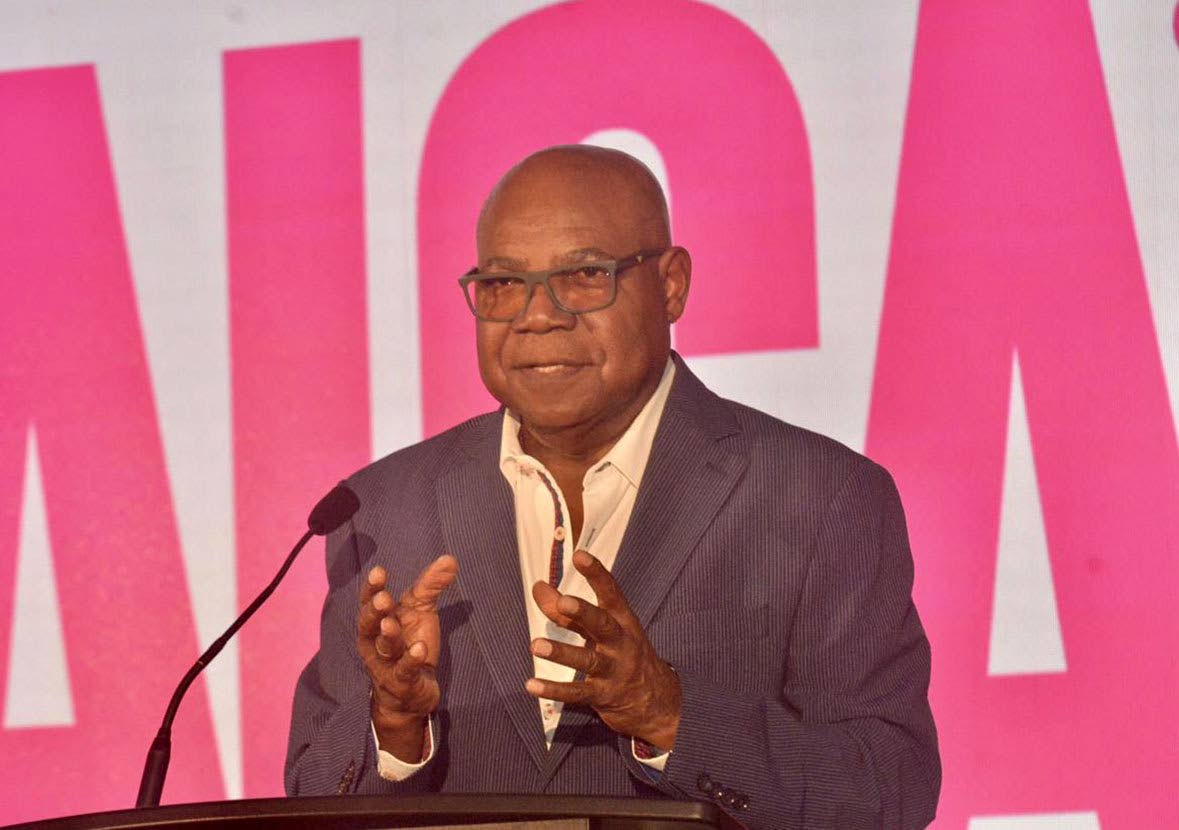
BARTLETT…the good news is that for tourism, our investment energy continues to be as strong as ever (Photo: Philp Lemonte)


