



Faith or unfair?
Warmington questions church access to NHT loans for post-Melissa recovery
Member of Parliament for St Catherine South Western Everald Warmington has again criticised the Government’s support for churches post-Hurricane Melissa, this time questioning why the National Housing Trust (NHT) is extending reconstruction loans to institutions which do not contribute to the scheme.
Warmington raised the issue during Wednesday’s first sitting of the Public Administration and Appropriations Committee (PAAC) for the year, as the committee examined the Office of the Prime Minister and the Ministry of Labour and Social Security on the progress of Hurricane Melissa recovery efforts.
The exchange quickly shifted from technical questions about relief measures to a broader debate on the role of churches in accessing public support, particularly through the NHT.
At the centre of Warmington’s concern was the apparent contradiction between the NHT’s mandate to serve contributors and the decision to allow churches to access concessional loans for post-hurricane reconstruction.
“It’s a simple question…if the churches are not contributors, and the housing trust is established to assist contributors, and you are saying only contributors are qualified to apply… I’m asking how do you provide for them and they are not contributors?” Warmington asked.
He pressed the point further, challenging NHT Managing Director Martin Miller to explain how churches could meet contribution requirements.
“Can you provide evidence to this meeting that churches have been contributing to housing trust? How can a church contribute to housing trust? A church has never contributed a dime. What social security TRN (tax registration number) do they use to make that contribution?” Warmington asked.
Miller sought to clarify that the NHT has, for many years, operated what it describes as “institutional loans”, allowing non-individual entities to borrow once they meet specific financial and security requirements. He also stressed that special concessions were introduced under the Hurricane Melissa relief framework.
“One of the first things that was made clear is that there are certain contribution requirements that would be relaxed for the individual. So for example, one requirement is that your contribution ought to be current. It was made clear that that would be relaxed,” explained Miller.
He added that contributors were not being denied access to loans, but that the amount they qualify for may vary.
“Once you’re an NHT contributor, you are qualified for a loan. The issue that we tend to miss is the amount of loan that you are qualified for. It may not necessarily be sufficient to do what you want to do. But any contributor who walks into NHT now, they are qualified for a loan. The only question is the amount… But under the Melissa relief, we relax the section to treat with you being current, and that’s the reason why we were able to say once you have contributed to the National Housing Trust, then you can benefit,” added Miller.
But Warmington rejected that explanation, as he argued that long-standing contributors are still being disadvantaged by the NHT’s points system, while churches are able to access financing through alternative arrangements.
Miller later clarified that the assistance being discussed for churches was limited in scope and tied specifically to hurricane damage, particularly roof repairs to church buildings.
“This is a loan to assist in terms of the replacement of the roofs of the church as opposed to a residence,” he said, adding that churches were assessed based on their ability to service the loan, including cash flow and assets.
Miller also pointed to the social role churches play, especially in rural communities as a reason for providing the assistance.
“But If I may, and sometimes when we talk about getting back the life of Jamaicans to a point where they are reasonably comfortable. For most of us, Mr Chairman [Peter Bunting], and I know that you are aware of life in rural Jamaica, the churches are a very, very important part of that,” argued Miller.
Warmington acknowledged the social importance of churches but maintained that financial responsibility should rest with the churches themselves, particularly those with significant resources.
“I’m not talking about the established churches like the Baptist, Presbyterian, Anglican, but you have some little hurry-come-up church with this big elaborate building there, and every day you have to carry this, and five collections a day, or offering per day, you have to give it to the church. And when its pastor birthday, fish Sunday, you have to give extra one,” charged Warmington.
“So, what I’m saying, members of church have been giving all the while, and the churches that have more than $2 billion in their account, it’s time for them to give back to assist the poor persons who have been giving them over the years so they can rebuild,” added Warmington.
He argued that, instead of drawing on public funds, churches should play a leading role in supporting vulnerable members and small business owners affected by Hurricane Melissa.
“You have a lot of individuals who have little businesses and shops and so on that damage and blow down. This is the time when the Church has to step up and assist these individuals to restart their small businesses, and so on, but not to dip in the Government pool to rebuild the church,” Warmington expressed.
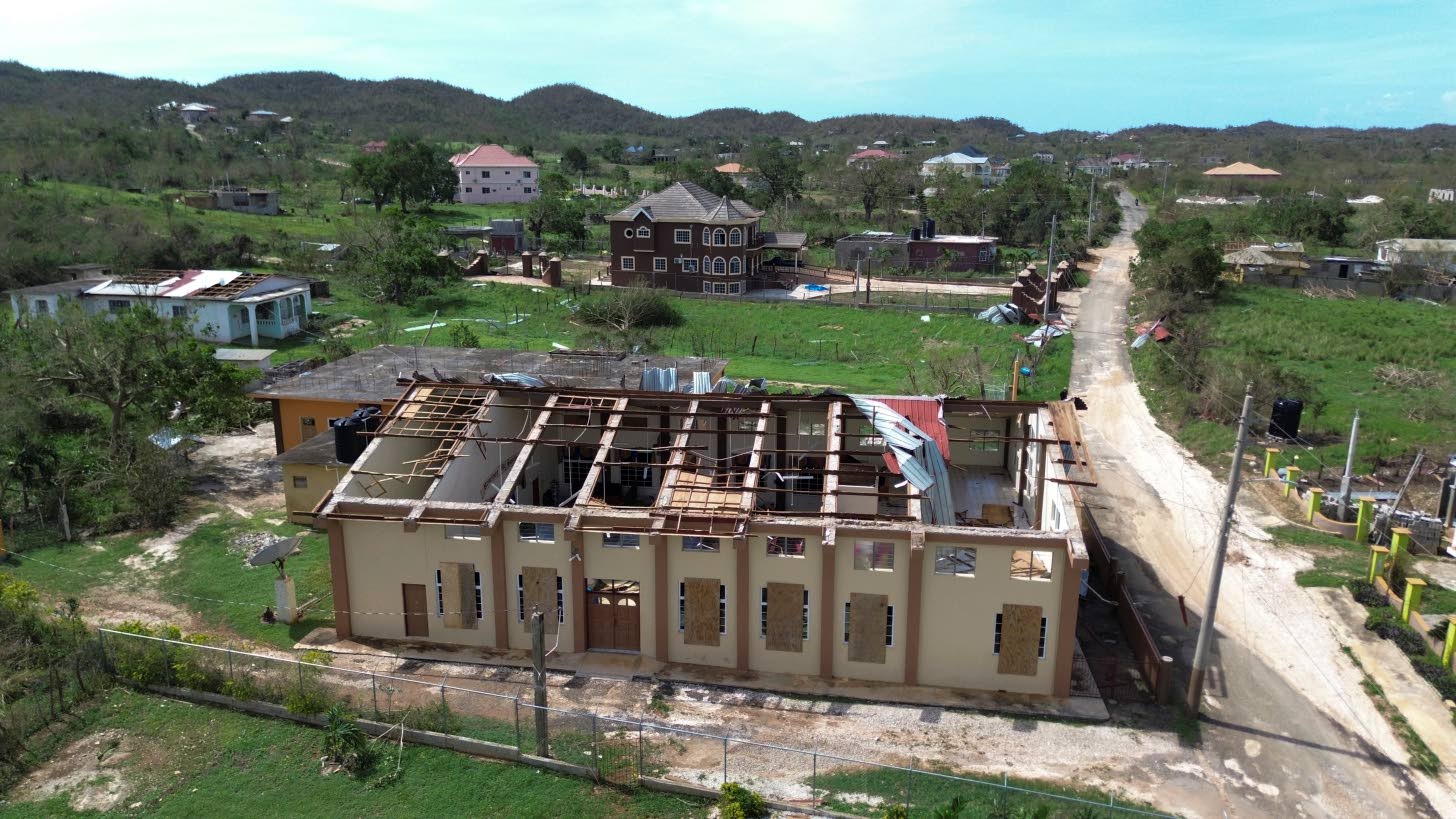
An aerial view of a damaged Seventh-day Adventist Church following the passage of Hurricane Melissa, in Williamsfield, St Elizabeth. (Photo: AFP)


