



Government charts long-term plan to reforest Jamaica
Millions in grant funding being eyed to repair hurricane damage
The Government is aiming to pull in millions of dollars in grant funding over several years to respond to the devastation to Jamaica’s forests by Hurricane Melissa.
Once steadily expanding, the island’s forests were set back in a single day by Hurricane Melissa — a blow that has now reshaped how the Government plans to protect land, water and communities for decades to come.
With more than half of the island’s impacted forests suffering moderate to severe damage, a sweeping rehabilitation programme is now being rolled out to restore ecosystems battered by the hurricane’s unprecedented force.
Speaking in the House of Representatives on Tuesday, Minister of Water, Environment and Climate Change Matthew Samuda laid out what he described as a decisive, science-based response to one of the most severe environmental shocks Jamaica has faced in modern times.
Samuda traced the journey from years of steady forest gains to the sudden reversal caused by Melissa, and set out how the Government intends to rebuild stronger, more resilient forest landscapes.
According to Samuda, before the hurricane struck in October 2025, Jamaica’s forests were quietly expanding with official land-use assessments showing consistent improvement in forest cover, supported by internationally recognised climate reporting systems.
“The Forestry Department, having completed the Land Use and Land Cover Assessment using data collected up to 2023, had reported that the forest cover in Jamaica had been increasing steadily year-on-year and had increased by a remarkable seven per cent up to that point. What that meant was that 47 per cent of our land of wood and water was at that point in time covered by forests,” Samuda said.
Those gains, he explained, were measured through Jamaica’s Reducing Emissions from Deforestation and Forest Degradation Plus (REDD+) Measurement, Reporting and Verification framework, using satellite imagery, change-detection analysis, and on-the-ground field checks. That system has now been used to quantify the damage left behind by Hurricane Melissa.
Samuda told the House that the scale of destruction demanded a response grounded in evidence rather than anecdote.
“Between November and December 2025, the Forestry Department conducted more than 300 rapid forest damage assessments islandwide, covering approximately 528,000 hectares of forested land, including Forest Reserves, Forest Management Units, and privately owned forested areas…The findings confirm that Hurricane Melissa carved a corridor of destruction across Jamaica, with southern, western, central, and parts of northern parishes bearing the brunt of the damage. In several forests — particularly those on steep terrain and shallow soils — damage levels reached between 76 and 100 per cent,” said Samuda.
He added that the assessments revealed damage that went beyond fallen trees, warning that the loss of forest canopy has left hillsides exposed, weakened watersheds, and increased the risk of flooding and landslides in already vulnerable communities.
In response, the minister said the Government has adopted a Reforestation, Ecological Enhancement and Landscape Framework (RE-LEAF) initiative as the national blueprint for recovery.
He described the programme as a targeted approach that will guide where and how forests are rebuilt, prioritising areas of severe damage, key watersheds, and communities most at risk.
Under the first phase of the plan, running from January to June 2026, the Forestry Department will replant about 300,000 seedlings, with more than half directed to priority watersheds and tens of thousands earmarked for urban and peri-urban areas. At least 30,000 fruit trees will be included, a move Samuda said is intended to link environmental recovery with food security and livelihoods.
He further announced that the rehabilitation drive will also be supported by expanded nursery capacity, particularly in western Jamaica, where damage was most severe, and by a revamped National Tree Planting Initiative Phase Two, which aims to plant an additional three million trees in a shorter time frame than originally planned.
“Through partnerships — and here I pause to recognise the sterling contribution of Trees That Feed, a US-based non-profit which has already provided a US$50,000 grant to supply approximately 12,000 fruit trees this year — which will be complemented by our own production from our national nurseries to supply, at no cost, species such as breadfruit, ackee, mango, avocado, and jackfruit,” Samuda added.
He also announced that the Forestry Department is moving to scale up nursery operations to support the expanded rehabilitation effort, including plans to establish additional nursery facilities in western Jamaica.
The minister said potential sites are being assessed in St James, St Elizabeth, and Westmoreland, a move expected to boost national seedling production by at least 20 per cent each year while improving the efficiency of reforestation and rehabilitation work in the areas hardest hit by Hurricane Melissa.
The minister’s presentation drew cross-party support, with Opposition spokesman on environment and climate resilience Omar Newell welcoming the overall direction of the Government’s response, while urging careful execution.
Newell cautioned that restoring forests on such a wide scale would place heavy demands on resources and called for broader public involvement in the recovery effort.
He also urged that plans to integrate fruit trees into the programme be carefully managed to protect local ecosystems.
Despite those concerns, Newell made it clear that the Opposition supports the rebuilding of Jamaica’s forests, describing reforestation as critical to the country’s long-term environmental protection and climate resilience.
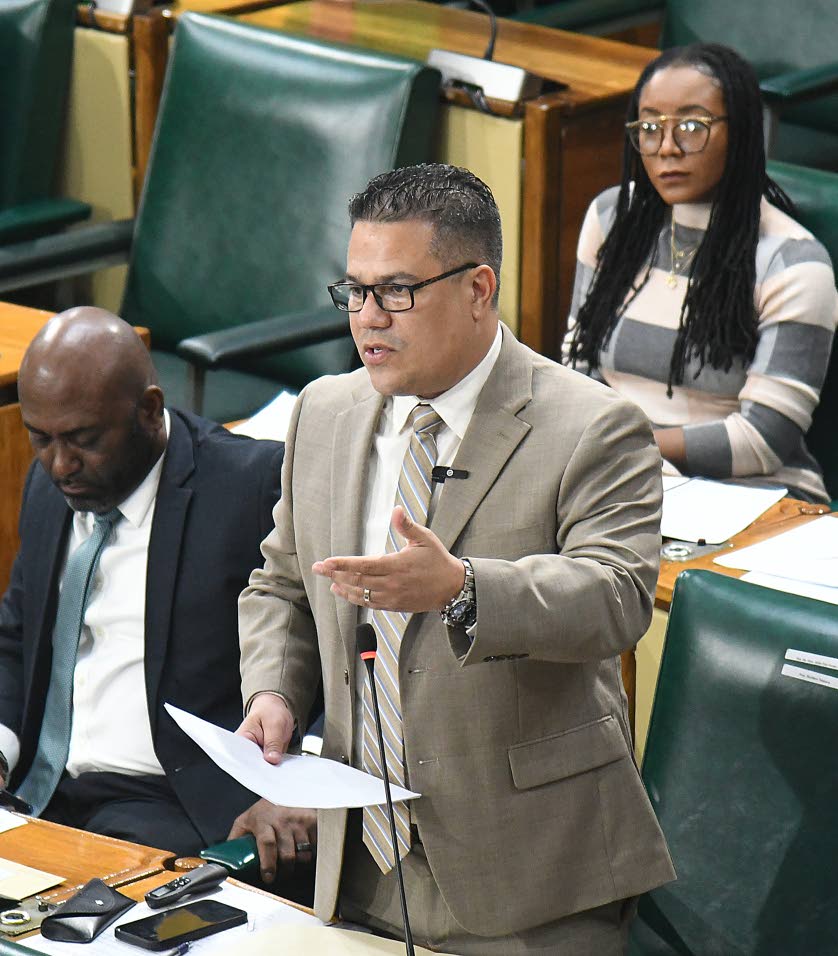
Minister of Water, Environment and Climate Change Matthew Samuda making a statement in the House of REpresentatives on Tuesday. (Photo: Karl Mclarty)


