



Opposition MP wants stronger legal protection for utilities
CHARGING that Jamaica’s most vital services are increasingly under threat, Opposition Member of Parliament (MP) Omar Newell has tabled a private member’s motion to classify the island’s utility networks as critical national infrastructure deserving stronger legal protection.
The motion, tabled in the House of Representatives on Tuesday, seeks to overhaul how the country treats electricity, telecommunications and water systems as Newell argued that repeated acts of theft, vandalism and sabotage now pose serious risks to public safety, national security and economic stability.
In giving notice of the motion, Newell said Jamaica’s core utility networks should no longer be viewed as ordinary commercial assets, but as essential national systems.
“Jamaica’s core utility networks, specifically telecommunications systems, electricity grids, and potable water infrastructure, collectively constitute essential national assets, indispensable to public safety, national security, economic stability, health, disaster response and the functioning of key institutions including hospitals, emergency services, financial systems, schools and public administration,” Newell stated.
The St Mary Central MP said the urgency of the motion is driven by a sharp increase in incidents targeting utility infrastructure, which he argued current laws are ill-equipped to deter or punish adequately.
“There has been a marked and troubling increase in incidents of theft, vandalism, sabotage and unlawful interference targeting telecommunications infrastructure, electricity distribution systems, and water supply assets, resulting in service outages, economic loss, threats to life, disruption of emergency operations, and reduced national resilience,” said Newell.
He pointed out that despite the seriousness of these acts, they are often prosecuted under general criminal provisions such as malicious destruction of property, or simple arson, which fail to capture the broader national implications.
The motion calls on Parliament to formally declare electricity, telecommunications and water systems as critical national infrastructure, a designation that would elevate their protection within Jamaica’s legal framework. It also urges the Government to undertake a comprehensive review of existing laws governing utility protection.
Among the proposals outlined is the creation of new sector-specific legislation, tentatively titled the Critical National Utility Infrastructure Protection Act, which would introduce specialised offences for theft, sabotage, vandalism and unlawful interference with utility systems.
Newell said such offences should carry penalties commensurate with the risks posed to national safety and be tried in the Supreme Court rather than parish courts.
“Designating such offences as indictable only triable in the Supreme Court [would enable] the application of appropriate sentencing powers and investigative processes for complex or organised criminal actions,” he argued.
The motion also calls for enhanced coordination among key agencies, including the Jamaica Constabulary Force; the Ministry of National Security; the Ministry of Science, Energy, Telecommunications and Transport; the Ministry of Economic Growth and Job Creation; the Office of Utilities Regulation; and utility operators themselves.
Another major plank of the proposal involves tightening oversight of the scrap-metal industry, which has long been blamed for fuelling theft of copper cables, transformers and other utility assets.
To support his case, the Opposition MP pointed to international examples where critical infrastructure enjoys enhanced legal protection, citing frameworks in Australia, Taiwan and the United States that provide elevated penalties and specialised investigative powers.
Newell also linked the issue to Jamaica’s growing exposure to hurricanes, cyber threats, and national emergencies, arguing that uninterrupted utility services are essential during disasters.
The motion also recommends the establishment of a joint select committee to receive submissions from utility providers, regulators, law-enforcement agencies, legal experts and civil society, and to report back to Parliament with recommendations for modernised legislation.
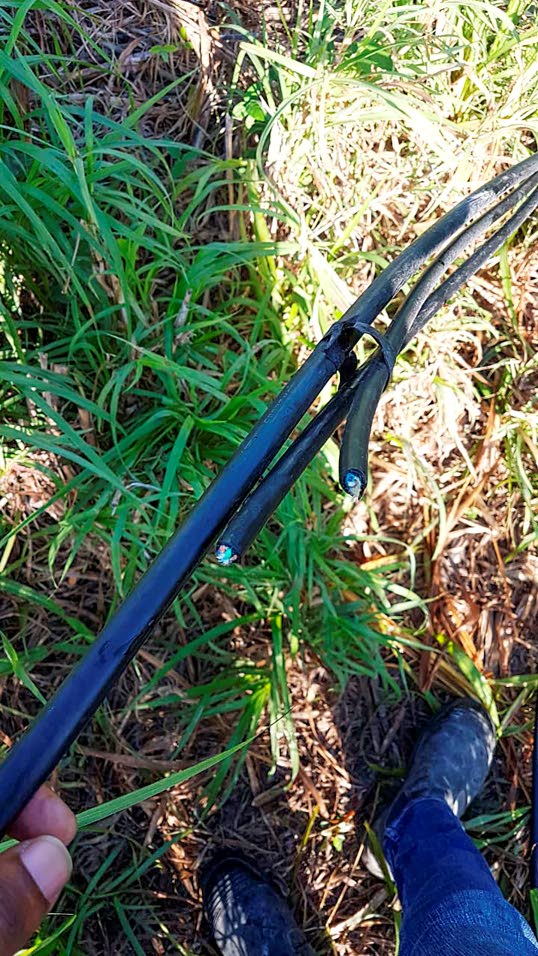
A view of Flow cables destroyed by vandals .


