



Leadership and a national project
As the nation ventures forth into 2026 it is being confronted by a national project of a proportion that we have never experienced before; namely, that of the rebuild as a consequence of the damage wrought by the passage of Hurricane Melissa. With just a mere three months lapse since its passage — even as its impact on the lives of people feels as if a longer time has passed and impatience grows among those whose spirit of resilience is wearing thin — there is a feeling that some things are taking too long to return to a state of normalcy.
At the same time, the challenge for leadership in governance and the various spheres of our national life is the extent to which we can foster a sense of nationalism and community that can embrace the population as a whole with a commitment to a common, social, political and economic vision as we restore, rebuild, and transform.
Our nation is deeply divided along partisan political lines and nothing is going to change that any time soon. At the same time we must face the fact the general election of recent time is over and that we have a legitimate Government in place for four years. It does mean, however, that partisan political perspectives will be brought to play in every issue of national import and the decisions and actions pursued by the Government. It is, however, the responsibility of the Government to offer leadership in this divisive context and to do so in such a way that the national energy and goodwill is channelled in positive directions.
It is also the responsibility of the Opposition to engage the Government regarding policies and programmes it advances as its legitimate function, but not to do so in a way that seeks to be bogged down or distracts the Government from its responsibility and engages in endless diversions and arguments.
The task for both Government and Opposition is made more complicated by the impact of social media in today’s world.
There is no doubt that the nation has made significant strides in responding to the devastation caused by Melissa through a combination of national and international relief response. There is also no question that the Government has played the leading role in managing and coordinating these initiatives. It does not mean, however, that the handling of the crisis has been perfect and there was no credible option to any of the many decisions it had to make.
As I write this article, I am reading a novel, The President is Missing, co-authored by former US President Bill Clinton and novelist James Patterson. In it the character the president reflects on the way in which the world of journalism and social media function in the contemporary world. Here I quote a few lines:
“Participation in our democracy seems to be driven by the instant-gratification worlds of
Twitter, Snapchat, Facebook, and the 24-hour news cycle. We’re using modern technology to revert to primitive kinds of human relations. The media knows what sells — conflict and division. It’s also quick and easy. All too often anger works better than answers, resentment better than reason, emotion trumps evidence. A sanctimonious, sneering one-liner, no matter how bogus, is seen as straight talk, while a calm, well-argued response is seen as canned and phony.”
Whether coming from a fictional character or a representation of the real experience of a president, it certainly speaks to what currently prevails in social discourse, radio talk shows, and in exchanges between representatives of the Government and the Opposition. The leadership challenge for the Government is that of steering a course that does not get bogged down in all of the distractions that these media present, whether from citizens or Opposition, while at the same time walking a path that can foster maximum cohesion and shared vision within the nation for the work of reconstruction.
Various polls undertaken of the Jamaican population in recent decades have revealed that the respondents do not trust politicians. It means that whatever action, however well-intentioned by politicians, will never receive overwhelming endorsement or approval but be always undermined by some conspiracy theory or allegation of partisan discrimination. It is therefore important that in face of the formidable national task before us, and which requires our collective focus and energy that our politicians seek to be, for us, the adults in the room and rise above these distractions and dissipation of what could be our best display of national unity in this effort.
Management consultant and author Peter Drucker, while speaking to the case of non-profit organisations, makes a point about leadership that is certainly applicable to our context of divided political loyalties. He writes: The way in which you judge the quality of leadership is by “the tone of the body, not the charisma of the leader, not by how much publicity the company gets, or the leader gets”.
This is at variance with the way in which political leadership has been traditionally understood and exercised in our Jamaican and Caribbean context. In an article entitled, ‘The ‘hero-provider’ model of Jamaican leadership’ carried in the Jamaica Observer in 2010, Dr Deborah Duperly-Pinks of The University of the West Indies shared a significant finding from research carried out on the
Ideologies of Leadership in Urban Communities in Kingston. She highlighted lessons which have an immediate application to Jamaica and region. The findings “illustrated that the various styles and practices that emerged over time were primarily authoritarian, so that all actors have understood leadership this way. The authoritarian style uses position, power, authority and promise of rewards rather than a belief in or using a participatory democratic or collaborative approach to problem solving and nation building. In this tradition, speaking out for the masses has been important — using the street and popular-style talk to draw in the crowds. Caribbean leaders have shown a preference in being seen as popular, and as heroes to their crowds (Singham 1968). The traditional leadership developed patron and client relationships (Stone 1980), had political linkages, and this was understood by both leaders and followers, and used by them in pursuance of their various goals. In sum, Caribbean leadership has been populist, pseudo-heroic, patron-oriented and authoritarian”.
One further observation arising from this research is that “the ideology that underlies the hero-provider model is about a power rooted in a sustained egoism of the national level leadership of the country, which has become far too preoccupied with the self-serving interests of party and individual agendas above nation… it has been a way that seeks always to serve self-interest and maintain the status quo and power equilibrium of the leadership, and reinforce an egoistic image”.
That Dr Pinks concludes that “this ideology is not equal to the work of transformation at either the community or national levels” should hold no surprise. If there is any validity to these findings then it is clear that the traditional authoritarian approach of political leadership and governance will certainly not bring about the collective spirit, trust, transparency, and accountability which a mobilisation of the citizens of all political shades will require. So it will not be beneficial if every announcement of a new policy or thrust by spokespersons of the Government meets accompanying denigration of every position or strategy advanced by the Opposition in a country that is already politically polarised. Neither can much of social media diatribe and falsehood be elevated to national significance in this moment of rebuilding and transformation.
It is important that the prime minister and his representatives listen to the feedback coming from people on the ground, and not assume that their declarations that the Government is handling the recovery process in the most effective ways, and that there is not partisan dimension to what is being undertaken, constitutes an undeniable truth or edict. There is often a gap between leadership assumptions and pronouncements and the reality on the ground where followership is concerned.
Some months ago as I read a biography of former Prime Minister Michael Manley I was struck by his admission that several of the social programmes that he advanced did not materialise because there was division in the ranks of the party and a lack of support by some within the public and private sectors. It is easy to dismiss this as something applicable only to the individual concerned and his politics. At the same, it is a reality that I have experienced as a leader in the Church. During my active years as a bishop, I participated in an outreach effort in partnership with Food For the Poor. Bulk supplies were received from the organisation and would be re-packaged for distribution in local communities. It was made clear by me to all priests involved and lay people assisting that the supplies were for those most in need. In one location it was noted that those assisting in the re-packaging process were helping themselves to the supplies. When reminded on spot what I, as bishop, had directed should happen, the response forthcoming was, “After a no the bishop sinting.” There is no doubt a parallel to the response from the most responsible declarations from the prime minister and Members of Parliament regarding relief supplies in the current and other situations.
In the long run, when we get to a point at which we can declare a state of reasonable recovery and transformation, it will be through the resilience of the people; the generosity, goodwill, and compassion of many people and agencies; the Opposition; and with the Government’s leadership of a democratic and cooperative enterprise. The nation anticipates that moment with great anxiety.
Howard Gregory is retired Anglican archbishop of the Province of the West Indies and lord bishop of Jamaica.
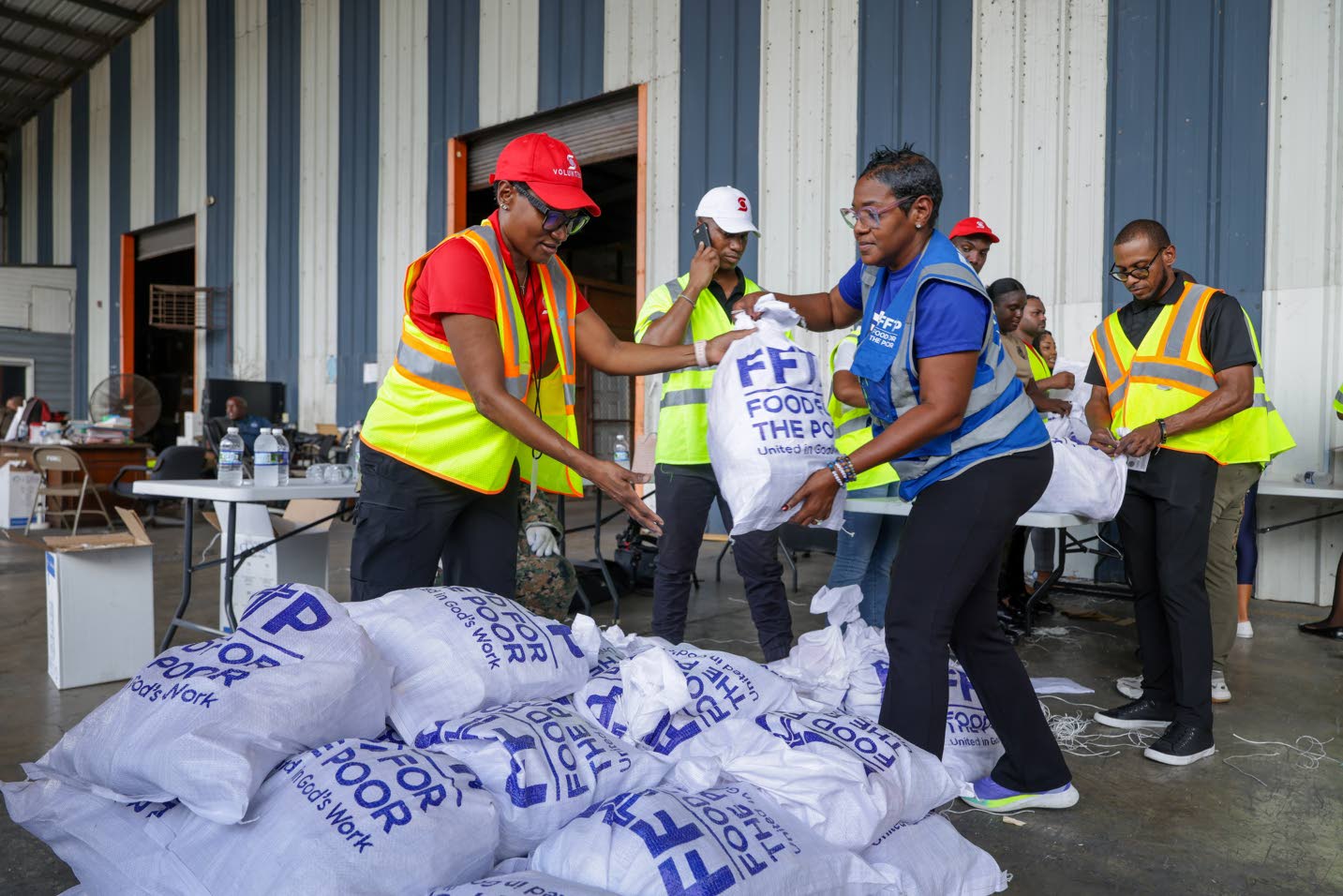
President and CEO of Scotia Group Audrey Tugwell Henry (left) assists Marsha Burrell, marketing, public relations and missions manager at Food For the Poor, with loading a pallet with bags of food items being distributed to families in communities affected by Hurricane Melissa.


