



‘Butch’ Stewart’s love affair with Air Jamaica
The Love Bird became the little piece of Jamaica that cries
January 4, 2026 marked the fifth anniversary of the passing of Gordon “Butch” Stewart, Jamaica’s ebullient, generous and patriotic businessman. This month, in his honour, the Jamaica Observer publishes a series of updated articles recalling actions of “The Chairman” that inspired the nation. This is part two of the second in the series.
For 10 years, from 1994 to 2004, Gordon “Butch” Stewart had spoiled Jamaicans with his vision of an ‘on-time no-line’ airline, believing that in the same way he had built his Sandals hotel chain into the most internationally recognised local brand, he could do it for Air Jamaica, the national airline.
In the quarter century before the Stewart-led Air Jamaica Acquisition Group (AJAG) paid US$26.5 million for controlling interest in the ‘Love Bird’, Air Jamaica had already won the hearts of Jamaicans at home and abroad with its familiar tagline ‘The little piece of Jamaica that flies’.
On April 1, 1969, Air Jamaica was an idea whose time had come and Jamaicans were smitten from the first flight of the Love Bird. But beginning in the late 1970s to 90s, the airline began a turbulent journey that, in hindsight, could only have ended in tragedy.
During that period, Air Jamaica was besieged by drug smugglers whose nefarious activities brought it the infamous tag “ganja bird”. Mike Fennell, who went to Air Jamaica as president and CEO at the height of the problem, said he had found a serious lack of security in the loading of its ageing planes, in the maintenance operations and in the airport generally.
Drug-running was only one of the problems. Politicians, their families and friends flew wantonly free of cost on Air Jamaica, apparently with little or no thought about the viability of the airline. The Government was unable to provide the required financing for new aircraft and two attempts to privatise Air Jamaica failed. The wounded Love Bird was now in dire straits and in imminent danger of crashing out of existence.
In this desperate context in November 1994, the airline was bought by Gordon “Butch” Stewart, the phenomenally successful owner of the Appliance Traders Limited, Sandals Resorts and the Jamaica Observer newspaper. The bid was supported by National Commercial Bank, with the Government retaining 25 per cent ownership.
Wasting no time, Stewart quickly re-imaged the airline, introduced now famous innovations such as on-time no-line schedules, champagne flights and the flying chef; bought new state-of-the-art planes and rekindled the pride of the nation in the airline.
With enormous national goodwill at his back, he articulated a vision of profitability through service excellence. This meant:
• Upgrading the ageing fleet of aircraft
• Improving and expanding route structure and service
• Optimising aircraft utilisation
• Cost reduction and increased productivity
• Making the airline the primary carrier for Jamaica and the Caribbean while establishing it as an international carrier through strategic alliances.
What Stewart and his team did not know was that another storm was brewing. In May 1995, less than a year after his AJAG took control of the airline, the United States Federal Aviation Agency (FAA) downgraded Jamaica to a Category II rating, a measure of its air safety operations led by the Civil Aviation Division. It hit Air Jamaica with the full force of a hurricane.
“The direct and consequential losses to Air Jamaica due to Category II, which remained in effect for over 2½ years, were enormous and horrific,” Stewart recalled, noting that PricewaterhouseCoopers (PwC) estimates had put the loss figure at more than US$150 million.
“With that US$150 million we could have opened more routes to cities like Tokyo, Moscow, and in the United Kingdom,” he suggested. The Category II blanket over Jamaica led to, among other things:
• image dilution
• lost market share in core routes – Miami, New York
• inability to utilise new aircraft
• utilisation of uneconomical wet leases with third parties
• delay in opening a proposed hub and new gateways
• delay in effecting the Delta Code Share alliance
• utilising uneconomic third party maintenance contracts
• increase in aircraft ownership costs due to inability to access concessionary financing
• huge operational inefficiencies due to restrictions in take off and flight capability
• management inability to plan and manage generally due to constant setbacks and lack of working capital.
“As a result of Category II, the losses totally wiped out AJAG’s equity over three years and created severe deficiencies in working capital,” Stewart said in an interview.
It was mind-boggling to watch Stewart and his team jump into action. Among the achievements they could boast:
• The airline’s excellent safety record was maintained
• After being re-imaged, it regained credibility as an on-time international carrier of quality
• The fleet was expanded and improved from nine ageing aircraft to a total of 20 state-of-the-art, well maintained Airbus aircraft which allowed the airline to benefit from the newest fleet in the region
• It won several major international awards, including ‘Best Airline Servicing the Caribbean’.
Importantly, the airline was playing a more pivotal role in promoting Jamaica as a preferred destination. It added 12 new gateways and massive improvement in customer service through motivation and training of staff. Big investment in technology led to upgrading of check-in counters and ground equipment.
Improvement and expansion of the route structure was one of the key elements of the new service.
Air Jamaica planes flew to such critical tourism marketplaces as Chicago, Los Angeles, London, Toronto, Fort Lauderdale, and Philadelphia. This increased the number of passengers carried yearly to 62 per cent, accounting for the majority of the increase in tourism arrivals into Jamaica at the time. In fact, 52 per cent of tourists to the island arrived on Air Jamaica.
The decision to enter into an agreement with Delta Airlines, one of the largest airlines worldwide, for code-sharing and cost-sharing initiatives, was critical to this success.
There was a second priceless initiative. Flying into Heathrow Airport in London was the preferred destination in England for nearly all the world’s major airlines. When AJAG landed an additional slot there it was nothing short of a coup.
“We were all aware that we had achieved a travel industry feat that made us the envy of many other airlines,” said Stewart. “We have the former high commissioner to London, Derrick Heaven, to thank for his invaluable assistance in achieving that.”
While Jamaicans, and commercial interests in particular, were raving over the new Air Jamaica, one special constituency stood out — a hardy group of mostly Jamaican women, itinerant vendors whom Edward Seaga would rename informal commercial importers, or ICIs, who sold Jamaican good overseas and bought foreign goods for sale on the popular local ‘bend down markets’. Air Jamaica was their ‘minibus’ in the skies.
To optimise aircraft utilisation, Stewart created the Montego Bay ‘Hub’ which moved utilisation rate from below six hours per day to approximately 10 hours per day, regarded as a key performance indicator for sustainable viability.
The hub became the catalyst for significantly increasing major international airlift, which facilitated the development and growth of the tourism industry and attracted various Spanish brands, adding more than 5,000 rooms over the last five years.
Crucially, the hub linked all the English-speaking Caribbean islands, achieving a dream of long-standing supporters of the Caribbean Community (Caricom) to have a truly regional airline.
The airline was soon dubbed the “engine of growth” for Jamaica, as passenger loads increased from 62 per cent to 69 per cent, the fruit of Air Jamaica’s US$10 million spend on promotion and advertising per annum.
To get independently confirmed figures on Air Jamaica’s contribution to the Jamaican economy, Stewart turned to a 2006 Boston-based Massachusetts Institute of Technology (MIT) study that looked at the 10 years of AJAG, from 1995 to 2004.
MIT determined the economic benefit of Air Jamaica by estimating the economic contribution of air transportation for the case where Air Jamaica did not exist and then subtracting this value from the economic contribution of air transportation for the case where Air Jamaica did exist.
“Thus the value we determine is the incremental contribution of Air Jamaica to the Jamaican economy, ie the benefit that can only be attributed to the presence of Air Jamaica. Although there are many different ways in which airlines contribute to socioeconomic growth, only two of these mechanisms are explored in this study:
• the portion of airline revenues that remain in Jamaica by virtue of the wages that are paid to residents of Jamaica, and the goods and services that are purchased from companies in Jamaica
• the expenditures of foreign visitors.”
The researchers suggested that the study represented a conservative estimate of the benefit of Air Jamaica to the Jamaican economy.
“The results of our analysis indicate that the economic benefit of Air Jamaica to Jamaica between 1995 and 2004 was US$5.491 billion, of which US$1.830 billion was a direct incremental contribution to the economy and US$3.661 billion is the corresponding indirect incremental contribution.”
At the same time, however, the airline’s balance sheet was showing accumulative losses of US$674 million over the 10-year period, or an annual average loss of US$67 million per annum, with 1998 achieving an operating break-even. The loss, of course, was a drop in the bucket, compared with the true value of the airline to Jamaica and the Caribbean.
But building back the airline was easier said than done. As things were looking up, Air Jamaica was again hit by another destructive force — the historic 9/11 terrorist attacks on the United States which caused a dramatic decline in travel and sent most major carriers in the USA to apply for bankruptcy protection under Chapter 11.
The US Government had to provide a financial bail out package of US$19 billion to their airline industry. Air Jamaica did not receive a similar bail out but weathered the storm. And Jamaica’s tarnished reputation as a tourist destination because of high levels of crime and violence, received major international press coverage, adding a further nail in the coffin.
Finally, the great man conceded he could do no more without jeopardising the empire he had built. And so, on the day before Christmas Eve, 2004, the nation was shocked to hear the announcement that AJAG had handed back the airline to the Government.
Stewart had done his best. It was a hard decision. He had put his life into making the airline viable, putting his lifelong marketing skills and considerable business savvy on the line. He had taken patrotism as far as he could go.
Air Jamaica was eventually bought by Trinidad-owned Caribbean Airlines and quietly flew into extinction, the final chapter in the journey of the little piece of Jamaica that cries.
Next Sunday: “Butch” Stewart’s last great gesture of patriotism — the fight against COVID-19
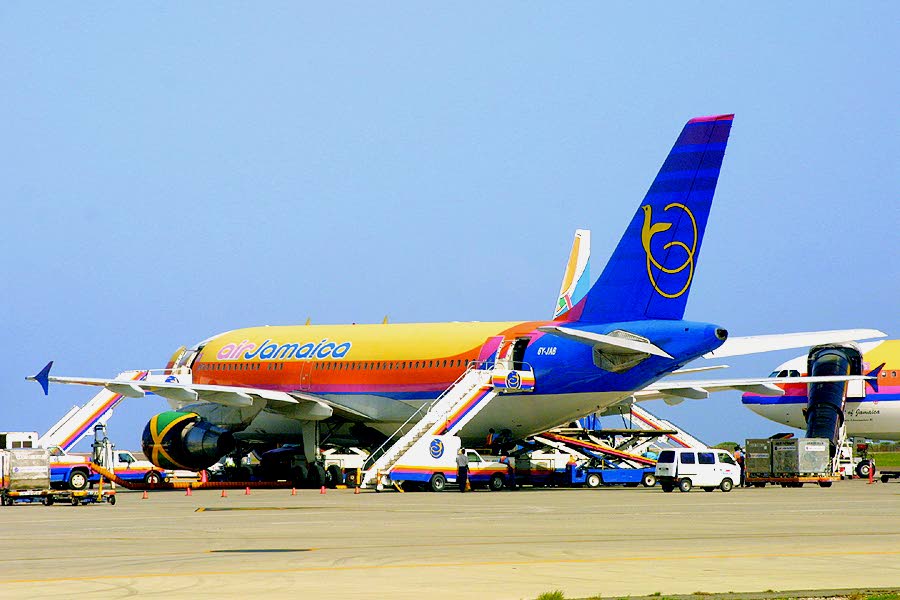
One of the new state-of-the-art aircraft acquired by Air Jamaica after the Gordon “Butch” Stewart-led Air Jamaica Acquisition Group acquired controlling interest in the airline.


