



Opposition raises red flags over proposed changes to FID Act
While acknowledging Jamaica’s need to meet international standards, Opposition legislators have warned that proposed amendments to the Financial Investigations Division (FID) Act could weaken safeguards and concentrate too much power in the hands of the agency’s leadership.
The concerns were raised during Tuesday’s sitting of the House of Representatives at which Government lawmakers argued that the amendments are necessary to protect Jamaica’s international standing and strengthen the FID’s ability to share intelligence with local and overseas partners.
However, Opposition members, while broadly supporting international cooperation, cautioned that the proposed changes require tighter wording and clearer limits to prevent abuse and protect Jamaicans whose personal information could be shared under the new framework.
Finance Minister Fayval Williams told Parliament that the amendments are driven largely by Jamaica’s obligations under global anti-money laundering standards and the need to remain in good standing with the Egmont Group — an international network of financial intelligence units that facilitates cooperation in the fight against money laundering and terrorist financing.
She said the changes are intended to strengthen the FID’s ability to exchange information with counterpart agencies at home and abroad, a key requirement under international assessments.
At the centre of the reform is how the FID shares information.
Under the existing law, Section 12 of the Financial Investigations Division Act governs “agreements and arrangements” for information sharing. It currently requires the chief technical director of the FID to obtain ministerial approval before entering into a memorandum of understanding (MOU) or similar agreement with a local or foreign agency for investigative purposes.
The proposed amendment would remove that requirement, allowing the chief technical director to enter into such arrangements independently — a move the Government says is meant to strengthen operational independence.
Williams said, however, that this independence would still be subject to the constitution and government policy. She also noted that while ministerial approval would no longer be required for individual information-sharing arrangements, the minister would retain the ability to make regulations governing the exchange of information, which would be subject to affirmative resolution of Parliament.
Opposition Leader Mark Golding made clear that his party supports the broader objective of maintaining Jamaica’s credibility as an international partner in the fight against financial crime. However, he warned that the drafting of the amendments raises legal concerns.
He pointed to language in the Bill that allows information to be shared for investigations “to enforce laws administered” by the receiving body, arguing that the wording is unclear and potentially problematic.
“It isn’t clear to me what laws are administered by the FID, because when you look at the FID Act it doesn’t list, to the best of my knowledge, those laws which are to be administered by the FID. It, in broad terms, speaks to what the objects of the FID are, and it says, for example, that the objects of the FID are to investigate all categories of financial crimes, to collect information and maintain intelligence databases on financial crimes, etc. But we’re using a formulation here of laws administered by the division,” Golding said.
He warned that this lack of clarity could create legal uncertainty and expose the law to court challenges, particularly when investigations involve statutes administered by other agencies.
Golding also raised concerns about a provision that would allow the FID to share information without ministerial approval, even in cases in which the disclosure is not strictly required for the receiving entity’s functions, once confidentiality undertakings are in place.
That, he warned, could significantly widen the discretion of the agency’s leadership and weaken existing safeguards.
“So if the disclosure is required for the purposes of that entity’s functions then, yes, I can see why we’d want to share that information, but the question to my mind is why would you want to share it with them if it’s not required for the purposes of their functions,” said Golding.
He cautioned that confidentiality undertakings alone were not sufficient protection.
“Why would we be allowing the sharing of information which is not required by the functions of the entity that’s receiving the information?… to me that opens the door too wide, and I would like to see that door have appropriate limits around it,” he added.
Member of Parliament for Manchester Southern Peter Bunting also expressed concern, focusing on the clause requiring that information-sharing arrangements be consistent with government policy.
While acknowledging that the amendment aims to give the FID greater independence by removing ministerial approval, Bunting warned that the reference to government policy could undermine that very goal.
He cautioned that the wording could allow ministers to influence the flow of information without transparency or parliamentary oversight.
“Any minister can then write a letter to the head of the FID and say, for example, it is government policy that you don’t share information on Cabinet ministers, and would that now be government policy? It would not be public, it would not be transparent, so I don’t believe that this corrects the mischief that section four is trying to address; in fact, it makes it worse,” Bunting said.
He argued that if government policy is to guide the process, it must be clearly defined, publicly accessible, and subject to scrutiny.
In response, Williams insisted that the amendments are designed to reduce political interference, not expand it.
She noted that under the current framework, the chief technical director must seek ministerial approval each time information is to be shared — a process, she said, is inconsistent with international best practice.
Williams added that Jamaica has already been assessed poorly in this area and that the changes are necessary ahead of the country’s next Financial Action Task Force mutual evaluation.
“When you consider the current situation that the chief technical director has to ask the minister every time for permission, this is not in keeping with international standards, and it puts at risk our mutual evaluation, which is coming up this year. We were already graded low on this score. And so this is a move to ensure that we put this provision in place,” she said.
Despite these concerns, the amendments were subsequently approved by the House of Representatives.
WILLIAMS… the amendments are driven largely by Jamaica’s obligations under global anti-money laundering standards
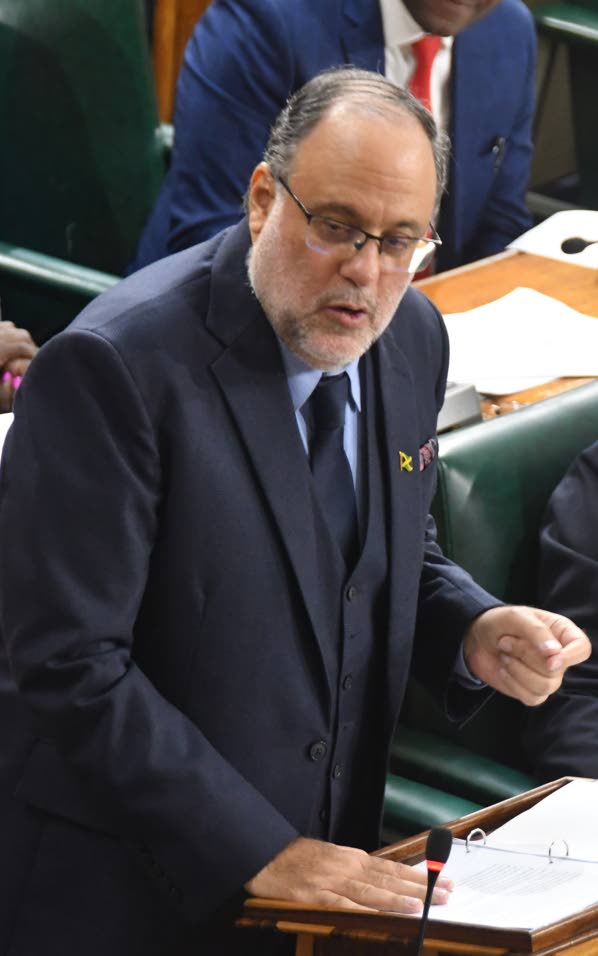
GOLDING… warned that the lack of clarity could create legal uncertainty and expose the law to court challenges


