



Chuck pauses Jury Act amendment after Golding flags key issues
THE Government but the brakes on a plan to approve the Jury (Amendment) Bill 2026 in the House of Representatives on Tuesday after Minister of Justice Delroy Chuck accepted the need to consider several issues raised byOpposition Leader Mark Golding.
The Bill was tabled in the House on January 13 by Chuck, who had indicated that he intended to take it through all its stages on Tuesday.
But after several of the proposed amendments were picked apart by Golding, a former justice minister, Chuck announced the pause.
Among the concerns raised by Golding was the proposed clause which outlines the matters a judge must consider in confirming a trial date. These include the status of disclosure; witness availability; readiness of the parties; estimated trial length; and whether any issues remain that could affect the scheduled trial date.
Golding argued that this is an insertion into the Jury Act, “of a provision that doesn’t, on the face of it, have anything to do with trial by jury”.
He pointed out that the provision speaks to trial readiness hearing and argued that the clause did not make a single reference to jury.
Golding further argued that the proposed clause was not clear whether it was to apply to civil and criminal proceedings, or just criminal proceedings.
“To the extent that it’s intended to apply to criminal proceedings, I submit that this provision should be in the Criminal Justice Administration Act because it has nothing to do with trial by jury, it is a general provision for a new procedure called a trial readiness hearing,” Golding asserted.
“To the extent it is intended to apply to civil proceedings, it should be in the Civil Procedure Rules; it does not belong in the Jury Act. That’s my point; it is not a jury provision,” added Golding.
He also took issue with the proposed clause to clarify the method of payment in jury trials in civil cases.
The proposed clause provides that the party who applies for a jury trial in a civil matter must pay the required monies into court; and the court would responsible for paying jurors and other entitled people.
It also states that the cost associated with special juries are to be treated as costs in civil cases.
But Golding explained to the House that in the case of special juries, typically, whoever loses has costs awarded against them. He pointed to the proposed change which states that “if a party applies to have the case tried by jury, the payment to the jurors is an obligation of that party”.
Golding expressed concern that this provision would lead to the perception of a conflict of interest.
“How can it be that the person who applies to have the trial done by jury in civil proceedings is the party that ends up paying the jurors?” questioned Golding, as he quipped that this could be a case of, “whoever pays the piper calls the tune”.
He noted that while the payment would be made through the court it would still be the party making the application who would be paying the cost.
“So the jurors would know that their stipend is being paid by him, he is the one who applied for it to be tried by jury,” said Golding as he suggested that could build into the system of a perception of bias, “which is not right”.
The Opposition leader also raised concern about the proposed clause which addresses jury tampering and which, if accepted, would give the right to the prosecution to apply for a trial to be conducted without a jury with no similar right being given to the defence.
Golding pointed out that under existing law, any criminal case that will be tried by jury, but where the death penalty does not apply, can be tried by a judge alone if both defence and prosecution agree.
“Here we are achieving an imbalance because we are giving the prosecution the right to apply…and the defence is given no such right. I think that there ought to be a general right in the defence to apply to the court for a trial by judge alone if the defence wishes to do so,” he said.
Golding also took issue with the proposed clause which would allow a judge to terminate a trial and order a new trial if the judge is satisfied that it is in the interest of justice to do so.
“That’s it. This is not a tampering provision,” said Golding. He argued that the proposal was too broad and the proper scope needs to be clear.
“It can’t be just a general provision that seems to apply to all trials in Jamaica,” declared Golding.
Having listened to Golding’s contribution Chuck acknowledged that the Opposition leader had raised some important points.
According to Chuck, it was important that the Bill makes it clear that only in matters related to jury tampering that a judge will be allowed to terminate the trial and order a new one.
“And for that reason I’m going to postpone the closure [of the debate] and look at how we can do it over,” said Chuck.
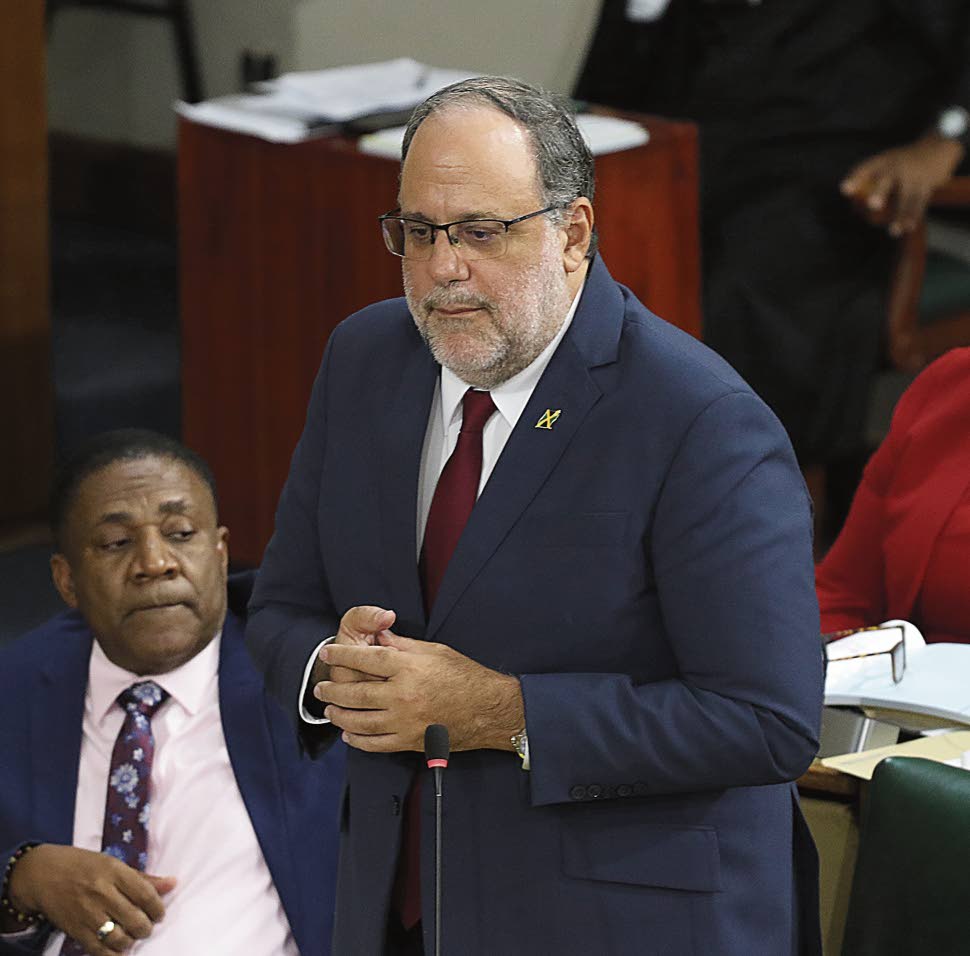
GOLDING… took issue with the proposed clause which would allow a judge to terminate a trial and order a new trial if the judge is satisfied that it is in the interest of justice to do so


