



Treat Jamaicans with fairness, PM urges new cops
AS 287 officers graduated from the National Police College on Wednesday, Prime Minister Dr Andrew Holness urged the newest members of the Jamaica Constabulary Force (JCF) to place dignity and respect at the centre of their work, stressing that State authority carries little weight if citizens are not treated with fairness and humanity.
Addressing the Batch 161 and 162 Passing Out Parade and Awards Ceremony at the National Police College of Jamaica in Twickenham Park, St Catherine, Holness framed the moment as more than a formal graduation, describing it as an entry into a new era of policing built on professionalism, accountability and public trust.
He pointed out to the recruits that their careers are beginning at a time when Jamaica is working to consolidate recent gains in public safety while responding to complex social and security challenges, including organised crime, cyber threats, and post-disaster recovery.
While acknowledging progress in crime reduction, Holness stressed that lasting security depends not only on enforcement but on the relationship between the police and the people they serve.
“Every Jamaican, rich or poor, powerful or vulnerable, deserves to be treated with dignity. And as your prime minister, I demand that every one of you here who will wear the uniform and ascribe unto yourself the authority of the State, as an officer of the law, that you must treat every Jamaican with dignity and respect for their rights. A modern police force embodies restraint where necessary, empathy where appropriate, firmness when essential, and fairness at all times,” said Holness.
He warned that the authority vested in police officers must never be confused with power over citizens, arguing that legitimacy flows from conduct rather than command.
“Remember, it is not the gun that you will carry, it is not the technology that you have, it is not the uniform that you have that gives you the authority. It is the values that you embody and represent. And the people, when you go amongst them in your communities, they will be able to determine, they will know, whether you come carrying the principles and the values that you have got in your training, or is it that you come to gain respect by fear,” added Holness.
He argued that the Jamaica Constabulary Force is undergoing a deliberate transformation by moving away from traditional models of policing toward a professional, intelligence-driven, and community-focused approach.
The prime minister noted that the graduating cops were only the second cohort trained under the new competency-based curriculum, which places heavy emphasis on ethics, critical thinking, human rights, and conflict de-escalation.
“Policing today cannot rely solely on command presence or traditional tactics. It demands nuanced situational analysis. It demands that officers ask not only what is the problem, but why it is happening, and how we fix it together,” Holness emphasised.
Holness also pointed to significant investment in technology as part of the Government’s modernisation drive, re-emphasising the Government’s support for the use of body-worn cameras by police officers.
“I want to emphasise here that the JCF embraces wholeheartedly the use of body-worn cameras. The leadership of the JCF has been very proactive in securing the best technological platform and ecosystem to support the full deployment of body-worn cameras. But the JCF, like all other public bodies, are subject to the rules and regulations that guide how we procure this well-needed equipment,” he highlighted.
“So I make this announcement here in the hopes that the public concerns that have been expressed in various media and in various quarters can be allayed. It is the intention of the Government to provide the security forces with all the equipment that they need to ensure that their policing is transparent, and that there is a process of capturing data, capturing their interaction to make it evidentiary and to make it prosecutable, so that we can ensure that there is confidence and trust in the actions of the police.” he added.
Holness also reflected on the role of the police during Hurricane Melissa, praising members of the JCF who remained on duty despite destroyed stations, flooded communities and limited resources. He said their actions demonstrated the true meaning of service.
“They were not fighting crime; they were keeping a community safe. That is what it means to be an officer of the law — to be first in line when disaster strikes,” he said.
The prime minister urged the new cops to remember that their behaviour will shape how citizens view the entire JCF, particularly when they are in uniform.
“You must always aspire to the highest standards, in particular when you wear your uniform. When you wear your uniform you must act according to the values and principles of the uniform — no matter what is popular, no matter what is going to get you likes, no matter what other people think. You represent an institution that has values that it is placing before the public,” declared Holness.
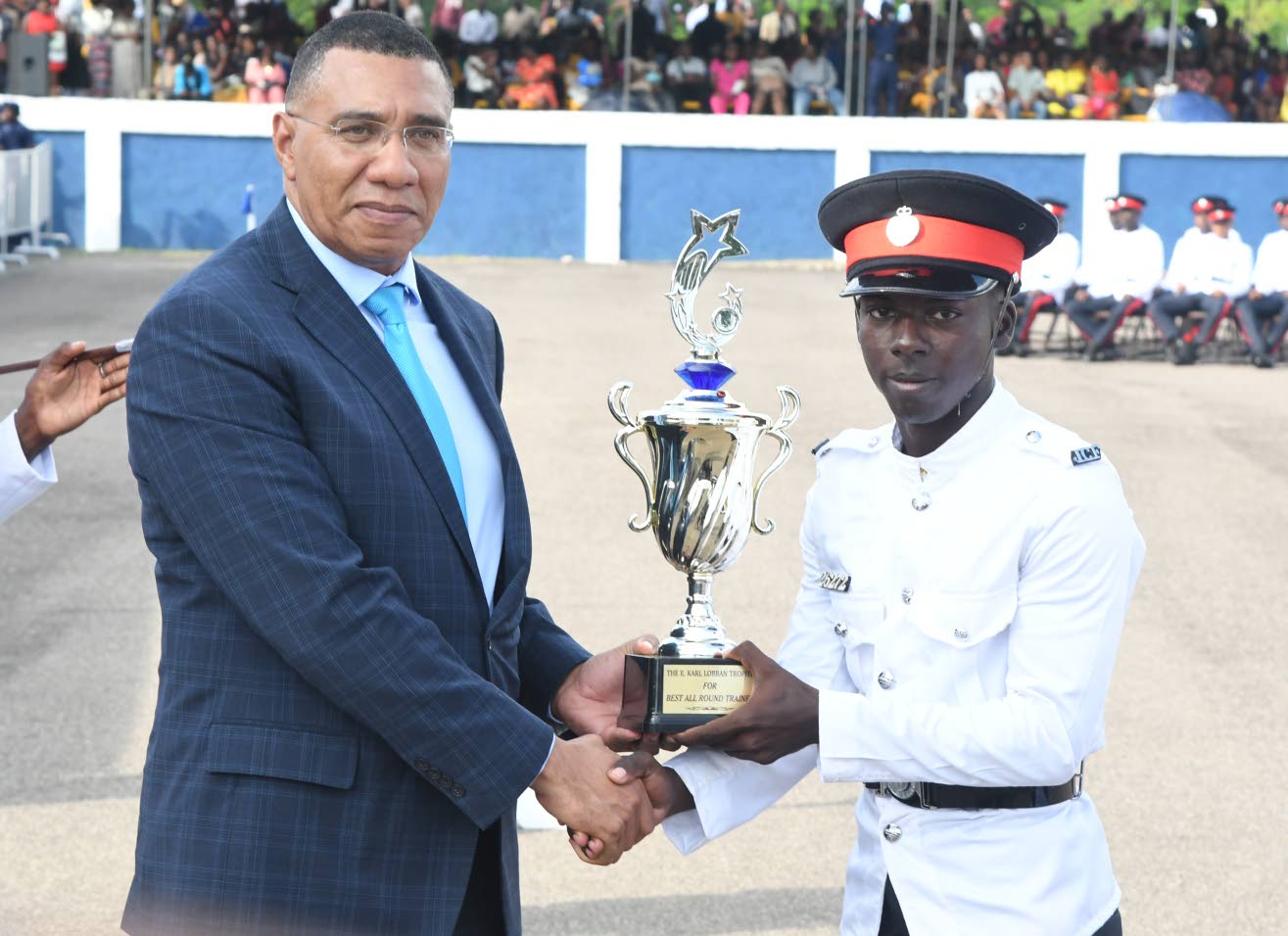
PM Andrew Holness presents a trophy to police graduate Chang Wilson, who was awarded for demonstrating best all-round performance. (Photo: Karl Mclarty)


