



Not drilling for oil yet
Vaz sets record straight on offshore exploration amid public speculation
AS Jamaica continues its search for oil, Energy Minister Daryl Vaz is emphasising that the offshore work to be carried out by United Oil and Gas does not involve drilling, but is instead aimed at collecting scientific data to determine whether the country has viable petroleum potential.
The clarification comes as the Dublin-based energy company prepares to begin a surface geochemical exploration programme offshore Jamaica — a process officials say represents an early, non-intrusive stage in assessing the island’s hydrocarbon prospects.
United Oil and Gas is set to carry out a multi-week survey using a specialised research vessel. The exercise will involve seabed mapping, heat flow measurements, and the collection of narrow sediment samples — all designed to determine whether the geological conditions necessary for petroleum formation exist beneath Jamaica’s waters.
Speaking during a media tour of the exploration vessel RV Gyre at the Port Royal Cruise Terminal on Monday, United Oil and Gas Chief Executive Officer Brian Larkin stressed that the operation is focused on gathering scientific evidence, not extracting oil.
“I do want to be very clear on this from the start, because it’s easy for these projects to get misinterpreted: We are not drilling a well. This is data collection, arguably the final piece of the jigsaw before you move towards potential exploration drilling. The purpose of the survey is to help us understand whether there’s an active petroleum system offshore Jamaica,” he said.
Larkin explained that the work would take place in deep waters, more than 450 metres below sea level, and well away from traditional fishing areas. According to Larkin, the survey will involve multi-beam mapping of the seabed, followed by heat flow measurements and piston coring at approximately 41 carefully selected locations.
“These locations are selected using existing seismic data and known geological features, as we’re targeting indicators commonly associated with hydrocarbon migration,” Larkin noted.
The company has also sought to reassure the public about environmental safeguards, noting that the operation has received all required approvals from the National Environment and Planning Agency (NEPA) and the National Fisheries Authority.
According to Larkin, representatives from both agencies, along with marine mammal and fisheries observers, will be present during the operation to ensure compliance with environmental standards.
“The equipment we plan to use operates within very clearly defined limits. It’s soft start procedures, and we’ve followed piston coring — and piston coring causes only very small, temporary disturbance to the seabed. We’ve [also] engaged with the National Fisheries Authority and with the fishing communities ahead of this work, recognising that the ocean supports livelihoods across Jamaica and helps play an important role in the daily lives of many families,” he assured.
The company’s work falls under a production-sharing agreement with the Government of Jamaica which provides the legal and regulatory framework for offshore exploration.
In the meantime, Vaz said the initiative forms part of the Government’s broader and deliberate approach to strengthening energy security while maintaining environmental responsibility.
“This activity represents an early stage, non-intrusive exploration effort aimed at improving our technical understanding of Jamaica’s offshore petroleum potential. It does not authorise drilling or production. It is a data-gathering exercise that supports informed, responsible, evidence-based decision-making.”
He emphasised that all necessary approvals had been secured and that oversight mechanisms are firmly in place.
“The survey is being executed in accordance with international best practices, local regulatory requirements, and the highest applicable environmental standards. There will be robust monitoring to ensure the protection of Jamaica’s marine environment and the livelihoods that depend on it,” he added.
Vaz also moved to temper public speculation surrounding the exercise, cautioning against the assumption that oil discovery is imminent.
“Let me emphasise that the survey represents due diligence, not destiny. So, I’ve seen the comments every time the whole issue of this exploration comes up, where people get excited and basically think that we have struck the magic oil. We have not. Therefore, I would say to you that the best person to listen to is me, and if you don’t hear me say it, then you know it’s not on,” he said.
He added that while Jamaica continues to invest heavily in renewable energy, the country also has a responsibility to examine all potential domestic energy resources in a careful and transparent manner.
The survey is expected to last between three and four weeks, with preliminary results anticipated within one to two months. Full analysis is expected by mid-year, after samples are examined in specialised laboratories.
For Vaz, the exercise represents a measured step forward rather than a dramatic turning point.
“So, let us try and desist from the misinformation, but to say to you that if others of our Caribbean neighbours and in the region have been so fortunate to strike oil, then we know that Jamaica is a blessed country and our time is coming, hopefully,” Vaz added.
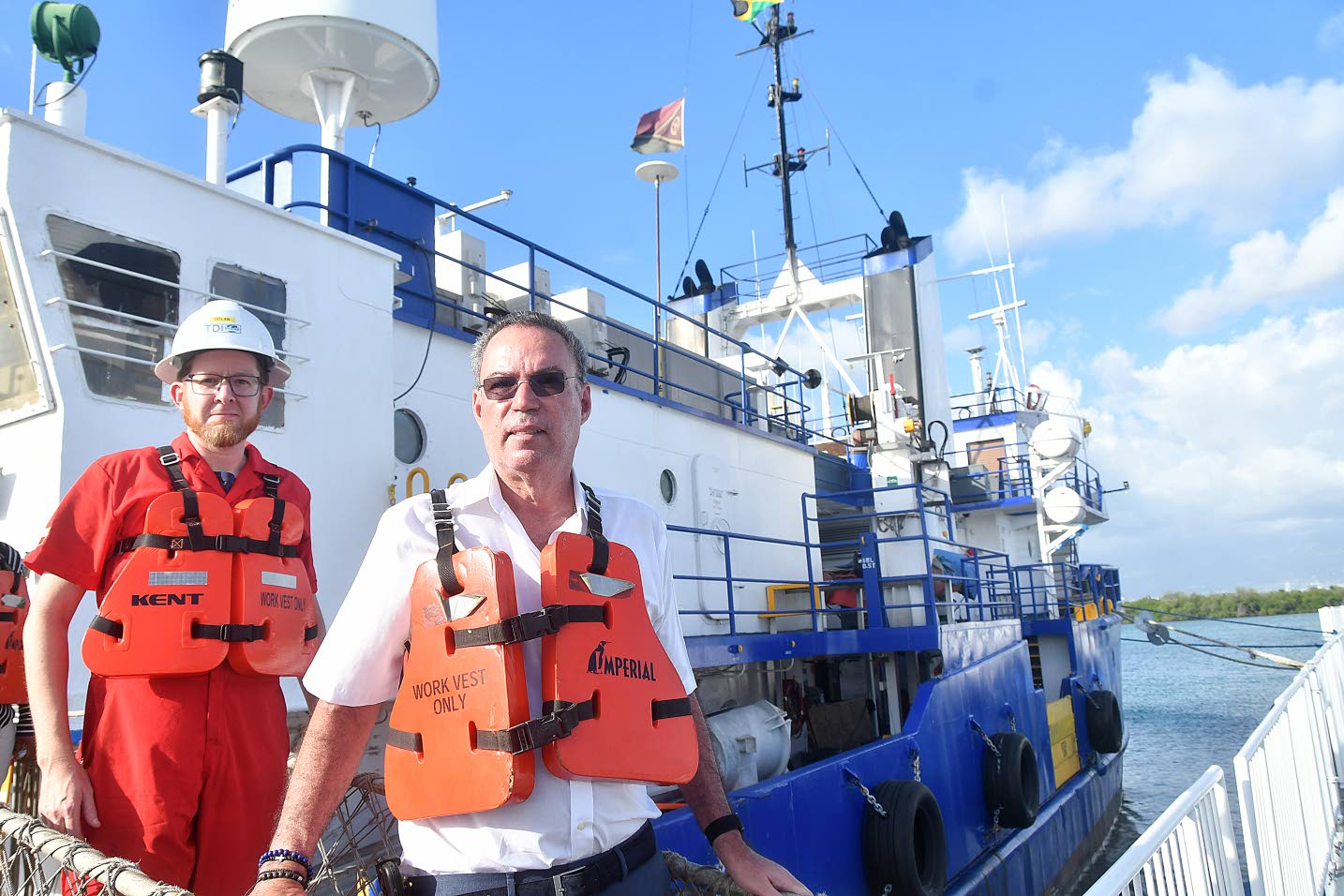
Chief engineer on the RV Gyre Brian Dolan (left) and Energy Minister Daryl Vaz exit the ship following a tour of the vessel, which will be used to conduct offshore surface geochemical surveys aimed at assessing Jamaica’s petroleum potential. (Photo: Garfield Robinson)


