



Death stalks the young
Jamaica losing prime population to road crashes, ITA data reveal
Island Traffic Authority (ITA) statistics paint a grim picture that Jamaica is losing a significant number of people in their prime productive years to road crashes each year, according to vice-chairman of the National Road Safety Council (NRSC) Dr Lucien Jones.
The data, published in the ITA’s daily crash reports, show that Jamaicans in the age groups 20-24 and 25-29 are those most likely to be involved in fatal road crashes, followed closely by road users between 30 and 34 and 35 and 39 years.
According to the statistics, 345 road users between the ages of 20 and 24 died in traffic crashes from 2020 to 2025. During the same period, there were 329 fatalities in the 25-29 age group; 236 in the 30-34 age group; 180 between 35 and 39 years; 142 aged 55-59; and 139 who were in the 40-44 age group category.
Pointing out that the transport sector is arguably the biggest contributor to Jamaica’s gross domestic product, Jones said the safe movement of people and goods has to be one of the priority issues for any Government.
“It is in that context that as a nation we ought to consider the frightening reality that well over half of road fatalities fall within the age cohort 18-49 — the most productive cohort of persons in any country,” he told the Jamaica Observer.
Jamaica’s situation is compounded by the fact that in some years, the age group 15-19 also sees a relatively high number of deaths as a result of the carnage on the nation’s roads. This was evident in 2020 and 2021 when 68 teenagers died — 34 in each of those years. In total, 164 teenagers died in motor vehicle collisions between 2020 and 2025.
In contrast, road deaths are far less prevalent among the very young — those 0-14 years old. Deaths in this category totalled 65 in six years.
Among the oldest road users, the numbers are also on the lower side. A total of 146 road users aged 70-74 and 75 and over died in the six years between 2020 and 2025 — 73 in each category.
Of note is that the numbers for road fatalities across all age groups could be higher since each year the ITA is unable to state the age of a significant number of crash victims — 360 over the six years, or 60 per year.
When the category for children is extended to age 17, the total number of fatalities is 128. Broken down, it shows that 93 were males and 35 were females.
When the elderly age group is combined to show those who died in the 60-74 age group, the number totalled 343, with 286 being males and 57 females.
Among the elderly, pedestrians and pedalcyclists are most likely to die on road mishaps. A total of 26 elderly pedestrians died each year from 2020 to 2022. Overall, fatalities among elderly pedestrians totalled 145 from 2020-2025, while elderly pedalcyclists died during the same period.
Jones, a road safety advocate for more than three decades, insists there are practical solutions to the unfolding carnage.
Reiterating that the demerit points system should become a point of focus, Jones argued that it can single-handedly, as part of the sanctions regime of the new Road Traffic Act (RTA), “remove even temporarily, persistently-errant drivers, by triggering a suspension of their driver’s licence”.
The entire country, he said, should agree and clamour for “the urgent rolling out of this vital aspect of the new RTA”.
Additionally, the NRSC vice-chair said there is need to expand the breathalyser programme to nab more drivers who drink alcohol and drive — a major cause of road fatalities worldwide. He said based on local research, it should also be extended to those who smoke ganja and drive. This, he said, should be “aided and abetted by protocols established by the Ministry of Health and Wellness to facilitate the testing of dead drivers for mind-altering substances, and also injured drivers who are unable to do a breath test”.
“For the same reason, as soon as all the logistical and technical challenges are overcome, we need to employ the use of new technologies, such as cameras and drones to assist in ensuring that drivers of bikes and other vehicles proceed at safe speeds,” said Jones.
He also reiterated that the Government must ensure that roads are safe for driving. And, he is urging lawmakers to insist that road users buckle up in both the front and back seats and that motorcyclists wear a certified helmet.
The road safety advocate said all of these measures serve to protect the integrity and usefulness of the Safe Systems Approach to Road Safety as recommended by the World Health Organization.
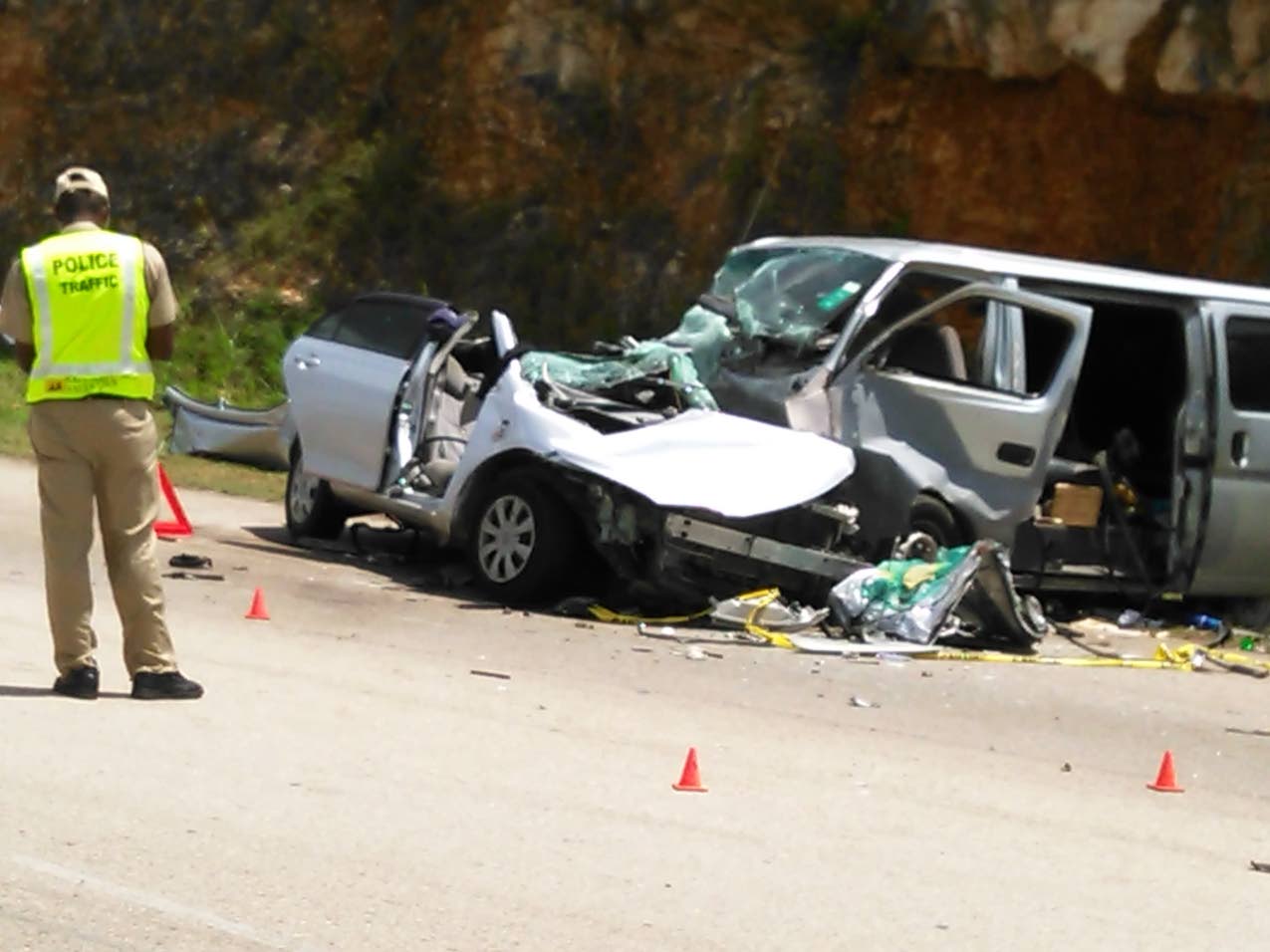
This file photo shows two motor vehicles that were involved in a deadly crash along the Duncans main road in Trelawny. According to Island Traffic Authority data, 345 road users between the ages of 20 and 24 died in traffic crashes from 2020 to 2025.


