



Melissa aftermath still felt by western schools sports
Nearly four months after Hurricane Melissa hit western Jamaica on October 28, many schools are still struggling to get back to normal, and that struggle is reflected in their sports programmes.
That reality was laid out on Monday morning at the Jamaica Observer’s Monday Exchange, where Sagicor Foundation, and Running Events Jamaica officials, and their partners gathered at the newspaper’s headquarters to discuss this year’s Sagicor Sigma Run. The event, set for the streets of St Andrew on Sunday, February 15, aims to raise $150 million to help five schools affected by the hurricane. These are Green Pond High, Little London High, Salt Marsh Primary, in Trelawny; Mayfield Primary and Infant School in Southfield, St Elizabeth; and Hopewell High in Hanover.
For Green Pond High Principal Orane Ebanks, the storm left lasting damage that has made it difficult for student-athletes to train and compete. The Montego Bay-based school, now in its 20th year, lost its roofs and continues to hold classes in roofless classrooms. Because of space issues, the school has been forced to operate on rotational learning.
“Our courts were damaged significantly — the surface, the fencing, the poles,” Ebanks said. “Our netballers recently rejoined the ISSA competition after Hurricane Melissa. We didn’t even have the facilities for them to train, really.”
Despite those challenges, Green Pond’s junior and senior netball teams reached the quarter-finals.
“We went to the quarter-finals and I’m really proud of the girls for making it that far,” Ebanks said.
Football presented a different set of issues. Green Pond’s daCosta Cup campaign had already ended before Hurricane Melissa, so that competition was not affected by the storm. The real impact has been felt at the junior level.
“For our U16 and U14s, we’re only able to field an U16 team just recently,” Ebanks said. “We’re still in the competition.”
Other sports had to be put on hold altogether.
“We had to scrap the track and field programme this year, because of the damage to the facilities, and also, we’re not able to get the students out to prepare,” he said. “So, sports had to be truncated, really.”
Ebanks said that even limited sporting activity plays an important role in helping students cope after the hurricane.
“The idea is to really bring them out of that traumatic experience and back into normalcy as best as possible,” he said, noting that social interaction through sport helps students recover.
In Westmoreland, where Melissa made landfall as a Category 5 system, Little London High Principal Dr Garfield James said the impact has been severe. Only about 60 per cent of the school’s students have returned since the storm, affecting both academic and sporting programmes.
“Our sporting activities have been impacted negatively,” James said. “However, despite that, we have registered for the ISSA cricket competition.”
That competition is the Headley Cup. Little London also plans to stage its internal sports day, but James said the loss of students has affected the programme.
“We would’ve lost some of our potential athletes,” he said. “They have not yet returned and it has affected the programme.”
At Salt Marsh Primary in Trelawny, recovery has been slow and uneven. The school is still being used as a shelter for people who were left homeless, forcing some classes to be held in tents or under tarpaulins. Like Green Pond, Salt Marsh has also been forced to use rotational learning.
“For us at Salt Marsh, usually we participate in the Mark McGann Football Competition, which would have started in January of this year,” Acting Principal Venesha Brown-Gordon said. “However, that has been postponed until further notice.”
Salt Marsh does not have its own play area and normally uses a field owned by Orange Valley Estate several miles away. That option remains unavailable.
“An area of that play field is still under water and there’s still debris on it,” Brown-Gordon said.
Instead of completely cancelling activities, the school is adjusting its plans.
“We’re currently in a process of moving our sports day,” she said. “We’re preparing an area of the school…to have a mini sports day so that the children can still be engaged and involved in sporting activities.”
The effort to bring students back into sport follows of a wider national debate that followed Hurricane Melissa. In an interview with the Jamaica Observer last November, clinical and sport psychologist Dr André Bateman cautioned that while sport can help restore routine, asking athletes to return too quickly can also add pressure, particularly for students in the western parishes who were hardest hit.
The principals say they are trying to strike a balance — using sport to help students reconnect and socialise, while working within the limits caused by damaged facilities, displaced families, and ongoing recovery.
As organisers look ahead to the Sigma Run, the hope is that the funds raised will help schools rebuild not just classrooms and roofs, but also the spaces students need to train, compete, and steadily move back toward normal life. Sagicor Foundation Chairman Chris Zacca, however, warned that while they expect to exceed their target, the extensive damage and destruction across the western region would still require more than what they are capable to give from this effort.
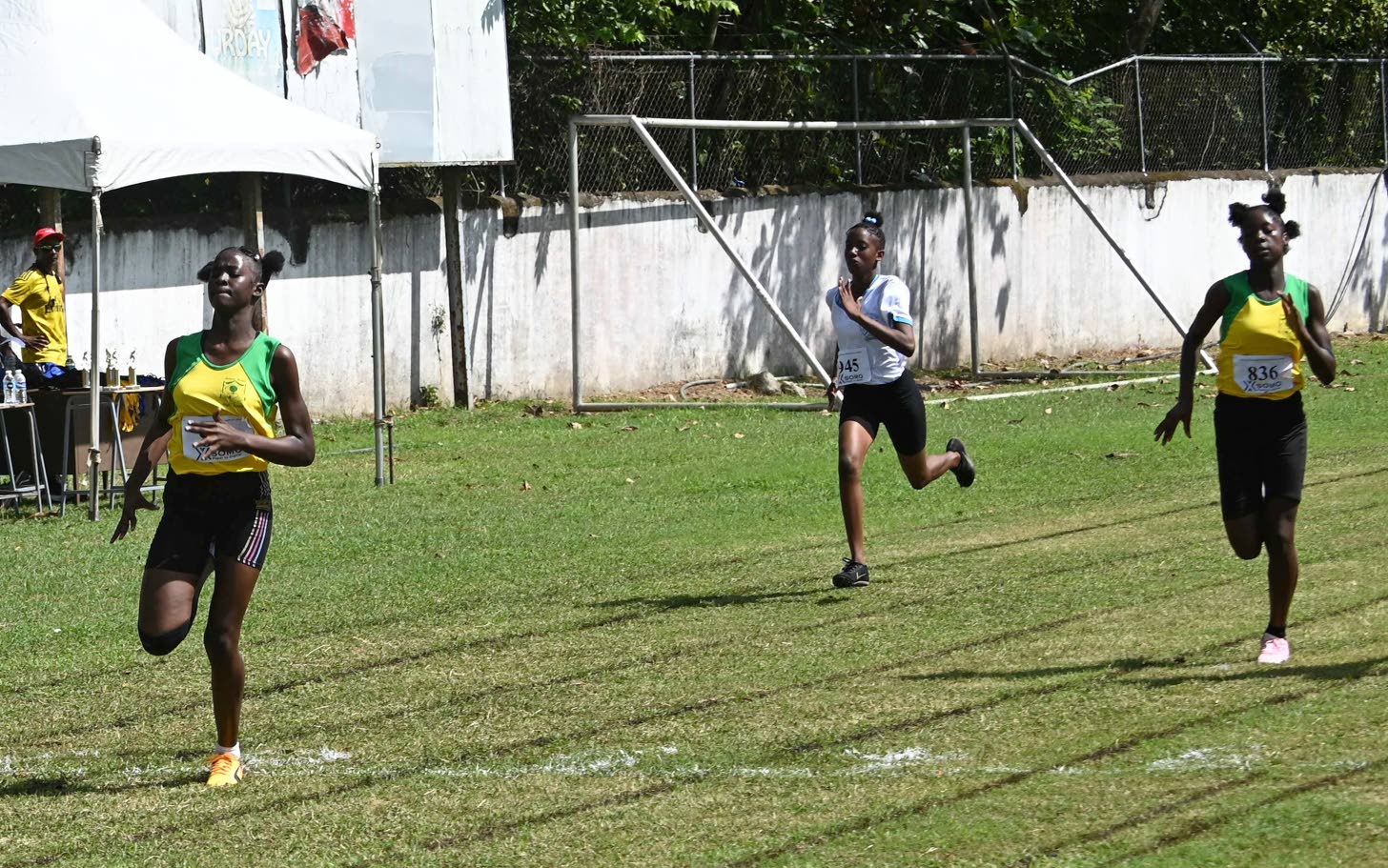
Green Pond High’s Phillian Gaynor (left) wins the Girls’ Class 4 100m event at the Comets Development Meet held at Herbert Morrison Technical in Montego Bay on Saturday, January 18, 2025. (Photo: Paul Reid)


