



Supreme Court ends mother-son lawsuit against JDF
Business duo sought damages six years after operation to apprehend ‘Dudus’ Coke
A mother and son, joint owners of several businesses on Spanish Town Road in downtown Kingston, have come out on the losing end after the Supreme Court tossed their 2016 claim brought against members of the Jamaica Defence Force (JDF) who, they said, “forcibly occupied” their premises for 22 days and stole cash, phones, and accessories and caused other losses and damage in 2010.
Supreme Court Judge Justice Dale Staple, in ruling in favour of the JDF, said, in his view, the two were “not entitled to any compensation” under the emergency powers regulations which were in force at the time as they failed to notify the Attorney General of their claim for compensation within the time specified by those regulations. As such, they “are statute-barred from making such a claim”.
He further said, “the claimants have failed to show that the actions of the security forces were done maliciously or without reasonable and/or probable cause or were a breach of any statutory duty imposed on them”. The judge also said he found that “there was no statutory duty imposed on the security forces to act in good faith”.
The mother and son sought compensation for breaches they said occurred in the summer of 2010 when, following a series of events, the security forces, comprising members of the Jamaica Constabulary Force and the JDF, decided to use force to enter Tivoli Gardens in West Kingston to apprehend Christopher “Dudus” Coke, who was wanted on an extradition warrant.
A limited state of public emergency had been declared by the governor general under the constitution, and the Emergency Powers Act (EPA) and Regulations were made under that Act to guide actions under the state of emergency. One of the areas covered by the extraordinary security measure was Tivoli Gardens and surrounding communities, including Denham Town.
The duo, who together owned several business enterprises on a plaza in Tivoli Gardens, said their business — which included a store that sells phones and accessories, a restaurant, a bar, and a meat shop — was “forcibly occupied” by members of the security forces from May 23, 2010, to June 13, 2010.
They contended that during the occupation they lost a quantity of cash, phones, and accessories from the phone store which were “unlawfully appropriated”, meat spoiled due to the security forces shutting off a backup generator, and there was other loss and damage suffered to the property.
Following the occupation, the pair wrote to the JDF seeking compensation for their losses, but after a lengthy back and forth no compensation was paid. Eventually, the two, on May 24, 2016, filed a claim in the Supreme Court to recover damages for what they termed as wrongful entry, wrongful occupation, and trespass. There was no contention at that time as to whether the JDF had acted in good faith.
The JDF, represented by the attorney general, in its defence argued that the entry was lawful, pursuant to the Emergency Powers Act and Regulations and that no business could have been conducted by the claimants due to sustained gunfire during the period, among other things.
Two years later, following a court order, the mother and son filed an amended claim seeking damages for breach of statutory duty under the Emergency Powers Regulations and trespass to goods among other things.
Attorneys for the JDF, in countering that claim, argued that the mother and son were not entitled to any relief under the Emergency Powers Regulations, as they should have pursued compensation under the scheme established under the said regulations, while pointing out that, in any event, the time to seek such compensation under the regulations had expired.
The attorneys further said, “They searched the property as it became apparent that some suspicious activity was taking place there” and while admitting that “some damage” was done, argued that it was to gain access to the property and to reduce security risks created by the light bulbs.
The JDF “specifically denied that cash or items of merchandise were removed or stolen. They also said that the generator had to be turned off as it was noisy and created an audio interference”.
Justice Staple, in deciding on the matter which was heard on December 8, 2025 and January 23, 2026, pointed out that Regulation 45 of the May 2010 regulations under the EPA, “conferred an unwaivable immunity from suit on members of the State exercising their powers in good faith under the EPA and Regulations”.
“This immunity goes to the court’s jurisdiction to even entertain the claim. I am fortified in this view by the very wording of the regulation. It says, ‘Subject to paragraph (2), no… suit… or other proceeding shall be brought or instituted… in respect of any act done in good faith…’ The wording is clear and unambiguous… in the context of a civil claim, a claimant must therefore, in my view, if they are going to seek remedies outside of the Regulation 44 compensation regime, ground the court’s jurisdiction to make even a provisional assessment as to whether the actions of the security forces were done in good faith,” Justice Staple reasoned.
“The effect of Regulation 45 is that you cannot commence the civil suit if the action by the State actor was done in good faith. If the State actor has the Certificate of Good Faith as evidence of their good faith conduct it makes the case that much more difficult to ultimately prove. But in the context of the commencement of the civil claim, the claimant must, whether there was a certificate or not, still assert that the State actor was not acting in good faith. If you fail to assert that they did not act in good faith, then the court would not have jurisdiction to entertain the claim and it cannot be cured by amendment,” the judge said further.
Added Justice Staple, “Unlike Section 33 of the Constabulary Force Act, Section 45 of the Regulations bars the suit from even being commenced if the actions of the State actor were done in good faith”.
In pointing out that good faith goes to the honest belief of the actor in the appropriateness of their actions while malice goes to the motive of the actor for their actions, Justice Staple said it was his view that it is “necessary to make the correct allegation”.
“To allow otherwise would deprive the security forces of the full intended protection from suit afforded by the Regulation,” he asserted.
As to whether the members of the security forces, whilst in occupation, took cash, removed and/or caused items of inventory to go missing, unnecessarily turned off the breaker to the cold room on the premises causing meat spoilage, caused miscellaneous damage to property, took items from the bar, took phones and stationery as well, Justice Staple said, “The claimants must therefore satisfy me, on the balance of probabilities, that the security forces did these things and that they did them in bad faith, and that these acts exceeded their statutory remit. It is important to note that if the actions were done in good faith, then they would be immune from suit, even if the actions exceeded their statutory responsibilities”.
On the evidence of the son that the security forces entered the premises without lawful justification, Justice Staple said, “I reject this evidence and find, based on the evidence from the security forces through their witnesses, that the entry was justified and in furtherance of their statutory mandate to secure life and property. I accepted the evidence of Lieutenant Colonel (name removed) when he said that their task was to seize certain structures, including what he identified as the claimants’ premises to establish vantage points so they could have clear line of sight into the community and activities on the ground. I also find that this entry was done in good faith on the part of the security forces”.
“I also reject his evidence that the search was unjustified and unnecessary. Again, the search was done in the good faith exercise of the statutory mandate of the security forces to secure life and property. According to the evidence of Sergeant (name withheld), which I accept as being true, they had to breach metal doors in order to access the roof to establish firing positions. I accept his evidence as being true and I find it was done in the good faith exercise of their duty… based on the evidence I find as proven that the effort to get into the building and secure the roof was done over a protracted period whilst they were under gunfire and duress,” Justice Staple declared further.
As to the claims that “the security forces turned off the generator and broke down some doors”, Justice Staple said “I find that the evidence given… as to the reason for this was credible and reasonable… there was no evidence of malice on the part of the security forces in damaging the doors. They testified that the generator was making too much noise and presented an unreasonable interference with their operational objectives. They could not hear well and in such an environment, hearing would be critical to locating enemy fire and enemy combatants. Their action in disabling the generator was more than reasonable and done in good faith,” the judge said.
He also dismissed as “completely false” the man’s claims that he had offered the security forces keys to the building.
“It is my finding that the claimant was well aware that the soldiers were trying to get access to the building, as he was monitoring activities from a location on the building with CCTV footage showing the exterior of the building. He did not alert them to his presence in the building at all, and it was they who actually had to come and find him. He did not deny this evidence,” Justice Staple said.
While acknowledging that the pair were unable to operate business for a while, Justice Stable said this was done for reasonable cause as the security forces needed to maintain a presence.
As far as claims that up to $1.067 million in cash was stolen, the judge simply said, “I do not believe [this] evidence. I do not accept that any reasonable business person in Jamaica would have cash of that amount simply lying around in an unsecured location… I accept the evidence… that the meat and other items in the cold room were lost, but I do not accept that these losses were caused by any malicious act or were done maliciously or without reasonable and/or probable cause. I also do not accept the valuation. There was no evidence put in to support that valuation. Surely, the claimants, as business people, could have gotten invoices from their suppliers as to what these things had cost at the time. Even if the original invoices had been lost due to the incident, their suppliers or other suppliers could have provided invoices. So, I do not accept them simply throwing figures at the court when it was easy for them to get actual evidence,” he said.
“I do accept that they had suffered losses to their businesses, but again, I do not accept the value of loss. The claimants said they would have earned $4.4 million in roughly 20 days. I am not disputing the capacity so to do. I am saying that they have provided no proof of this. With such earnings, the claimants ought to have been paying GCT and filing quarterly income tax returns to prove that they have made their GCT returns and are paying their fair share. Remember, their evidence is that they are proper business people. So they would have had proper records of their earnings, etc, and had filings at the tax office upon which they could rely to substantiate their income. Not one document was put into evidence to support their claims for this level of income,” the judge said.
He further said there was no evidence supplied to support the claims of losses from the bar, the more than 40 assets listed, or the income from the restaurant, even while he noted that he accepted that there was damage to the bar.
Regarding the claim by the pair that there was loss of equipment and other electronic devices, Justice Staple said, “I therefore reject that these items were lost. Incidentally, there was no evidence from him in his witness statement or from his mother that phones were taken or missing from the phone shop. He said that he lost income from the phone business but there was no evidence from him that phones were actually taken or missing. I found that the members of the security forces who testified were generally credible and believable. Mark you, there were moments where they had Nelsonian memory of certain events, but I also bear in mind that over 15 years had passed since those events ’til now when they are testifying. So I can reasonably excuse some memory lapses if they ‘could not recall’. But I did not find that it entirely destroyed their credibility”.
The judge’s reference to “Nelsonian memory” is a veiled allusion to Jamaica’s former National Security Minister Dwight Nelson‘s “I cannot recall” responses to several questions during the inquiry which followed the 2010 West Kingston operation that saw gunmen loyal to Coke engaging the security forces.
Coke allegedly fled Tivoli Gardens before the fighting which resulted in more than 70 deaths. He was captured on June 23 in the company of the Reverend Al Miller and arrested.
He was extradited within days to the United States and in August 2011, pleaded guilty to several charges, including conspiracy for trafficking large quantities of marijuana and cocaine into the US, and conspiracy to commit assault in aid of racketeering.
On June 12, 2012, Coke was sentenced to 23 years in prison.
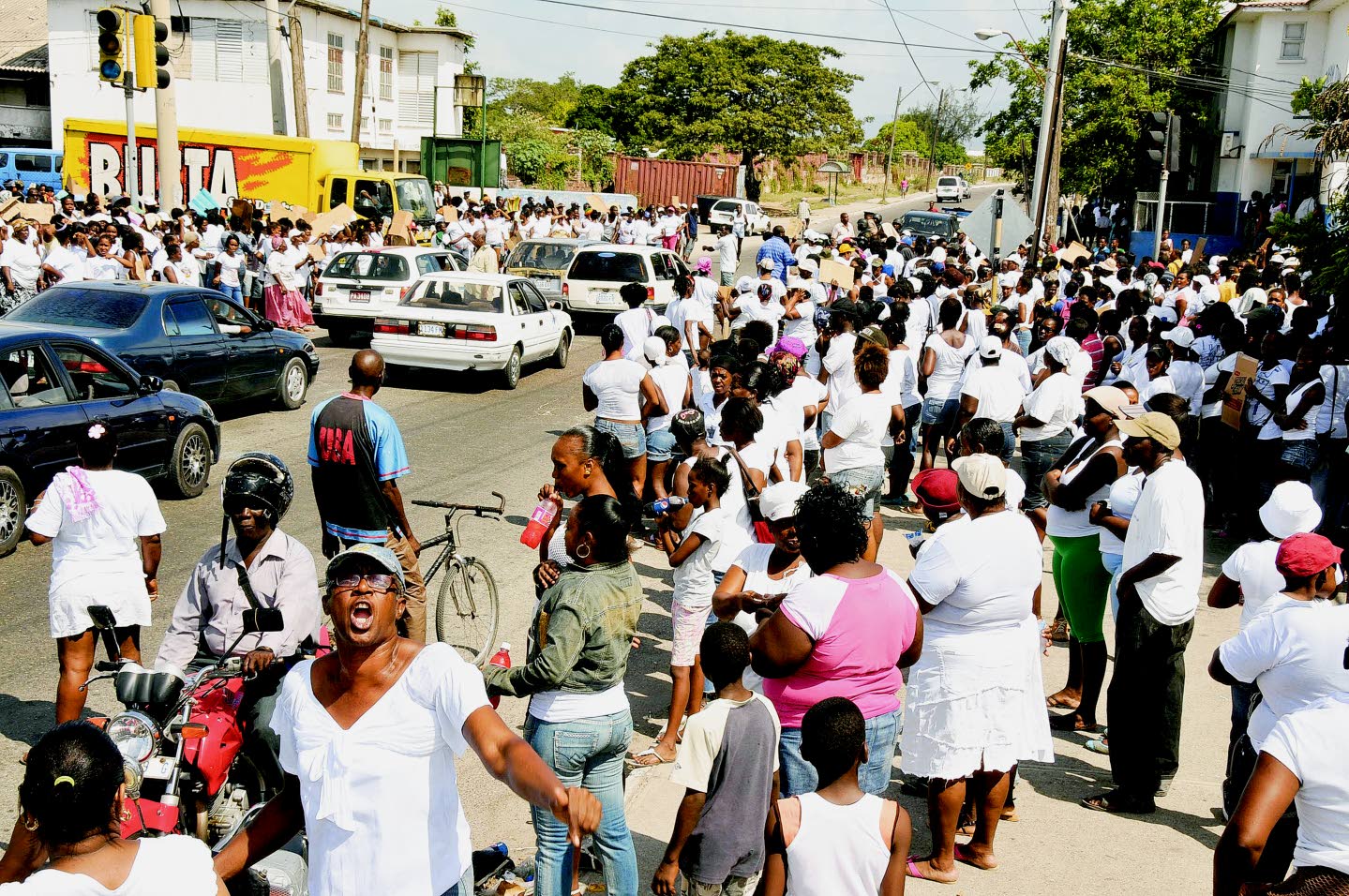
Supporters of Christopher “Dudus” Coke stage a protest days before the security forces battled gunmen in an effort to enter Tivoli Gardens to arrest Coke on an extradition warrant in May 2010. (Photo: Observer file)
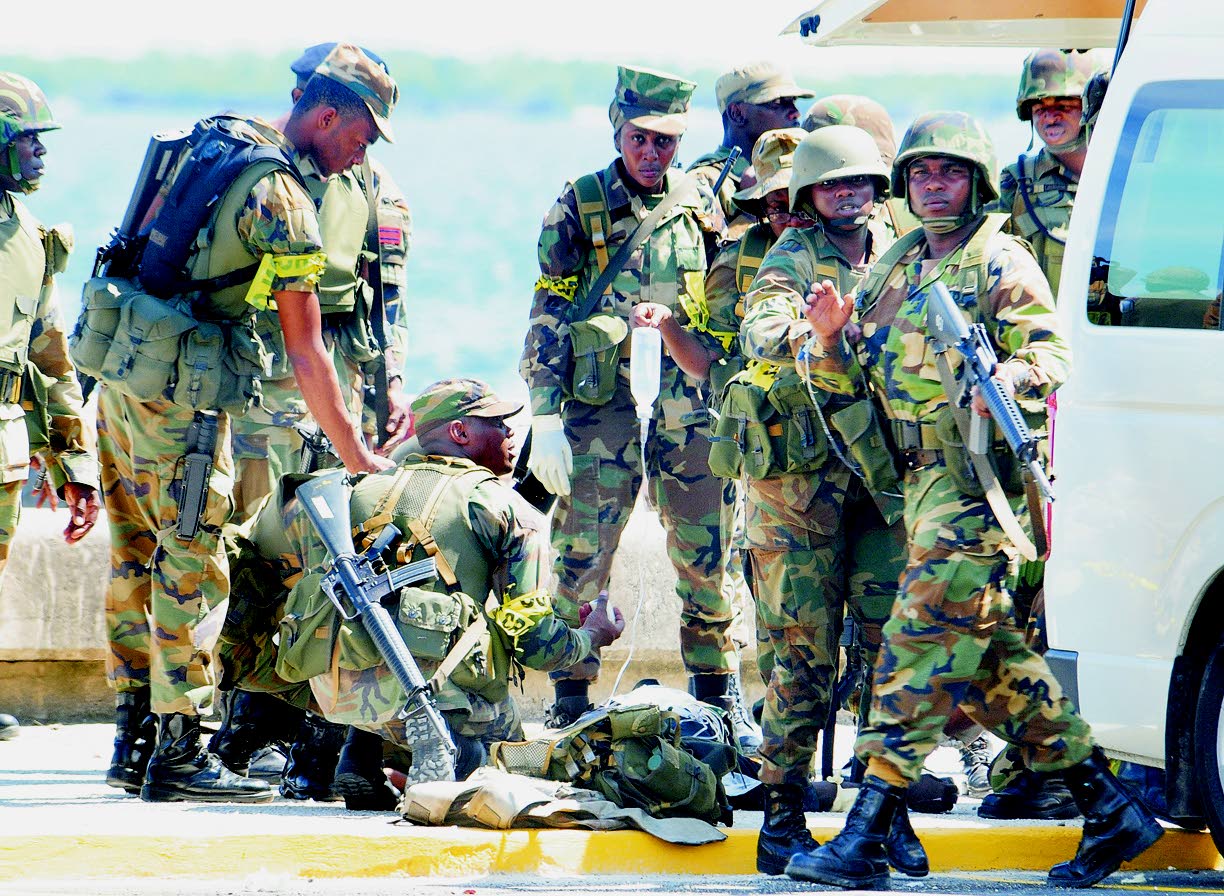
A soldier who was shot by gunmen loyal to Christopher “Dudus” Coke receives treatment while his colleagues keep watch during combat as the security forces try to enter Tivoli Gardens in May 2010 to arrest Coke on an extradition warrant.


