



Death Knell?
Economist believes Grand Slam Track revival unlikely with some athletes owed millions
With Grand Slam Track’s (GST) debt situation worse than earlier reported, noted economist Keenan Falconer doesn’t believe the league has a future due to its loss of credibility in the eyes of potential investors and athletes.
On Tuesday, it was revealed in new bankruptcy filings that the Michael Johnson-led league had over US$40 million ($6.2 billion) in debt, US$10 million more than the league had previously stated. The filings also showed that the league made just US$1.8 million ($282 million) during its three stops in Kingston, Miami, and Philadelphia.
The new document showed that Olympic sprint hurdles finalist Ackera Nugent and World 100m champion Oblique Seville are among several Jamaicans yet to receive a significant share of their prize money and related fees.
Nugent, who was one of the main draws for the event and competed in all three cities is owed an incredible $21.5 million. Seville, who competed in Kingston and Miami, is owed close to $10 million.
Two-time world 100m hurdles champion Danielle Williams is owed $9.1 million, 400m hurdles star Andrenette Knight is owed $8.6 million, two time World Championship silver medallist and three-time national 400m champion Nickisha Price is owed $7.6 million hurdles champion and two-time national 400m hurdles Roshawn Clarke is owed $6 million.
Other Jamaicans — including Rushell Clayton, Megan Tapper, Shiann Salmon, Malik James-King, and Ackeem Blake — are owed a combined $20.9 million.
American stars Sydney McLaughlin-Levrone, Kenny Bednarek, and Gabby Thomas are each owed in excess of $28 million.
GST initially filed for bankruptcy last month after failing to pay the athletes and vendors who were involved in the inaugural meets. An emergency financing in October saw GST pay athletes half of what they were owed, but vendors were against a settlement offer. The league, through a filing, is expected to announce on Friday plans to pay back its debts.
While acknowledging that bankruptcy isn’t always the end of the world for businesses, Falconer told the
Jamaica Observer that he can’t see a way back for GST.
“Investor confidence will naturally be more skittish in the aftermath of its financial troubles. Perception often matters more than reality in the financial world, so even if these developments were not as negative in actuality, just the mere appearance of damage to the brand is enough to steer investors in another direction despite any convictions to the contrary,” he said.
“It’s a tough situation all round. Credibility is shot, and it’s the most important thing to have, but the easiest thing to lose.”
Falconer says shortcomings in planning and execution contributed to GST’s difficulties.
“Track and field already isn’t the most lucrative sport compared with other largely individual sports like tennis, golf, and boxing,” he said. “However, several missteps didn’t help their cause with respect to broadcasting, scheduling, and overall event logistics, not to mention the absence of field events and inordinate delays between races to accommodate recovery time for athletes competing in multiple races.”
“Even if they were able to better manoeuvre these considerations, however, the overreliance on financial support from only few investors always introduced an element of uncertainty in its sustainability.”
Despite GST’s current situation, Falconer believes its situation shouldn’t discourage the launch of other track and field leagues.
“I think fans of the sport will welcome them, especially if there’s an element of competition and rivalry among them. It will make the sport more exciting and potentially attract more supporters,” he said.
“The Diamond League still represents the gold standard where this is concerned, and it remains popular after almost two decades, but it points to an important consideration — these investments are long-term and must be approached as such if you want to retain and augment sustainable interest in the sport. Innovation will be key because the sport is not short of talented and sensational personalities. It is just for these track leagues to be able to accommodate them in the right way.”
During a recent trip to Jamaica, World Athletics President Sebastian Coe said, “Grand Slam is going to be a footnote in the history of our sport and shouldn’t be taken too seriously.” However, he believes there’s room for other start-up athletic events, but says that, unlike GST, it must be pursued in a more practical manner.
“I have always encouraged, from the very first moment I became president of the sport, encouraged external innovation and external funding. And if there is external funding coming into the sport, we should take pride in the fact that we’ve created a landscape where people feel that they want to invest in a sport,” he said.
“But for that innovation to work, it has to be suffused in reality and credibility. You can’t put the athletes at risk and it needs to be thought through in terms of a sustainable business model. And we will always encourage new thinking and new events and sometimes find space for them in the calendar. But I think we’re going to have to make sure that in future those events are credible and they are actually adding to the quality of the sport and not taking us in the wrong direction.”
Michael Johnson (Photo: Joseph Wellington)

Sprint hurdler Ackera Nugent celebrates winning the Grand Slam Track title during the Miami leg at Ansin Sports Complex on May 3, 2025. (Photo: Grand Slam Track)
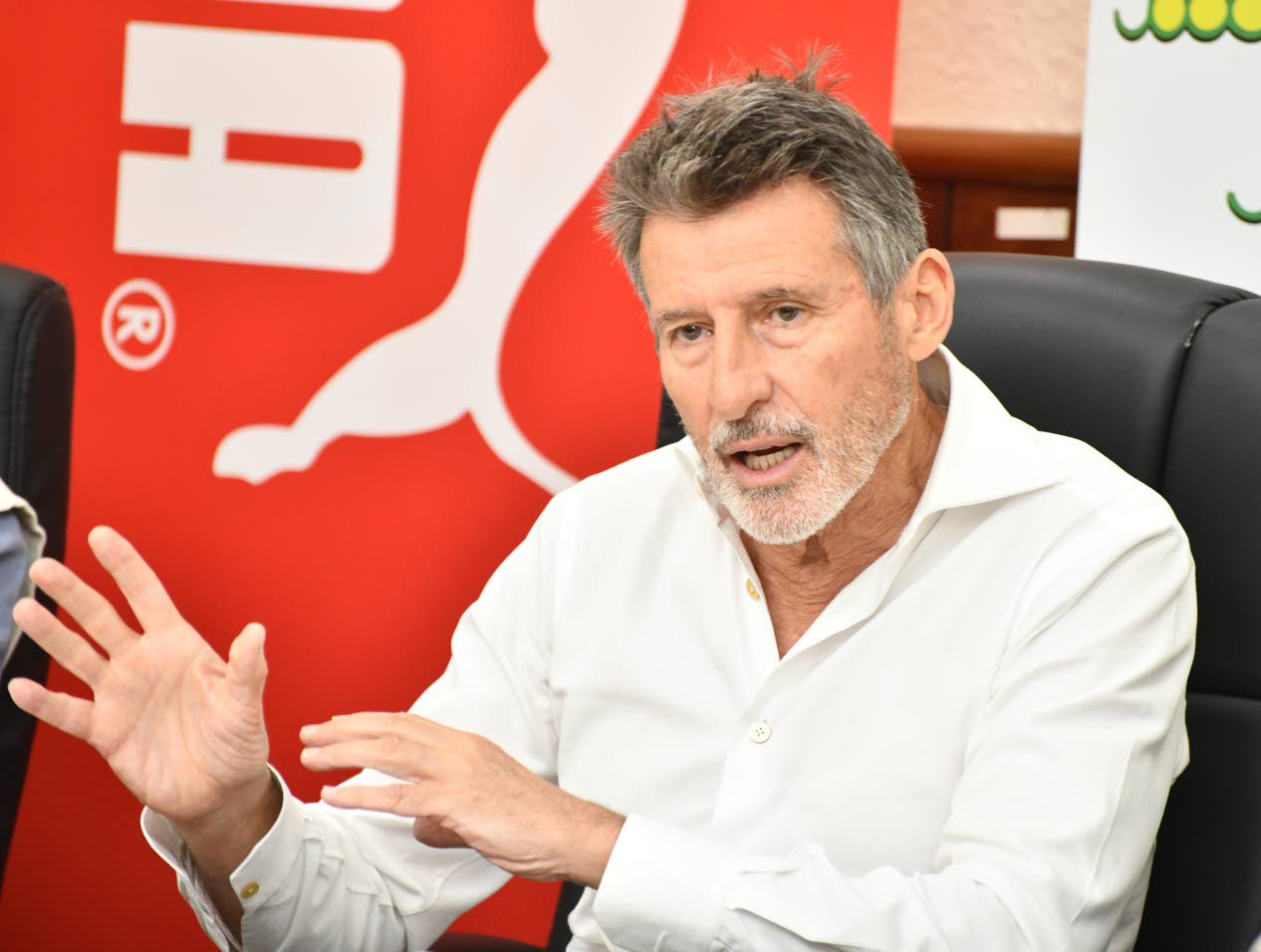
COE… Grand Slam is going to be a footnote in the history of our sport and shouldn’t be taken too seriously (Photo: Naphtali Junior)


