



REBUILD FACES EXECUTION TEST
Fiscal watchdog questions State’s readiness for post-hurricane reconstruction
JAMAICA’S post-hurricane reconstruction drive risks being undermined by the State’s limited capacity to deliver large-scale public investment, despite strong fiscal buffers and access to financing, the Independent Fiscal Commission (IFC) warned on Tuesday in a report tabled in Parliament.
In its January assessment, the fiscal watchdog said the government’s stronger-than-expected budget performance in the first half of the 2025/26 fiscal year reflected widespread under-execution of capital projects rather than improved implementation capacity — a pattern that could constrain recovery efforts following Hurricane Melissa.
The warning comes as the government prepares a major rebuilding programme after the October storm caused an estimated US$8.8 billion in damage, equivalent to about 41 per cent of gross domestic product (GDP), and prompted the temporary suspension of Jamaica’s fiscal rules.
According to the IFC, central government capital spending between April and September reached just $19.2 billion, nearly 46 per cent below the original budget of $35.5 billion, while the wider specified public sector recorded a surplus of $22.9 billion instead of a planned deficit.
The specified public sector comprises central government and most public bodies, excluding the Bank of Jamaica and the Jamaica Mortgage Bank.
The commission said repeated underspending had supported near-term fiscal outcomes but masked structural weaknesses in the State’s ability to execute investment programmes.
“The continued under-execution of capital expenditure weakens the prospects for future economic growth and higher tax revenue in the medium to long term,” the IFC said, cautioning against what it described as “over-ambition in materially executing additional capital projects amid local capacity constraints.”
Self-financing public bodies posted a combined surplus of $38.4 billion in the first half of the fiscal year, compared with a budgeted surplus of just $1.1 billion, largely reflecting delayed or stalled capital projects, the report showed.
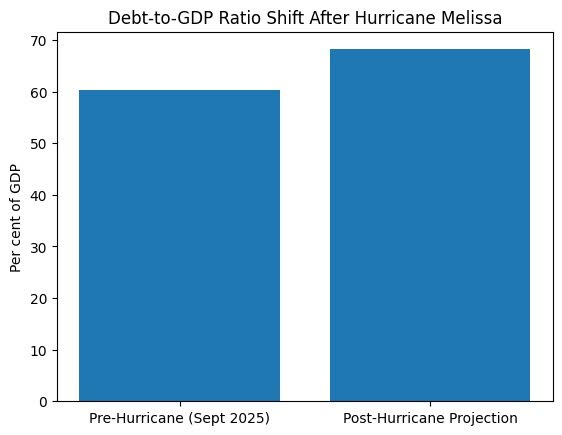
Jamaica entered the current fiscal year with strong macroeconomic indicators, including declining public debt, low unemployment and improved credit ratings. By September 2025, the debt-to-GDP ratio had fallen to 60.3 per cent, placing the country on track at that time to meet its legislated 60 per cent debt target ahead of schedule.
That trajectory has since shifted following Hurricane Melissa, with the government invoking escape clauses in the fiscal rules and seeking a two-year extension to the debt-reduction timeline. Public debt is now projected to rise to 68.2 per cent of GDP by the end of the fiscal year.
The IFC said Jamaica’s fiscal buffers and disaster-risk financing arrangements — including access to about US$663 million in contingent resources — had enabled a swift initial response to the shock. International development partners have also mobilised up to $6 billion in potential financing to support recovery and reconstruction.
However, the commission stressed that financing was not the binding constraint.
Instead, it pointed to long-standing weaknesses in public investment management, including procurement delays, limited project preparation and constrained project-management capacity across ministries and public bodies.
The IFC said uncertainty remained over the government’s ability to execute the remaining 72.7 per cent of the capital allocation for the current fiscal year, given the slow pace of spending in the first half.
As Jamaica moves into a reconstruction phase, the commission said aligning capital budgets more closely with delivery capacity — and strengthening execution frameworks — would be critical to ensuring that rebuilding efforts translate into durable economic growth rather than short-term fiscal gains.
.


