



Second chance without compromise
Senate approves criminal records amendments; says move not a softening on crime
AS the Upper House approved amendments to the Criminal Records (Rehabilitation of Offenders) Act on Friday, Government senators stressed that while the changes are intended to give deserving Jamaicans a second chance after brushes with the law, they should not be interpreted as a shift toward a softer approach on crime.
Expressing his support for the Bill during the debate, Government Senator Abka Fitz-Henley insisted that the legislation forms part of a broader, balanced crime-fighting strategy that combines tough enforcement with rehabilitation for those who have demonstrably turned their lives around.
“Let it not be mistaken, this Administration is not coy about applying legislation which might be contemplated as draconian, which is appropriate in dealing with the social ills of the day. But the passage of this Bill which is being debated, I’m of the view, can be contemplated as a recognition by the Administration that it takes a holistic approach, a multi-pronged approach, to address the issue of violence across society — and part of that is giving encouragement to people who might have offended but have demonstrated that they are willing to turn a different page,” he said.
He warned against interpreting the reforms as leniency, arguing instead that they reflect a more mature justice system that recognises rehabilitation as a key pillar of public safety.
The amended legislation broadens the scope of the Criminal Records (Rehabilitation of Offenders) Act by allowing the Criminal Records Board to consider applications from individuals who were previously ineligible because of the length of their sentence.
Under the changes, people who served prison terms of more than five years but not exceeding 10 years may now apply for expungement after completing an extended rehabilitation period. For adults, that period will be 15 years, while individuals who were under 18 at the time of the offence may apply after eight years.
The amendments also expand the discretion of the board by outlining clear factors to guide its decisions, including the seriousness of the offence, evidence of rehabilitation, participation in reintegration programmes, expressions of remorse, and whether granting an expungement would affect public safety or Jamaica’s international obligations.
Fitz-Henley noted that the legislation brings Jamaica in line with international best practices, pointing to similar frameworks in other jurisdictions.
“In the United Kingdom you have what’s called the spent convictions law. In sections of North America there is the record suspension law. In the subcontinent you have similar laws, and in Oceania you have what is called the Clean Slate Act. So passage of this Bill today brings Jamaica in line with what is considered international best practice,” he said.
Government Senator Charles Sinclair Jr also voiced support for the amendments, aligning himself with Fitz-Henley’s position that the legislation strikes the right balance between firmness and reform, while stressing that its success willo depend heavily on how it is implemented.
He noted that once enacted, the amendments will make Jamaica’s expungement framework among the most progressive in the region, but warned that reform cannot stop at legislation alone.
“As we pass this Bill we must also continue to give our attention to improving the correctional services and the prison system, particularly having regard that the period given for offenders who have experienced incarceration has increased from five years to 10 years. So you’re dealing with persons who have had a longer time within the prison system,” he said.
He also advocated stronger reintegration programmes, including structured work and training initiatives for inmates.
“I want to suggest that we implement a work-and-earn programme within the system, because I don’t think that that exists. Earnings that can offset expenses of the inmate, compensate for the needs of the victim, and also to maintain or assist in the maintenance of their family who is outside of the system,” he said.
He argued that such measures would preserve dignity and reduce the likelihood of reoffending.
Leader of Opposition Business in the Upper House Senator Donna Scott-Mottley also rejected suggestions that the amendments amounted to leniency, arguing instead that justice must be tempered with fairness and humanity.
She said the idea that reforming the expungement system means being soft on crime is misplaced, stressing that compassion and accountability are not mutually exclusive.
“Let me say, you’re not soft on crime when you show compassion — because in this context such an action is bound to attract criticism as being soft on crime. But courageous leaders have to understand that there are times when they are going to attract criticism but they must move with a fixity of purpose and compassion,” she said.
Scott-Mottley said the amendments were necessary to address the reality faced by many Jamaicans who have long paid their debt to society but remain trapped by past convictions.
“Who are the people who suffer?” she asked. “It is the poor. It is the voiceless. It is the ones who stop parliamentarians on the road begging for a chance, not because they want favours but because the system does not work for them.”
She cautioned, however, that while the legislation is well-intentioned, its success will depend heavily on how efficiently it is implemented, noting that many applicants had struggled for years to get responses from the authorities.
Drawing from her own experience, Scott-Mottley said she has personally intervened on behalf of individuals who had met all the legal requirements for expungement but were still left waiting indefinitely.
“I have had people come to me in tears. They had done everything required of them, yet they could not get a response,” she said.
She warned against the belief that passing legislation alone will fix the problem, urging lawmakers to ensure that the systems responsible for implementing the law are properly resourced and held accountable.
Despite her concerns, Scott-Mottley made clear that she supports the amendments, and urged continued oversight of the legislation to ensure it delivers meaningful relief rather than becoming another well-intentioned law undermined by delays and bureaucracy.
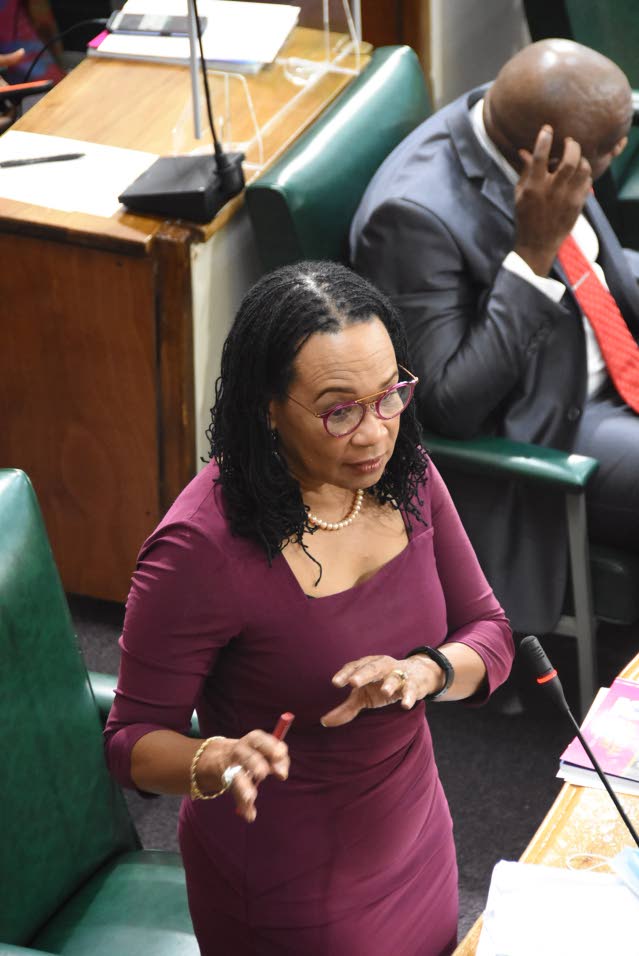
SCOTT-MOTTLEY… the amendments are necessary to address the reality faced by many Jamaicans


