



Caricom emerges as Jamaica’s bright spot for export growth
Regional demand offsets weakness in North America as overall trade deficit widens
JAMAICA’S latest trade figures present a familiar and uncomfortable picture. Imports are rising faster than exports, and the country’s visible trade deficit continues to widen. Yet within the data lies a clear bright spot. Exports to the Caribbean Community (Caricom) have surged, making the region Jamaica’s fastest-growing export market at a time when shipments elsewhere are stagnating or falling.
For the first nine months of 2025, Jamaica’s exports to Caricom climbed 33 per cent to US$142.3 million, even as total exports declined by 2 per cent overall. By contrast, exports to the United States–Mexico–Canada Agreement (USMCA) bloc fell by 3.8 per cent, while shipments to the European Union (EU) rose by a more modest 11 per cent.
In value terms, Jamaica now exports virtually the same amount to Caricom as it does to the EU, with exports to the EU totalling US$141.9 million over the same period — a notable shift in trading patterns.
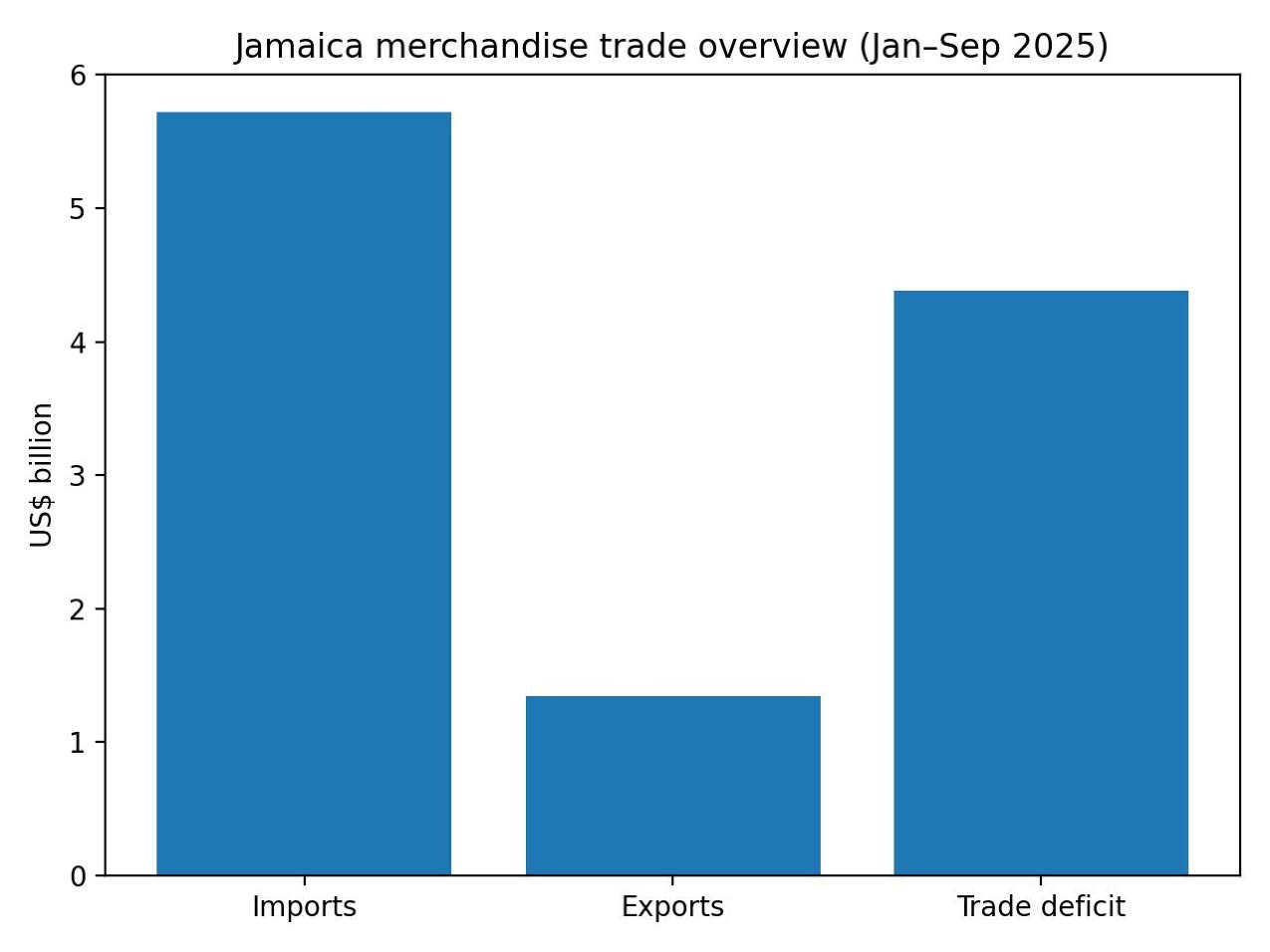
Between January and September 2025, Jamaica’s total imports rose by 3.6 per cent to US$5.72 billion, driven by higher spending on consumer goods, industrial supplies and construction materials. Exports, meanwhile, slipped to US$1.34 billion, leaving the visible trade deficit wider at US$4.38 billion.
This imbalance reflects long-standing structural challenges. Jamaica’s export base remains narrow and highly concentrated, dominated by a small group of products and industries. Mineral fuels and alumina account for a large share of export earnings, while manufacturing exports are heavily skewed toward refined petroleum products and a limited range of food and beverage items such as rum, sauces and baked goods. Agricultural exports — including yams and other root crops — remain comparatively small and volatile.
Against that backdrop, the performance of Caricom stands out.
Several factors explain Caricom’s resilience.
First is proximity. Shorter shipping distances reduce transport costs and delivery times, giving Jamaican exporters a competitive edge in supplying regional markets. This is particularly important for food, beverages and other goods where logistics costs can quickly erode margins.
Second is product familiarity. Jamaican brands enjoy strong recognition across the Caribbean, and many manufactured food products fit naturally into regional consumption patterns and distribution networks.
However, proximity and product fit only tell part of the story.
The bulk of the recent jump in exports to Caricom is being driven by mineral fuels. According to the trade data, Jamaica exported US$51 million worth of mineral fuels to Caricom during the period, accounting for more than one-third of total regional exports and representing the single largest contributor to the increase.
This reflects Jamaica’s expanding role as a regional supplier of refined petroleum products and energy-related goods — a role that has boosted export earnings but also concentrated growth in one category.
The divergence between Jamaica’s trading partners is becoming clearer.
Exports to the USMCA bloc declined as shipments of mineral fuels weakened, highlighting Jamaica’s exposure to changes in demand and pricing in its largest market. That exposure may increase amid uncertainty surrounding US trade policy, including the renewed prospect of higher tariffs.
Exports to the EU improved, but growth remained concentrated in crude materials and fuels rather than higher value-added goods.
By contrast, Caricom recorded the strongest export growth rate of any major trading bloc, even though the absolute value of trade remains smaller than with North America.
The Caricom story is encouraging, but it is not without risks.
Export growth is heavily concentrated in mineral fuels, leaving Jamaica exposed to energy price volatility, refinery disruptions and the longer-term global shift away from fossil fuels. A pullback in fuel exports would quickly soften regional gains.
At the same time, manufacturing outside of fuels remains fragile, and agricultural exports declined during the period. Without broader participation by non-energy exporters, Caricom’s role may remain supportive rather than transformative.
Despite these risks, the message from the data is clear. Regional trade is working.
At a time when Jamaica’s overall trade position remains under pressure, Caricom has emerged as a rare source of momentum. The challenge now is to convert fuel-led growth into a broader export strategy — one that deepens Jamaica’s presence in regional value chains and reduces dependence on a narrow set of commodities.
Caricom may not replace North America as Jamaica’s primary market, but it is becoming increasingly impossible to ignore as a pillar of export growth.
.


