



‘FIT FOR PURPOSE?’
WADA’s 2027 Code under scrutiny over Global South impact
AS the World Anti-Doping Agency (WADA) moves toward implementation of its revised World Anti-Doping Code on January 1, 2027, concerns are emerging in Jamaica that aspects of the new framework, despite reforms aimed at fairness and athlete welfare, could further marginalise athletes from the Global South.
The 2027 code, approved in December 2025 at the sixth World Conference on Doping in Sport in Busan, South Korea, introduces several athlete-focused changes. These include a more proportionate sanctioning framework, expanded treatment of contaminated sources, reduced penalties for substances of abuse, enhanced protections for minors, and stronger guarantees around the operational independence of national anti-doping organisations.
However, Toronto-based Trinidadian sports lawyer Dr Emir Crowne has questioned whether the code adequately accounts for the realities faced by athletes and support personnel from developing sporting nations.
“As a starting point, it’s interesting that WADA retained Michael Beloff, King’s Counsel, as counsel to write a legal opinion on the compatibility of the changes to the WADA code with general human rights principles,” Crowne told the Sunday Observer.
He says Beloff, widely regarded as the most authoritative figure in sports law, identified areas where the code may deviate from established human rights norms.
One of those issues relates to access to the Court of Arbitration for Sport (CAS). While the revised code seeks to address disparities by expanding appeal rights beyond international-level athletes, Crowne says the broader trend continues to entrench CAS as the final authority in sport without sufficient regard for economic and geographic inequality.
“But alongside that though is the general sort of trend to entrench the CAS as, in fact, the supreme court for sport,” he said.
He warned that this development fails to consider, “how that may impact athletes from Jamaica, the Caribbean — the so-called Global South”.
Crowne says while CAS rules may allow for appeals without arbitration costs, athletes are still required to pay a filing fee of 1,000 Swiss francs and retain specialised legal representation.
“The CAS will say, ‘We have legal aid for athletes,’ but legal aid really isn’t available for so-called middle-income earners,” he said, mentioning as well that assistance is typically limited to those whose appeals threaten their basic ability to survive. As a result, he said, access to justice remains uneven.
He also mentioned the procedural complexity of CAS proceedings, saying that although CAS has its own rules, it ultimately defaults to Swiss law in many areas.
“So, unless you’re trained in and have some knowledge of Swiss law, common law-trained lawyers may not be entirely familiar with the body of law that would govern CAS proceedings,” Crowne said, mentioning an additional layer of disadvantage for athletes and legal practitioners from regions like the Caribbean.
In his view, these realities raise a fundamental question about the suitability of CAS as a truly global dispute resolution body.
“Some thought still needs to be given as to whether the CAS is in fact fit for purpose,” he said, suggesting that alternative models — including regionally adapted arbitration structures for low-income or developing countries — should at least be explored.
Crowne is also concerned about the code’s 10-year statute of limitations for pursuing anti-doping violations, which he said sits uneasily with domestic laws in many countries.
In Jamaica, he says, limitation periods for negligence or breach of statute are typically six years, raising questions about how conflicts between domestic legislation and the WADA code would be resolved.
“What happens there? Is there a conflict of law situation? Does the WADA code take supremacy over Jamaica’s Parliament?” Crowne asked, questioning whether it is acceptable for an international body to impose time limits that exceed those set by democratically enacted national laws.
“To me, it’s an unresolved issue,” he said. “Perhaps there is an easy answer, but I’m not entirely sure there is.”
Despite these concerns, Jamaica’s anti-doping authorities have emphasised continuity and compliance. Jamaica Anti-Doping Commission (JADCO) Executive Director June Spence Jarrett says the new code will not alter the agency’s operational approach.
“It doesn’t change how JADCO operates in the future,” Spence Jarrett told the Sunday Observer, explaining that whenever WADA updates its rules, JADCO is required to develop corresponding national regulations. She confirmed that work is already under way to ensure JADCO’s updated rules take effect on January 1, 2027.
At the policy level, Sport Minister Olivia Grange said the Government will move to amend local legislation to reflect the new international standards.
“In light of the new WADA code, which will become effective in January 2027, my ministry will work alongside JADCO and the relevant organs of Government to effect the amendment of the anti-doping in sport legislation 2024,” Grange said during JADCO’s annual symposium recently.
Crowne’s concerns reflect a broader debate about equity in global sport governance. While the revised code seeks to modernise anti-doping enforcement, he warns that without greater sensitivity to economic and legal disparities, the system risks reinforcing the very inequalities it aims to eliminate — particularly for athletes from the Global South striving to compete on an even playing field.
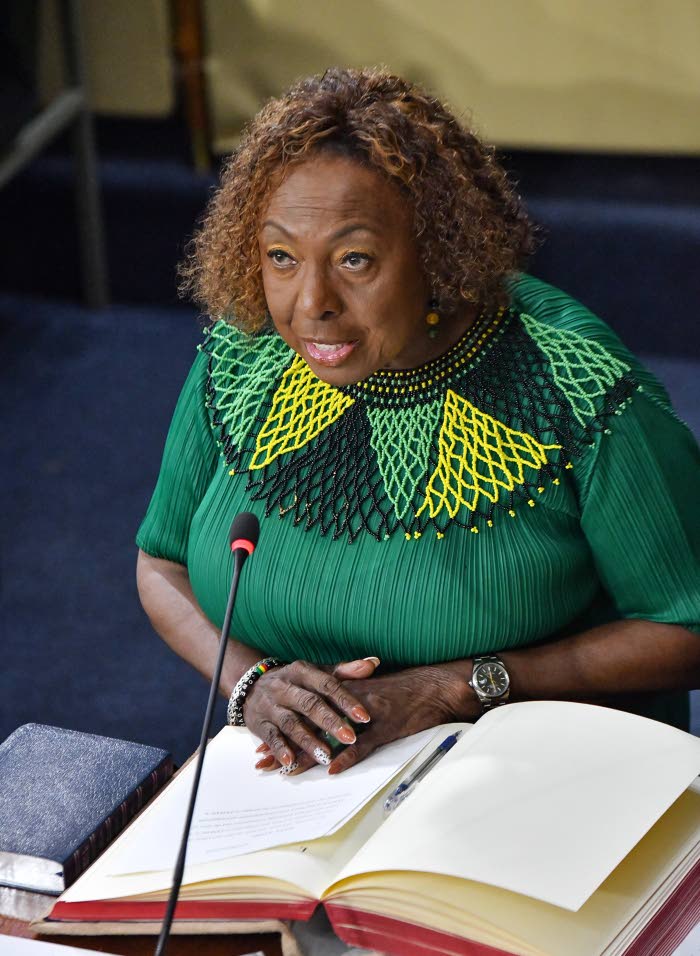
Sport Minister Olivia Grange (Photo: Naphtali Junior)

CROWNE…some thought still needs to be given as to whether the CAS is in fact fit for purpose.


