



‘Take responsibility’
Bunting tells House clerk to own $29-m credit card blunder
Member of Parliament for Manchester Southern Peter Bunting has urged the clerk to the Houses of Parliament to accept responsibility for internal errors after a $28.96-million credit card transfer escaped detection for four months, exposing what he described as a serious breakdown in basic financial oversight.
Bunting’s call came during Tuesday’s sitting of Parliament’s Public Accounts Committee (PAC) during which he rejected suggestions that the bank was solely to blame and argued that the problem began with the wording of Parliament’s own instruction. He told the committee that the failure to detect the massive debit for months pointed to weak reconciliations and inadequate supervision within the institution.
The committee was examining findings from a special audit by the Auditor General’s Department into governance at the Houses of Parliament. While the audit found no evidence that the Government-funded credit card was used for personal purchases, it highlighted poor monitoring, late reporting, and the extraordinary transfer error that left millions moving in and out of accounts without being quickly identified.
The auditor general’s report explained that the $28.96 million was withdrawn from the recurrent account after Parliament requested a much smaller payment linked to the credit card account. The overpayment remained unnoticed for several months before being reversed, raising fresh questions about whether regular checks of bank and credit card accounts were taking place.
Committee Chairman Julian Robinson pressed the clerk, Colleen Lowe, on how such a large discrepancy could pass through Parliament’s accounts without being flagged. He noted that the error went undetected for four months and asked whether reconciliations were being done consistently before the appointment of a new principal finance officer.
Lowe conceded that the systems in place at the time were inadequate.
“Based on instructions received, it is our understanding that the reports were not being maintained in a consistent manner and proper oversight perhaps was not adopted in the circumstances which would have led to this processing error,” she told the committee.
She sought to explain that the credit card itself had a modest ceiling, suggesting the transfer far exceeded anything that should have been possible.
“The credit card in question, it has a limit of US$5,000 only. So the error would have occurred between the financial institution because if we only have a limit of $5,000, on what basis would you seek to withdraw or to make a claim for $28.96 million?” Lowe said.
But Robinson questioned the clarity of Parliament’s own instructions to the bank, reading from the letter that triggered the transaction. He suggested the wording could easily have led to confusion and asked why, even after the money left the account, the mistake was not caught through routine checks.
Bunting was more direct, telling the clerk that the institution needed to own its role in the fiasco.
“Mr Chairman, looking at this letter, the bank made no error. The error was made in how the instruction was written, because having spent many years working in a bank, this is clear: requesting the recurring expenditure account be debited with a Jamaican equivalent of $181,026.73 and credited to the US dollar account. So clearly, if it’s a Jamaican equivalent of an amount to be credited to a US account, it is perfectly acceptable that the bank would have interpreted it that way,” he said.
“So the error was in the instruction, and the instruction was signed by Colleen Lowe, clerk to the Houses. Maybe a mistake was also made in the wording by the principal finance officer, but we must take responsibility for our own errors, and clearly, you were the co-signer on this instruction, Ms Lowe,” he told the clerk.
He argued that even if the bank had misinterpreted the request, the lapse was compounded by months of inaction.
“I really don’t think it’s fair to the bank to be trying to say the bank made an error. An error was made in the instruction that was given to the bank, and then this was further compounded by reconciliations not being done on a regular basis. It really shouldn’t go more than a month, but it should perhaps be even more frequent, given the… sums that are being transferred… anybody can make a mistake, but let’s take responsibility for our mistakes and then put measures in place so that they don’t recur,” he declared.
However, Lowe maintained that the bank had a duty to verify an unusually large transaction before executing it.
“Notwithstanding the specific reimbursement amount that is in the cover letter, the bank also failed to make contact with a representative from the Houses of Parliament to confirm the sum that was to be credited, and this is a standard practice from the bank, and there are e-mails we’re trying to find where the bank would have stated that they did try to reach out to the then PFO (principal finance officer) to confirm the amount that should have been transferred, but they were unable to make contact with her….[But] every transaction, even if we are requesting per diem from the bank, they usually call and confirm the amount and who is to collect it,” she said.
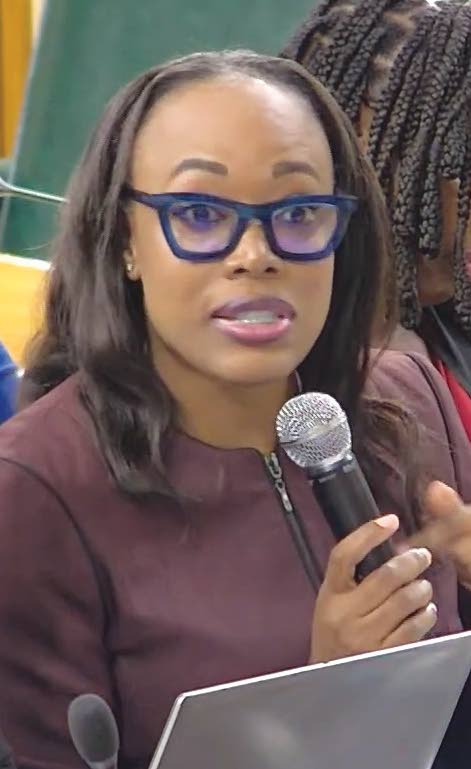
In this video grab, House Clerk Colleen Lowe answers questions from members of the Public Accounts Committee in Parliament on Tuesday.


