



Opposition cries ‘back-door politics’ as FID Bill passes Senate
The Government has used its majority in the Senate to secure passage of a Bill to amend the Financial Investigations Division (FID) Act, aimed at reducing direct ministerial control over the agency, despite Opposition warnings that a clause requiring information sharing to align with “government policy” could still expose the FID to indirect political influence.
The same concerns, first raised when the Bill was debated in the Lower House, resurfaced in the Senate but were not enough to halt passage of the legislation.
The Bill is set to remove the long-standing requirement for the FID to obtain ministerial approval before entering into information-sharing agreements with local and foreign agencies.
It eliminates direct ministerial sign-off and introduces safeguards requiring any memorandum of understanding to be consistent with Jamaica’s constitution and established policy frameworks.
However, Opposition senators remained unconvinced, arguing that inserting “government policy” alongside the constitution creates uncertainty and could allow future Administrations to shape the flow of sensitive intelligence.
Opposition Senator Lambert Brown was among the strongest critics of the wording, arguing that policy decisions made by the Cabinet should never be placed on the same level as constitutional safeguards.
“The Integrity Commission, for example, is a public body and there is a memorandum to allow for the sharing of information between the said Integrity Commission and the FID. We’ve seen in recent times members of the Cabinet have been challenging submissions and reports from the Integrity Commission and now I’m seeing [in] this Bill something about Government policies. Now who is responsible for formulating policies? Chief policy formulators under the constitution are the Cabinet. Now members of the Cabinet are challenging the Integrity Commission,” he said in a bid to expound on his point of possible government interference despite the change.
GOLDING CAMPBELL… this Bill is about the sharing of information, not just in relation to local entities, but also in relation to international entities
He insisted that intelligence-sharing should be guided strictly by the constitution and laws passed by Parliament, noting that removing the minister’s approval while inserting a policy requirement amounted to little more than cosmetic change.
“The removal of the minister’s approval is not something that is unique to us, it seems to be part of the international relationship to take the politics out of law enforcement. And so the minister is removed, but somehow we’re replacing the minister who is a major, main proponent of policies in that ministry. We now remove the minister’s approval, but we’re now inserting something to the back door called government policies,” Brown argued.
Leader of Opposition Business in the Senate Donna Scott Mottley questioned why policy was placed on equal footing with constitutional safeguards, pointing to past cases in which laws based on policy were struck down.
“There have been many pieces of legislation brought by the Government, formulated on Government policy, which have been found to be unconstitutional. I just want to remind us that when one is planning…one has to anticipate that there is no Government, certainly I hope not in Jamaica, which will stay in power forever,” she warned.
Government Senator Sherene Golding Campbell led the initial defence, dismissing the Opposition’s portrayal of the policy clause as dangerous or vague. She argued that the term “government policy” has a clear meaning in Jamaica’s legislative tradition and cannot operate outside the constitution.
“Government policy is not an arbitrary term. It’s not a term that Senator Johnson Smith can give new definition to, anymore than it is a term that anybody who sits in the Cabinet can give new definition to. There is a process by which the Government determines its policy and publishes that policy to the nation,” Golding Campbell told the Senate
She said the clause was necessary because international cooperation, which is a core function of the FID, is guided not only by law but also by national policy positions approved by elected governments.
“This Bill is about the sharing of information, not just in relation to local entities, but also in relation to international entities, and how we share with international entities is not a feature of our constitution, it is a feature of government policy, and Government must have the ability to determine who we’re going to be talking to abroad,” she argued.
She insisted that the reform strengthens, rather than weakens, the division’s autonomy by removing the need for direct ministerial approval.
Closing the debate, Leader of Government Business Kamina Johnson Smith also strongly rejected the Opposition’s interpretation, describing it as a misunderstanding of both the amendment and Jamaica’s international obligations.
“I wanted to just expressly reject that perspective and to say that it reflects a complete misreading of the language set out and the broader context of the Bill,” she told the chamber.
Johnson Smith said the reference to policy was critical to ensuring Jamaica remains aligned with evolving global standards set by the Financial Action Task Force (FATF) and the Egmont Group.
“Government policy is at the heart of the efforts to make Jamaica compliant with international best practice. Government policy allows for the agility to adopt international best practice where it has not yet been implemented here, but it is, and would be consistent with, the Constitution of Jamaica and the laws of Jamaica,” Johnson Smith, who is also the foreign affairs and foreign trade minister, explained.
She emphasised that the amendment removes ministerial constraints that could create a perception of interference while maintaining strong constitutional guardrails.
“What is being done here is to ensure that the widest and most effective guardrails of the Constitution of Jamaica and laws of Jamaica are being supplemented by policy in so far as they are required for the implementation of the purposes of the legislation, which is to allow for effective investigation of financial crimes and the hardening of our financial system against illicit activity,” Johnson Smith said.
The minister also dismissed suggestions that the term Government policy equates to party politics.
“There’s nothing partisan or tribal about having a policy. It is a part of the democratic process. It’s at the very heart of it, and the fact that it is referenced in conjunction with the Constitution, there is absolutely nothing to fear about that,” she added.
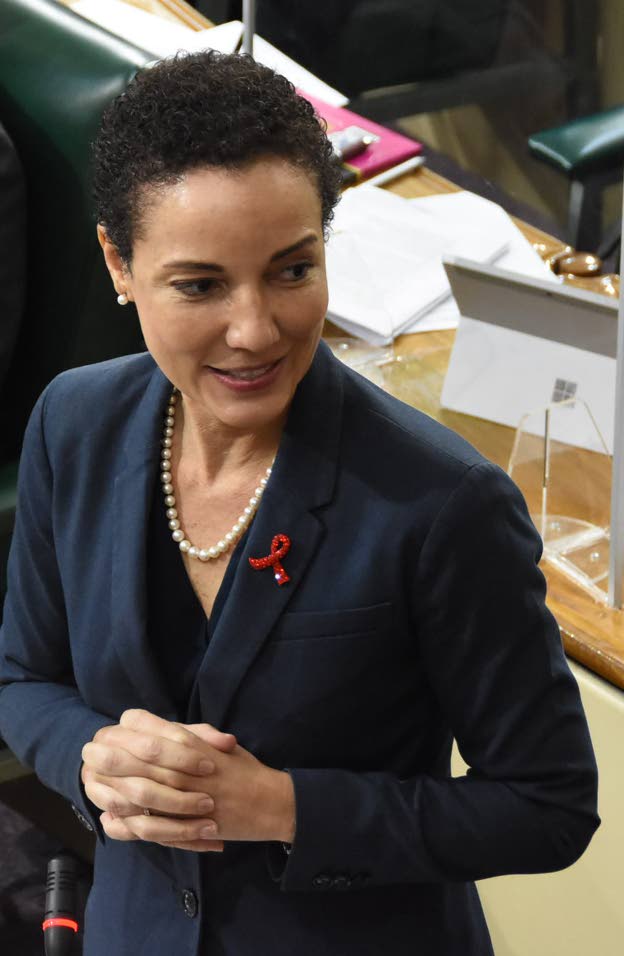
JOHNSON SMITH… rejected the Opposition’s interpretation of the Bill, describing it as a misunderstanding of both the amendment and Jamaica’s international obligations


