



Driving the future
UWI revs up EV assembly prototype with help from JPS, German Gov’t
As electromobility accelerates its positioning as a future standard for Jamaican motorists, JPS Foundation Chairman Damian Obiglio is heartened that related courses of study are being taught at one of the island’s leading universities.
Obiglio had rave reviews at a recent unveiling ceremony for an assembled, driving electric vehicle (EV) at The University of the West Indies (The UWI), Mona campus’ E-Mobility Lab.
The local automotive initiative manifested through a partnered programme funded by the foundation, the Inter-American Development Bank (IDB) Lab, the German embassy, and the tertiary institution’s Faculty of Science and Technology.
“We have this prototype car which we just saw being driven around that can be assembled many times, and the students at UWI will learn how to do it. It is part of the education that is needed to appreciate the importance of e-mobility,” he said as he looked on admiringly at the electric-powered, two-seater auto with an exoskeleton frame that sits on three wheels.
Speaking further, Obiglio noted that the expansion of electricity consumption on the island “will come with the most efficient use of energy, and Jamaica is poised to be very well placed to profit from the conversion from internal combustion to electric”.
For the JPS Foundation chairman, the way forward for a consumer shift in electric vehicles should begin now.
“I have driven several electric cars already and there is no significant difference with the internal combustion. The only difference is having infrastructure to charge them,” he added.
To this end, Obiglio said while JPS has been instrumental in the development of 39 charging stations — branded Charge ‘n Go — across the country, motorist usage has remained below expectations.
“Still, there are not too many customers for them,” he observed. “But I think eventually, a lot of people will realise that in driving back and forth to work, it makes more sense to have an electric car than an internal combustion one.”
JPS provided assisted funding to the university’s Faculty of Science and Technology through its e-Drive programme for which it partnered with the IDB Lab. The programme, which wrapped in 2024 after its five-year project duration, had three main focus areas: Innovative technology and finance, technical capacity building and training, and marker sensitisation.
“I am very happy to see the money that we invested — you can touch it basically. It was not lost in fees or consultants. These are things that are going to profit the university and they can use it in finding future engineers,” asserted Obiglio.
UWI’s E-Mobility Lab, where the EV prototype was developed, is headed by Dr Louis-Ray Harris, the senior lecturer in the physics department. He was the man in charge of the week-long EV assembly workshop that saw 11 participants drawn from Jamaica, Antigua, Belize, Grenada, St Kitts and Nevis, and St Lucia.
“Over a period of six days, we built the vehicle from the chassis only. The participants were required to put everything together,” detailed Dr Harris in a post-ceremony interview.
“From the mechanical perspective, the participants got the wheels on, installed the brakes and the steering, and bled the brakes. They also mounted the motor,” he added.
On the flip side, another team focused on the electrical aspects needed.
“That team did all the wiring for the battery, cells, the battery pack. Wiring was required to provide power to the dashboard, programming, and the battery management system,” he added.
The workshop sessions, according to the physics academic, were intensive but rewarding.
“There were days the participants left later than they planned. It was a dedicated set of persons and this is truly a Caribbean project. Some participants were from Jamaica and from UWI graduate programmes here, and six were from other islands. The energy was there in the workshops, the interest and humour were there, it was a good team spirit,” said Dr Harris.
In addition to the EV assembly workshop, the faculty has since 2023 offered two e-mobility courses, ‘Fundamentals of EV Technology’ and its follow-up, ‘Safety Dynamics and Economics of EV Technology’.
For Nicholson Webster, an EV workshop participant from St Kitts, his experience in the programme proved gratifying.
“The training has been very interesting because we built the car from scratch,” shared Webster, who is chief foreman mechanic at the Public Works Department for his island’s Ministry of Infrastructure. “We did everything from the mechanical side to the electrical side, and were able to get everything done in a reasonable time. It has been an eye-opening experience and I really look forward to going back home and implementing some of the things that I have learnt.”
EV training was entirely new to him as in his day-to-day responsibilities, the fleet of 200 vehicles he oversees are all non-electric.
Meanwhile German Ambassador to Jamaica Jan Hendrik van Thiel sung high praises for the assembled electric vehicle, which he said immediately won his approval on sight.
“I think every boy and man will fall in love with this car. I saw it and I wanted to have it,” the diplomat declared to fits of agreeable laughter from the gathering of members of UWI’s academia and management, JPS senior execs, and government officials attending the EV unveiling event.
The EV assembly workshop formed part of funding from the German Federal Ministry of Economic Affairs and Climate Action (BMWK) through their International Climate Initiative (IKI) and in cooperation with the Deutsche Gesellschaft fur Internationale Zusammenarbeit (GIZ) via the programme, supporting the implementation of NDCs in the Caribbean.
“This is public-private partnership at its best,” hailed Ambassador van Theil. “This is not just some agency coming giving some training curriculum. This is real cooperation between industries and universities and technology. This is fantastic and is the way to go with development of projects in general.”
He highlighted the German Government’s sustained interest in climate diplomacy and funded a range of programmes at home and abroad.
“Germany invests a lot of money every year in integration adaptation. Last year it was around 12 billion Euros, which is roughly US$14 billion. It is important for us,” he said.
UWI Principal and Vice Chancellor Denzil Williams recognised the long-term value of the university’s expanding suite of e-mobility programmes.
“One of the big challenges that we have in this 21st century is sustainable transportation. We think as a university we must have answers to that particular challenge,” he remarked. “We have partnered with GIZ, JPS and others to really think through and implement a solution that can help us to drive sustainable transportation. Today is a journey that is part of a bigger vision. That bigger vision is to make sure that we continue to modernise our plant, modernise our institution so that we can deliver greater value to our stakeholders.”
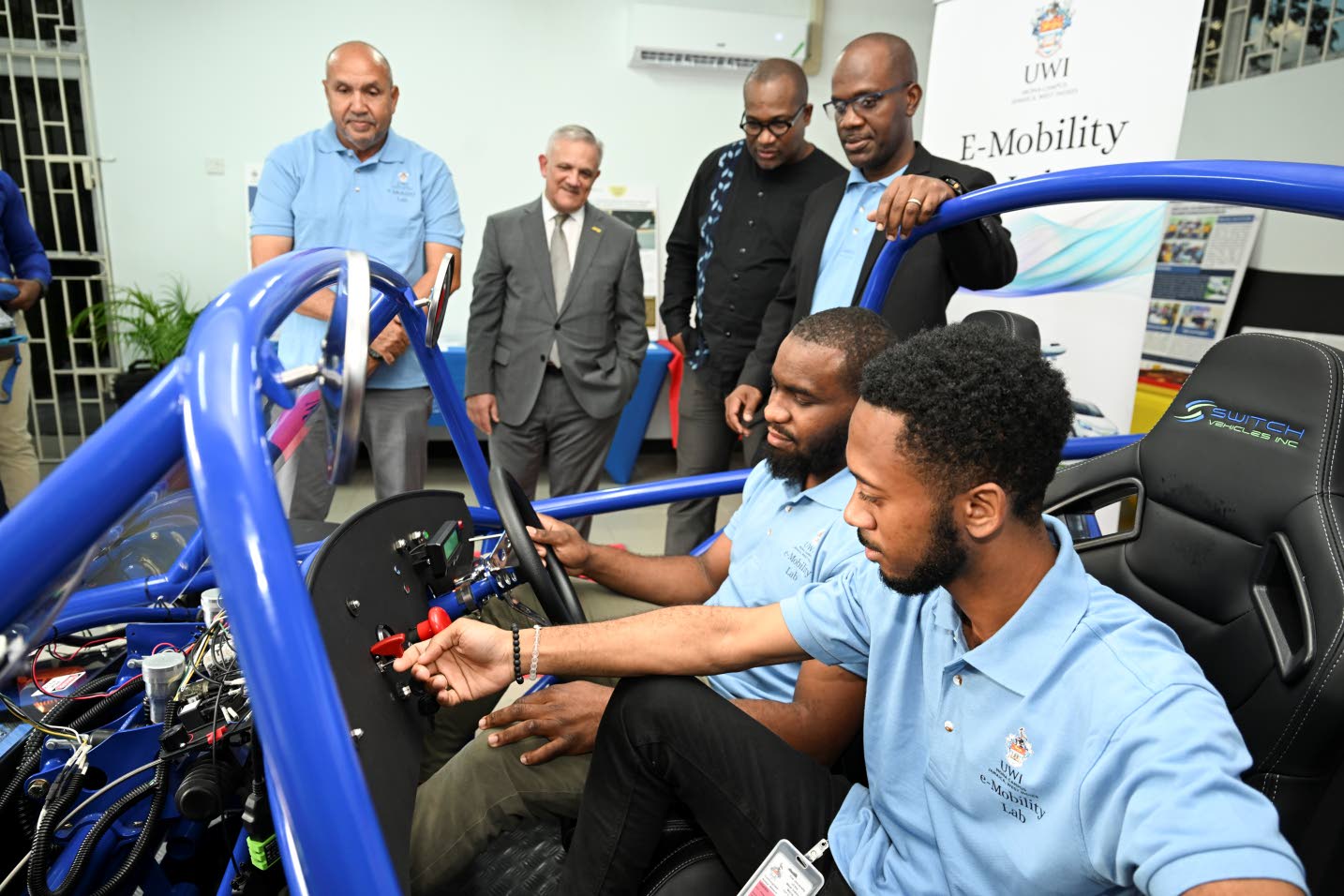
Seated in the electric vehicle (EV) they assembled from participating in a week-long EV training workshop, Jamaican Andre Cunningham (right) and St Lucian Nazib Williams (second right) show the auto’s operational functions to (from left) fellow workshop participant Belizean Eric Vernon, JPS Foundation Chairman Damian Obiglio, The University of the West Indies (The UWI) Principal and Vice Chancellor Denzil Williams, and Dr Louis-Ray Harris, senior lecturer in the physics department at The UWI.


