



Jamaica’s offshore oil question
What the evidence shows — and why it’s back on the agenda
More than 40 years after Jamaica’s last oil well was drilled, its offshore petroleum question is back under scrutiny as new seabed sampling seeks to confirm whether decades of geological evidence point to an active offshore system.
FOR decades, Jamaica’s offshore oil story has existed more as geological footnote than commercial narrative — a scattering of old wells, surface seeps and unanswered questions. Now, a new phase of exploration is attempting to turn that fragmented evidence into a clearer investment case, not by drilling, but by reducing uncertainty.
At the centre of that effort is United Oil & Gas, which holds a 100 per cent interest in the 22,400-square-kilometre Walton Morant offshore licence south of the island. The company has begun a new round of offshore survey activity and is preparing to acquire shallow seabed core samples to directly test for hydrocarbons — a relatively low-cost step that could materially alter how Jamaica’s offshore potential is assessed by investors and industry partners.
The geological evidence underpinning that work was outlined by United’s technical team during a recent in-house technical discussion released as offshore survey operations commenced in the Walton Morant area.
“We’re getting ready to acquire drop core samples from the seabed to directly test for oil,” said Donal Meehan, United’s head of business development. “But there is already a lot of evidence for oil offshore Jamaica.”
A long trail of clues — onshore
That evidence begins on land. According to United, 11 wells have been drilled in Jamaica to date — nine onshore and two offshore — the most recent in 1982. All recorded some form of hydrocarbon shows, a pattern that supports the existence of a working petroleum system rather than isolated anomalies.
More compelling still are surface oil seeps. In at least three locations across the island — east, west and central Jamaica — oil has been observed at surface and tested. Independent analysis has confirmed a thermogenic origin, meaning the hydrocarbons were generated at depth under heat and pressure.
“These are live oil seeps,” said Paul Ryan, United’s business technical manager. “They’ve been tested and found to be of thermogenic origin.”
An offshore seep has also been documented. During operations by former licence holder Tullow Oil, fishermen directed survey crews to an area known as Blower Rock, where an oil slick was visible at the sea surface. Samples taken from the slick were later analysed.
“The signature is suggestive of a thermogenic origin,” Ryan said, adding that it could not be confused with diesel or vessel-related contamination.
Old geology, new data
What distinguishes the current phase of work is the integration of historical evidence with modern data sets. Since 2014 an estimated US$40 million has been invested across the Walton Morant area by successive operators, including the acquisition of modern 2D and 3D seismic data, satellite seep analysis, and onshore fieldwork.
In 2020, United conducted a satellite seep study using up to two decades of imagery, identifying repeated surface slick anomalies appearing in the same offshore locations over time. These anomalies overlap with features visible in seismic data beneath the seabed — vertical “fluid escape” structures and shallow amplitude anomalies that suggest hydrocarbons may be migrating upward.
“Where those features are found are quite close to where the satellite anomalies are seen at the water surface,” Ryan said. “Taken together, they point back toward a specific source location.”
The company argues that this convergence — historical well data, verified seeps, satellite imagery and seismic interpretation — provides consistent evidence for an active petroleum system offshore, mirroring what is already proven onshore.
What the seabed samples are meant to settle
Still, evidence is not proof — and that distinction matters, particularly in a frontier basin.
The planned piston coring programme is designed to directly test seabed sediments for thermogenic hydrocarbons, effectively “ground-truthing” the circumstantial case. The survey is expected to collect 40 to 60 shallow cores, penetrating only soft sediments and leaving no lasting environmental footprint.
Independent geoscience consultancy Iapetus Geoscience has assessed the impact such results could have on exploration risk. In a September 2025 review the firm concluded that a successful coring campaign would directly de-risk two critical elements of the petroleum system: source rock presence and hydrocarbon migration.
As a result, the geological chance of success for United’s lead Calibri prospect could rise from about 19 per cent to roughly 32 per cent — a meaningful shift in exploration terms, though still far from a guarantee.
“That uplift doesn’t eliminate risk,” the report noted, “but it materially improves the probability profile for a frontier basin prospect.”
Other risk elements — including trap, reservoir and seal — are already supported to varying degrees by seismic data, according to the review, though uncertainty remains inherent.
Why this matters commercially
For United, the implications extend beyond a single prospect. The Walton Morant licence contains more than 20 identified prospects and leads, with unrisked mean prospective resources estimated by the company at around seven billion barrels across the basin — a figure that remains speculative but underscores the scale of the opportunity.
More immediately, positive seabed results could strengthen the company’s ongoing farm-out process, improving commercial terms and attracting a partner willing to fund drilling. United has indicated that its strategic priority is to de-risk the licence sufficiently to justify a drill-or-drop decision before the licence expires in 2028.
The company is also operating under financial constraints. It currently has no producing assets and remains reliant on equity raises and a successful farm-out to fund future activity, according to its latest annual report. That reality makes low-cost, high-information work programmes particularly important.
A measured bet, not a discovery claim
United is careful not to frame the current programme as a discovery moment. No drilling is planned at this stage, no reserves have been declared, and no commercial volumes have been proven.
Instead, the effort represents a calculated attempt to narrow uncertainty in a region that has long intrigued geologists but deterred investors.
For Jamaica, confirmation of an offshore petroleum system would elevate the strategic value of its offshore acreage, potentially reshaping long-term energy and investment considerations. For investors, it remains a frontier play — but one where risk is being addressed methodically rather than ignored.
As Meehan put it, the immediate goal is straightforward: “Extend the proof offshore.”
Whether that proof ultimately leads to drilling — and commercial success — remains a question for another day.
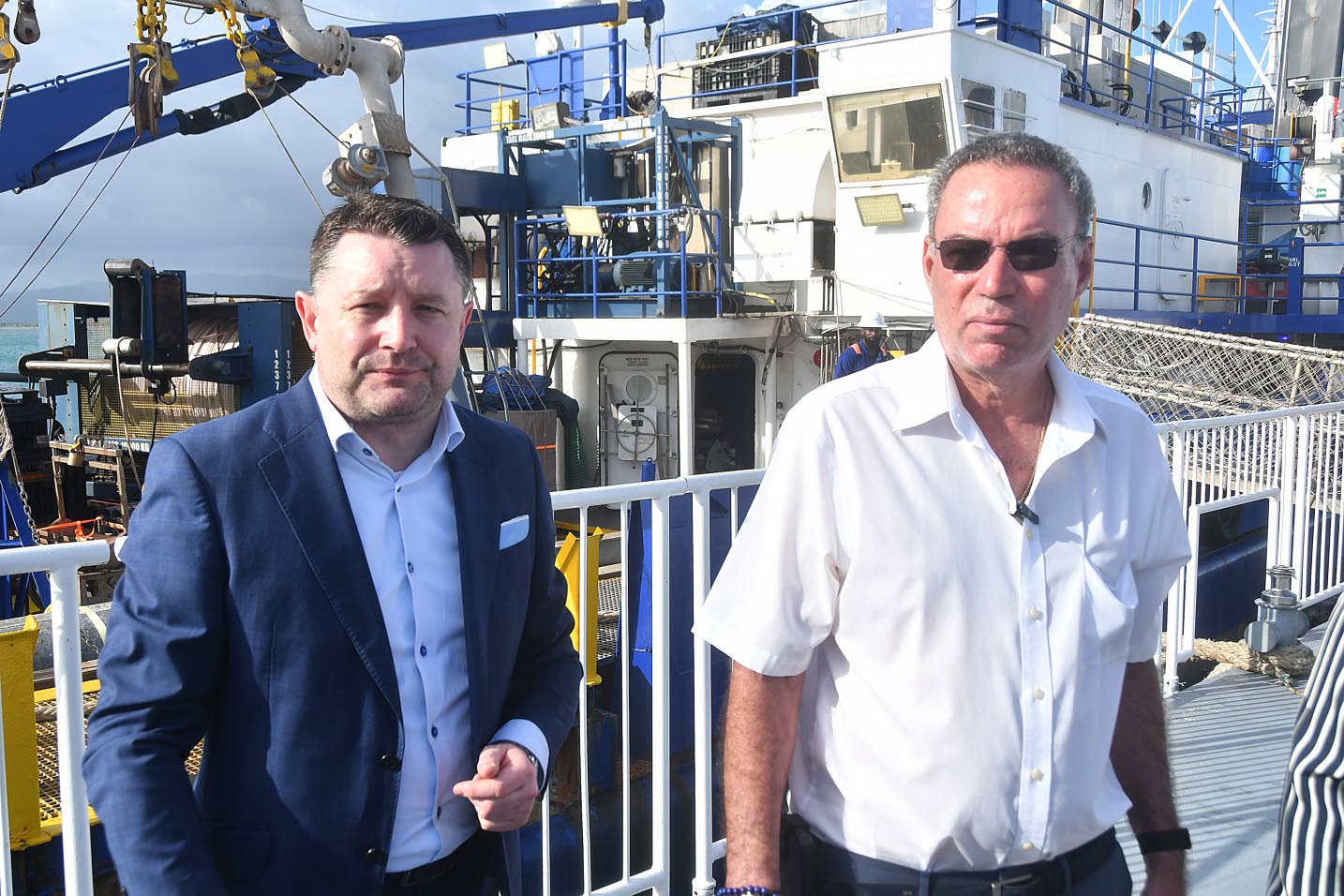
United Oil & Gas chief executive Brian Larkin (left) with Energy Minister Daryl Vaz at the launch of offshore piston-core sampling in the Walton Morant Basin. (Photo: Garfield Robinson)


