



NEW TAXES AHEAD
Hurricane damage forces new tax reality
FOR the first time in almost a decade, new taxes are likely to return to Jamaica’s budget — a step economist Dr Damien King says reflects fiscal realism after Hurricane Melissa, not a retreat from discipline.
Speaking in an interview with the Jamaica Observer ahead of Thursday’s tabling of the 2026/27 Estimates of Expenditure, King said the scale of damage caused by Hurricane Melissa — estimated at about US$8 billion — makes it unrealistic to expect balanced budgets or a continuation of the long-standing “no new taxes” pledge, even as Jamaica’s overall fiscal credibility remains intact. The Government has financed the last eight budgets, from 2018/19 to 2025/26, without implementing new taxes.
King said the destruction caused by the hurricane on October 28, has fundamentally altered the fiscal landscape, forcing the Government to confront rebuilding costs that cannot be absorbed within existing revenue streams or normal capital-spending timelines.
“This is a hurricane budget,” King told Business Observer, noting that the extent of the damage would affect public finances for several years. He argued that even if the Government had the capacity to rebuild all damaged infrastructure within a year, it would not be fiscally prudent — or affordable — to attempt to do so.
In its January Economic and Fiscal Assessment Report, the Independent Fiscal Commission said Hurricane Melissa caused an estimated US$8.8 billion in damage — about 41 per cent of GDP — with a cumulative fiscal impact of 5.3 per cent of GDP over FY2025/26 to FY2029/30, triggering the temporary suspension of Jamaica’s fiscal rules under the law.
As a result, King said Jamaicans should expect a combination of additional borrowing, a temporary pause in the reduction of the debt-to-GDP trajectory, and new tax measures aimed at financing reconstruction and recovery.
“Balanced budgets and no new taxes cannot survive a natural disaster of the scale of Melissa,” he said.
The economist said the final accounts for the current fiscal year are unlikely to be balanced because of hurricane-related spending already incurred, while the upcoming budget will face similar pressures.
Beyond the direct cost of repairs, King said the Government is also contending with weakened revenue flows, particularly from the western half of the island, where production disruptions have been most severe. Tourism, agriculture, retail and distribution, he noted, have all been affected, reducing the State’s revenue-earning capacity at the same time that expenditure demands have surged.
“You don’t have to be partisan to see this,” he said. “The Government is not a magician. They are going to have to raise additional taxes to pay for it,” he added, arguing that anyone who thinks otherwise is “living in fantasy land.”
The pressure is already visible in the current fiscal year. The Government has brought four supplementary estimates to Parliament since April, lifting total expenditure from about $1.26 trillion in the original budget to roughly $1.39 trillion by the fourth supplementary, as hurricane-related demands, recovery spending and revenue disruptions accumulated — underscoring King’s view that the existing fiscal framework could not absorb the shock without adjustment.
The Independent Fiscal Commission has warned that Hurricane Melissa has sharply weakened the revenue base, with tax collections projected to fall by about $80 billion below original estimates this fiscal year even as reconstruction spending accelerates — leaving limited scope to fund the recovery without new revenue measures.
While King acknowledged that he had not modelled the size of any potential tax measures, he said the scale would depend heavily on whether the authorities seek to compress the rebuild into a shorter timeframe or spread it over a longer period.
Despite the prospect of new taxes and higher borrowing, King stressed that Jamaica’s long-term fiscal credibility remains intact — a position he said reflects more than a decade of disciplined fiscal reform.
He pointed to what he described as “world-class improvements” in fiscal management since 2012, arguing that those reforms are precisely what allow Jamaica to absorb a shock of this magnitude without unsettling lenders or international capital markets. That assessment, he noted, has been reinforced by post-hurricane reviews from international rating agencies, which have maintained confidence in Jamaica’s fiscal framework despite the scale of the damage.
“None of Jamaica’s lenders or participants in the capital markets are concerned about the sustainability and viability of the country’s fiscal management, because even at the scale of the damage, it is clear we can handle it,” King said.
While the country may be forced to postpone reaching its 60 per cent debt-to-GDP target by several years, King said there is little doubt that the benchmark will still be achieved, underpinned by continued confidence in Jamaica’s fiscal management. He contrasted that resilience with the nation’s precarious position just over a decade ago.
“Remember where we were 12 years ago,” King said. “Jamaica was the third most indebted country in the world.”
The challenge now, King said, is for policymakers and the public alike to hold two realities at once: the unavoidable need for additional borrowing and taxation in the short term, and the longer-term success of a fiscal reform programme that has left the country better equipped to withstand shocks than at any point in recent history.
KING…you don’t have to be partisan to see this. The Government is not a magician. They are going to have to raise additional taxes to pay for it.
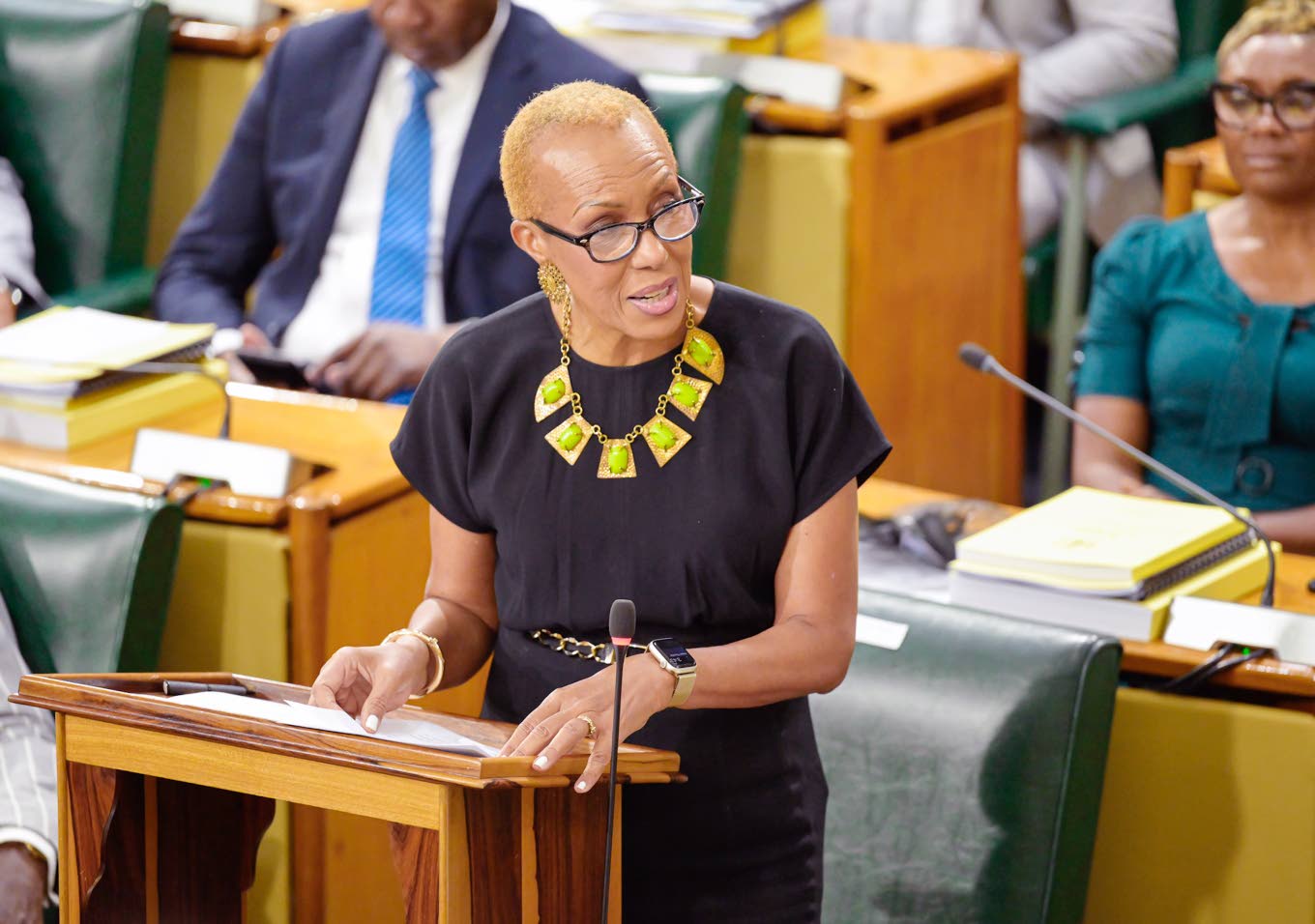
Fayval Williams, minister of finance and the public service, is expected to table the 2026/27 Estimates of Expenditure in Parliament on Thursday amid heightened focus on post-hurricane reconstruction.(Photo: Observer File).


