



Urgent Relief, Lasting Impact
How Project HOPE is helping Jamaica rebuild after Hurricane Melissa
AS Jamaica continues its recovery following the devastation of Hurricane Melissa, Project HOPE’s work across the island has become a clear example of its global motto in action: “Urgent relief, lasting impact”. From immediate emergency response to longer-term health system strengthening, the organisation’s intervention has focused not only on meeting urgent needs, but also on ensuring communities and institutions are better prepared for what comes next.
Currently, Project HOPE engages 30 active Jamaican consultants across a range of roles, reinforcing its commitment to local capacity-building. The organisation promotes fairness, respect and staff well-being through clear, contract-based expectations and a supportive working environment that allows consultants to deliver high-quality services while meeting national recovery goals.
According to Dr Tamakloe Azamesu KN Didinu, country director for Project HOPE Jamaica, the organisation operates through an integrated, three-pillar approach: primary health care; water, sanitation and hygiene (WASH); and mental health and psychosocial support.
“Project HOPE is a global health international organisation, particularly responding to emergencies,” Dr Tamakloe Azamesu explained. “We support health facilities through consultation, mobile medical unit activities, and the provision of medicines and medical supplies. We also support water trucking, hygiene kit distribution, hygiene promotion, infection prevention and control, and mental health and psychosocial support for affected populations.”
Following Hurricane Melissa, which pummelled Jamaica on October 28, 2025, Project HOPE launched a five-month emergency response project beginning in November 2025 and running until May 5, 2026, with funding led by the United States Department of State. The core budget for the operation stands at US$2 million, with additional funding from private donors bringing the overall response value to approximately US$3 million.
The organisation moved quickly, drawing on an established partnership with the Spanish emergency medical non-governmental organisation SAMU, which had previously collaborated with Project HOPE for responses such as in Ukraine. “As soon as the hurricane started we engaged discussions with SAMU,” Dr Tamakloe Azamesu said, noting that the emergency medical team was mobilised within days.
Project HOPE’s long-standing partnership with SAMU was critical to the emergency medical response in Hanover, where an international emergency medical team operated a field hospital at the Noel Holmes Hospital in the immediate aftermath of Hurricane Melissa.
In terms of scale, Project HOPE’s post-Melissa response is designed to reach more than 45,000 beneficiaries through primary health care, 15,000 through mental health and psychosocial support, and 11,000 through WASH interventions. As of January, approximately 25 per cent of beneficiaries had already been reached, aligning with the project’s implementation timeline. “For the next four months we’ll intensify the response and we’re confident we’ll reach all the beneficiary targets of this project,” Dr Tamakloe Azamesu said.
“So far, we already reached 25 per cent of the beneficiaries so we think that for the next four months we’ll intensify the response and we’re confident we’ll reach all the beneficiary targets by this project,“ he added.
The impact has been visible across Hanover, St James, St Elizabeth, Westmoreland and Trelawny, where Project HOPE’s mobile medical units and facility-based support have helped restore access to care in communities heavily affected by flooding, infrastructure damage and service disruptions. Dr Tamakloe Azamesu said he was struck by how quickly rehabilitation work had already begun in Jamaica. “In some countries, even after six months there is no rehabilitation,” he said. “But here, it is something that really impressed me that the Government started already rehabilitating or constructing some health facilities that were damaged, particularly this hospital. If you visit the maternity ward, the work actually is ongoing.”
A significant component of the response has been mental health and psychosocial support, addressing what many residents describe as the invisible but lasting effects of the hurricane. Tishauna Mullings, mental health and psychosocial support coordinator for Project HOPE, said emotional distress remains widespread, even months after the storm.
“What people can see is the physical damage but what a lot of people are feeling is psychological damage,” Mullings said. “People are still triggered by rain, by reminders of the hurricane, and many feel stuck in a state of constant victimhood as recovery feels slow.”
Through integrated mobile medical units Project HOPE delivers psychoeducation, coping skills training, psychosocial play, and referrals for clinical care, working closely with psychologists from the Ministry of Health and Wellness. Mullings noted that more than 5,000 individuals have already received direct mental health support, with a target of 15,000 beneficiaries across schools, churches and communities.
“We’re not just helping people in the aftershock,” she said. “We’re also helping them prepare for future shock. If people are not psychologically ready they can’t take advantage of opportunities to rebuild their lives.”
Mullings also highlighted Project HOPE’s focus on supporting front line workers who are themselves affected by the disaster and who they realised were, “coping by just working, working, doing, doing, helping, helping, without stopping to take note of what has happened to them. We remind them daily that self-care is important,” she said. “We teach emotional regulation, checking in with self, checking out at the end of the day, learning to carry the needs of the people in your heart and not on your back like a weight.”
On the clinical side, Dr Sabrina Ferguson, interim health coordinator for Project HOPE, described the response as both urgent and carefully coordinated. “It was an eye-opener to see what health care needed to be offered after Hurricane Melissa,” she said. “Through Project HOPE we were able to provide pharmaceutical aid, doctors, nurses and pharmacists to communities in need.”
Project HOPE currently operates multiple mobile medical units daily, covering affected parishes and delivering primary care, medications, WASH services, and mental health support free of charge. Each unit includes doctors, nurses, pharmacy staff, and monitoring and evaluation teams to ensure accountability and data-driven decision-making. Project HOPE has also been providing surge staffing support at the Montego Bay Type Five health facility, deploying additional doctors and/or nurses to help manage increased post-hurricane patient demand. A contracted consultant highlighted that, “We [Project HOPE] have capacity and want to support more health centres in this way.”
Beyond immediate relief, Project HOPE is already planning for long-term recovery, including a multi-sectoral assessment scheduled for February. The findings will be shared with donors and the Ministry of Health and Wellness to guide next steps. “We want to align with the Government’s priorities,” Dr Tamakloe Azamesu said. As Project HOPE transitions from emergency response to longer-term recovery, its leaders stress that their work in Jamaica is far from finished.
“We are not here just to end a project, but to support what is needed next.
“Project HOPE likes to be the first to come and the last to stay,” Mullings said, describing the organisation’s approach to emergency response and recovery. “So when everybody pack up and gone, we want to remain. So even though we are with our partners — SAMU, who is packing up — the mobile medical units will still be reaching out to the people, which means that mental health and psychosocial support will be coming to you at your school, your community, wherever you are. If you need the services, just call us. We’re ready.”
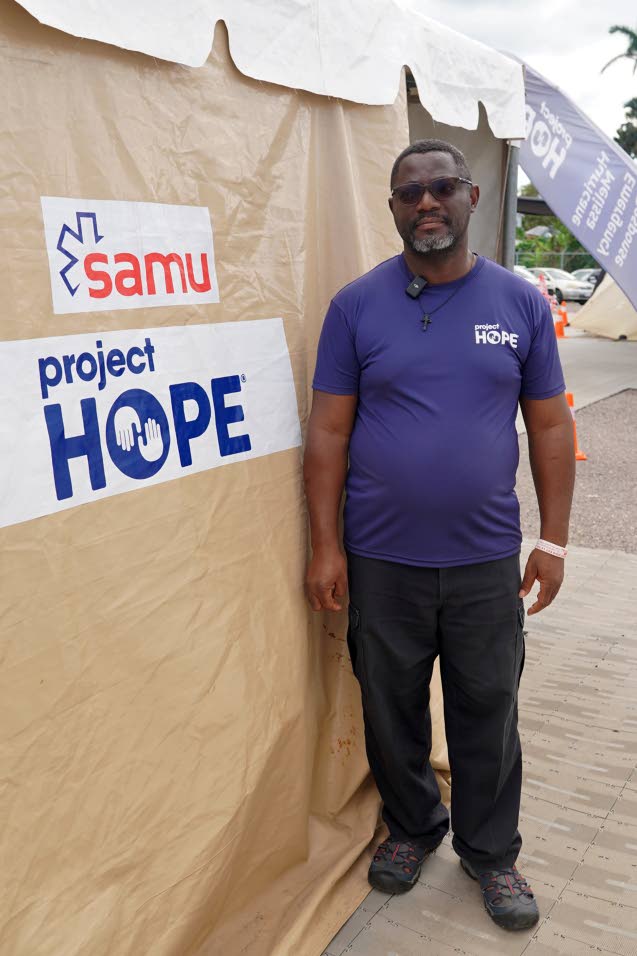
Dr Tamakloe Azamesu KN Didinu, country director, Jamaica, Project HOPE (Photo: Gavin Jones)


