



3D innovation at UTech
US$1.1-million investment to benefit students, industry stakeholders
JAMAICANS are set to benefit from a major technological advancement, the only one of its kind in the Caribbean, with Prime Minister Dr Andrew Holness welcoming the island’s first metal 3D printer, a US$1.1-million investment.
The University of Technology, Jamaica (UTech) Lloyd Carney Foundation IMEK Laboratory was officially launched Tuesday, made possible through the generous donation of the Lloyd Carney Foundation.
With metal and plastic 3D printers and cutting-edge equipment, students are now learning how to manoeuvre high technology and turn ideas into reality.
The printer enables the production of high-performance engineering components for critical sectors such as aerospace, including jet engine parts, automotive manufacturing, brake callipers and pistons, medicine and dentistry, implants and precision devices.
The investment is set to benefit students across the university and industry stakeholders.
“The IMEK lab is intentionally inclusive. Alongside this advanced system, the facility will house a wide range of general purpose 3D printers and digital fabrication tools that will be accessible to students across the university, not only engineering and computing students, but students from any discipline,” explained UTech President Dr Kevin Brown.
“And they will be trained to use the equipment, empowering hands-on experiential learning. Important to the lab is also that it’s designed to serve industry. Beyond teaching and applying research, the IMEK lab is positioned to provide prototyping and manufacturing services through industry collaboration.”
In explaining the capabilities of the unit, Brown shared that the name of the initiative, IMEK, is both a colloquial play on ‘I make’ in patois and an acronym for innovation, manufacturing, engineering, and knowledge.
“The centrepiece of the lab is a metal 3D printer, yes, metal, which can produce components from materials such as titanium, stainless steel, and others. Unlike traditional manufacturing methods, additive manufacturing builds parts layer by layer,” he said.
“What this does is it enables the manufacturing of complex structures that are lighter, stronger, and more heat resistant. So these components can be used in aerospace, advanced manufacturing, medical devices, and energy systems. This technology also reduces production timelines…it reduces material waste, it lowers costs, it accelerates design iterations, and, in practical terms, it enables faster innovation and better performing components.”
UTech chancellor Ambassador Lloyd Carney shared that this type of initiative is one that he has been involved with before, but it remains most fulfilling at home.
“I did this in Boston at different universities. But this is home, so it means much more to me to be able to give back to my children, to our children. So this is an opportunity for us to show how the private sector can work with government institutions. We hope this is a road map for others to follow,” he said.
Meanwhile, Holness reasoned that with technology evolving, Jamaica is capable of participating in high-value, high-technology endeavours.
“The Government has to focus on growth policy in parallel with maintaining good fiscal policy. It brings together the entrepreneur, capital, regulators into a market. It supports innovation and research. It brings education and industry together, reinforced in a common direction,” he said.
“The example of Luxembourg is a good example of a very small country, but they produce very high-value manufacturing output. We can do it right here. We have the right people here, too. We have the people who understand the science and the mathematics and the design. We must cultivate them and support them and dedicate resources to them.”
For his part, Hugh Cargill, programme director at UTech, explained that the lab will support applied research and will be open to collaboration with the extended industry, enabling rapid prototyping and the production of small-volume, high-value components in Jamaica.
“The IMEK Lab is not only for research and industry. It is also a university makerspace, open to students across all disciplines. Here, students can explore, design, test, and build using a wide range of modern tools, including plastic and resin 3D printers, laser cutters, 3D scanners, and much more. This is how we build innovators. This is how we strengthen Jamaica’s manufacturing capability. And this is how we prepare our students for the future of work.”
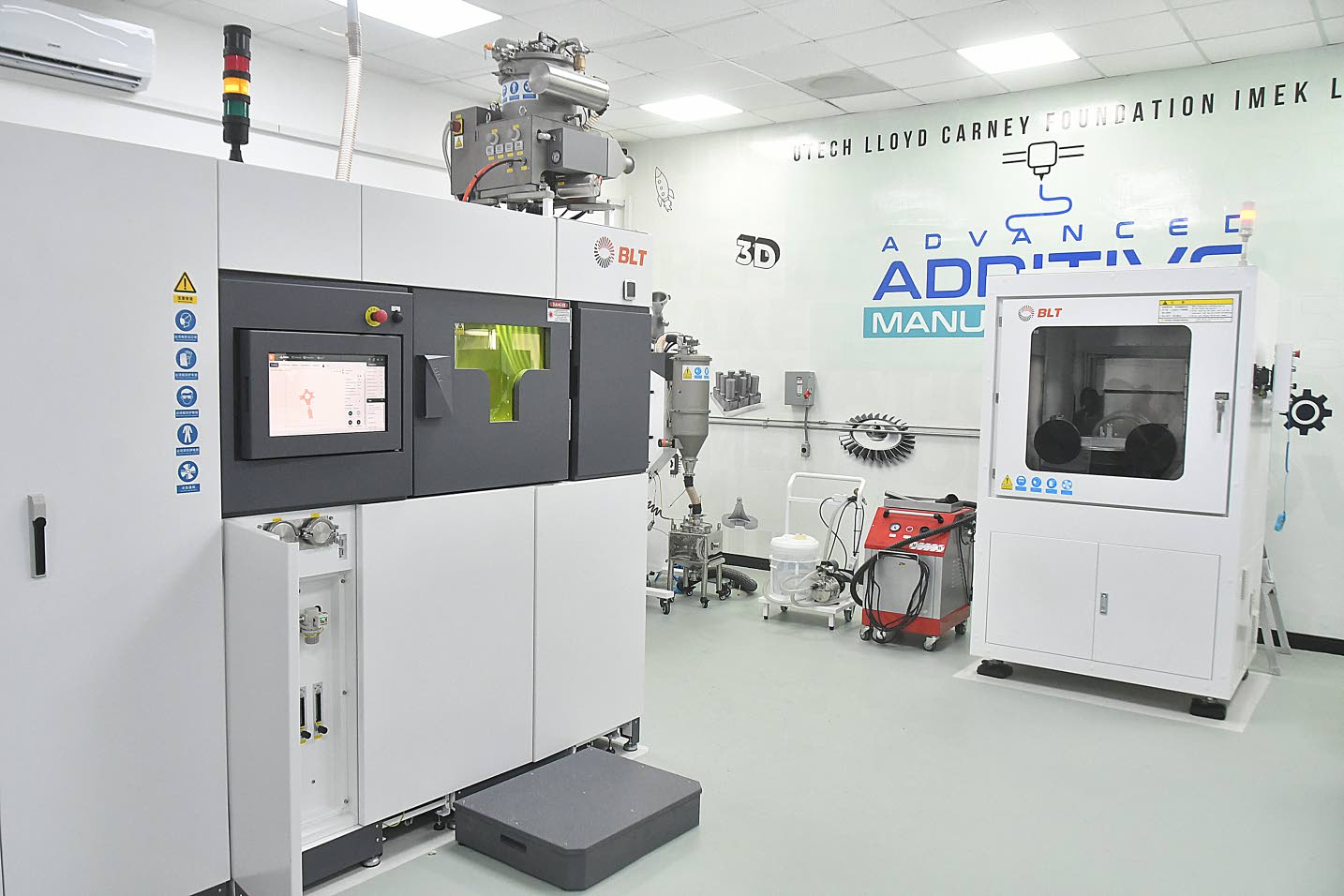
Lab showing the metal 3D printing system at UTech (Photo: Garfield Robinson)


