Jamaica looks up
Vertical living reimagined
STANDING on high ground anywhere in Jamaica, with the land folding toward the sea and the city pressing carefully against its limits, it becomes clear that the island’s future cannot be built on repetition.
Jamaica does not have the luxury of endless land, nor the tolerance for short-term solutions dressed up as progress. Growth here must be deliberate, layered, and intelligent.
Vertical living, when properly imagined, is not simply about stacking homes higher into the sky. It is about condensing life without compressing quality, about preserving land while expanding opportunity, and — critically — about building structures that think, adapt, and endure.
If Jamaica is to build upward it must do so with a level of sophistication that goes beyond minimum standards. This is not a moment for compliance alone; it is a moment for foresight.
Building up is meaningless without building smart
There is a dangerous misconception that vertical development is achieved the moment a structure meets the building code. In reality, that is only the starting line. Codes define what is permissible; they do not define what is prepared.
We cannot afford to build vertically and leave intelligence out of the conversation. A building that doesn’t understand itself — its movement, its stress, its environment — is already outdated the day it opens
Future-ready vertical buildings must be conceived as living systems. They require digital nervous systems — networks of sensors, cabling, and controls that allow the building to monitor itself in real time. Temperature is only the beginning. Movement through the building, energy consumption patterns, structural strain, air quality, humidity, water use, and even occupancy flow all become data points feeding into a central intelligence.
This is the difference between a tall building and a thinking building.
The building with a brain
Across parts of Asia, Europe, and North America, advanced developments already operate with what engineers increasingly describe as a building brain. Jamaica should not be excluded from this future.
In such buildings, sensors embedded throughout the structure constantly assess conditions. When weather systems shift, façades adjust shading and ventilation strategies. When seismic activity is detected, the building responds — not by resisting movement rigidly, but by absorbing and dissipating it.
This is where seismic technologies such as base isolation systems come into play. Rather than anchoring a building immovably to the ground, these systems allow it to float and sway gently, decoupling the structure from ground motion during an earthquake. The result is dramatically reduced structural stress and far greater occupant safety. For a seismically active island like Jamaica, this is not futuristic indulgence — it is rational insurance.
Hurricanes, too, become something the building anticipates rather than merely survives. Impact-resistant glazing, already non-negotiable, works alongside pressure sensors and envelope monitoring systems that detect vulnerabilities before they become failures. Roofs, façades, and service cores are no longer passive — they are continuously assessed and maintained through predictive intelligence.
Fire safety that thinks for itself
Nowhere is the gap between traditional construction and intelligent buildings more apparent than in fire safety. The old model — sirens, evacuation, hope — is no longer sufficient for vertical living.
In advanced buildings, fire systems are autonomous and compartmentalised. Instead of forcing residents to flee, intelligent suppression systems isolate and extinguish fires locally. Air pressure systems control smoke movement. Structural compartments seal automatically. Residents remain safely in place while the building responds.
A truly intelligent building doesn’t panic its occupants — it protects them. The goal is for people to stay where they are, because the building is already dealing with the problem.
This approach dramatically reduces injury risk, emergency congestion, and long-term damage. It also lowers insurance costs and operational disruption — critical considerations in Jamaica where recovery time after disasters often defines economic outcomes.
Technology as a tool for lower costs, not higher ones
There is a persistent fear that advanced building technologies are prohibitively expensive. In truth, intelligence often reduces life cycle costs, even if it raises upfront investment.
Smart monitoring systems detect maintenance issues early, preventing catastrophic failures. Energy management systems reduce consumption by learning resident behaviour and adjusting accordingly. Predictive maintenance lowers repair costs, extends equipment life, and minimises downtime.
For residents, this translates into lower service charges, greater comfort, and fewer disruptions. For developers and managers, it means buildings that age gracefully rather than expensively.
Importantly, Jamaica must build with future cabling and data capacity already embedded. Retrofitting intelligence into concrete towers is costly and inefficient. Buildings must be born ready for AI-driven systems, advanced connectivity, and technologies not yet fully imagined.
Living, working, growing without leaving the building
Vertical living only works if it supports full lives, not partial ones. Buildings that function purely as sleeping quarters create pressure elsewhere — on roads, transport systems, and urban infrastructure.
The future lies in self-contained vertical communities. Homes sit alongside offices, studios, clinics, workshops, and digital workplaces. Residents may work for employers located within the same structure or interconnected buildings, reducing daily travel to near zero.
Interconnected towers — linked by skybridges or shared platforms — allow people to move between residential and commercial spaces without ever touching a road. This is not about isolation, it is about efficiency and choice.
Food production, too, becomes part of the system. Vertical gardens, rooftop farms, and hydroponic walls do more than beautify buildings, they cool façades, improve air quality, manage water, and provide fresh produce. In a world of climate volatility, localised food resilience is no longer optional.
Not a location strategy— but a national mindset
It is tempting to argue over where such buildings should rise but the more important question is how they should function, wherever they are needed. Vertical development should respond to demand, infrastructure, and opportunity — not to speculative fashion.
What must remain constant is the standard: Intelligent systems, resilient structures, mixed-use integration, and long-term thinking. This allows Jamaica to grow upward without repeating the mistakes of cities that built tall before they built smart.
Building back stronger, not just taller
Build back stronger is not a slogan — it is a design discipline. It asks harder questions: How does this building behave under stress? How does it reduce dependency? How does it protect people when systems fail elsewhere?
Strong buildings aren’t the ones that look impressive on day one. They’re the ones still working quietly decades later, when the climate, the economy, and technology have all changed.
Jamaica’s opportunity is not to imitate global cities, but to outthink them — to build vertical environments that are adaptive, humane, and deeply responsive to island realities.
This is not about height for its own sake. It is about intelligence, restraint, and respect for a place that cannot afford careless ambition.
If Jamaica is going to look up, it must do so with clarity, courage, and systems that are ready not just for today, but for whatever the future brings.
Dean Jones is founder of Jamaica-Homes.com and a realtor associate. With master’s degrees in building surveying and communication design, as well as a strong foundation in real estate law and construction, he provides expert guidance on residential, luxury, commercial, and investment properties. He may be contacted at dean@jamaica-homes.com.

High-rise condos soaring above the north coast in St Ann, reflective glass towers with tropical greenery spiralling upward, elevated walkways crossing between buildings, fishing boats on the water below. (Photo: jamaica-homes.com)
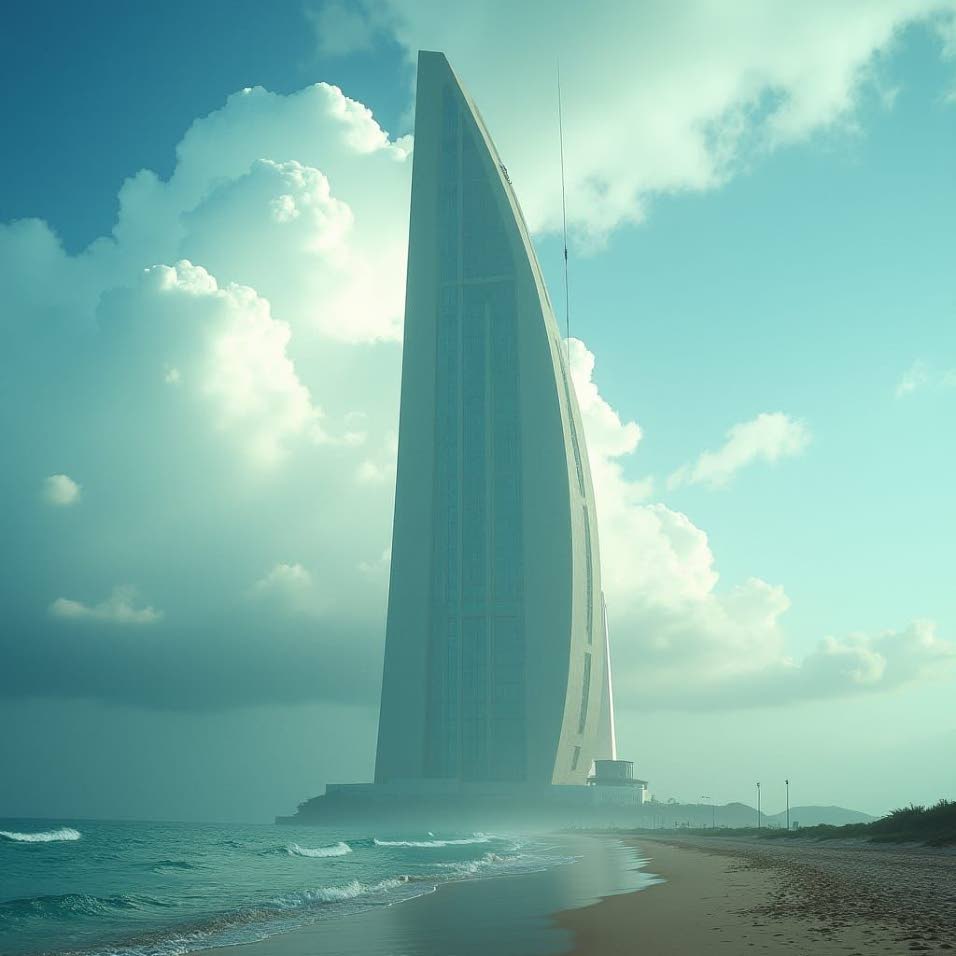
This conceptual high-rise is imagined as a singular vertical form rising directly from the coastal edge, its profile tapered to reduce wind load and visual mass. (Photo: jamaica-homes.com)
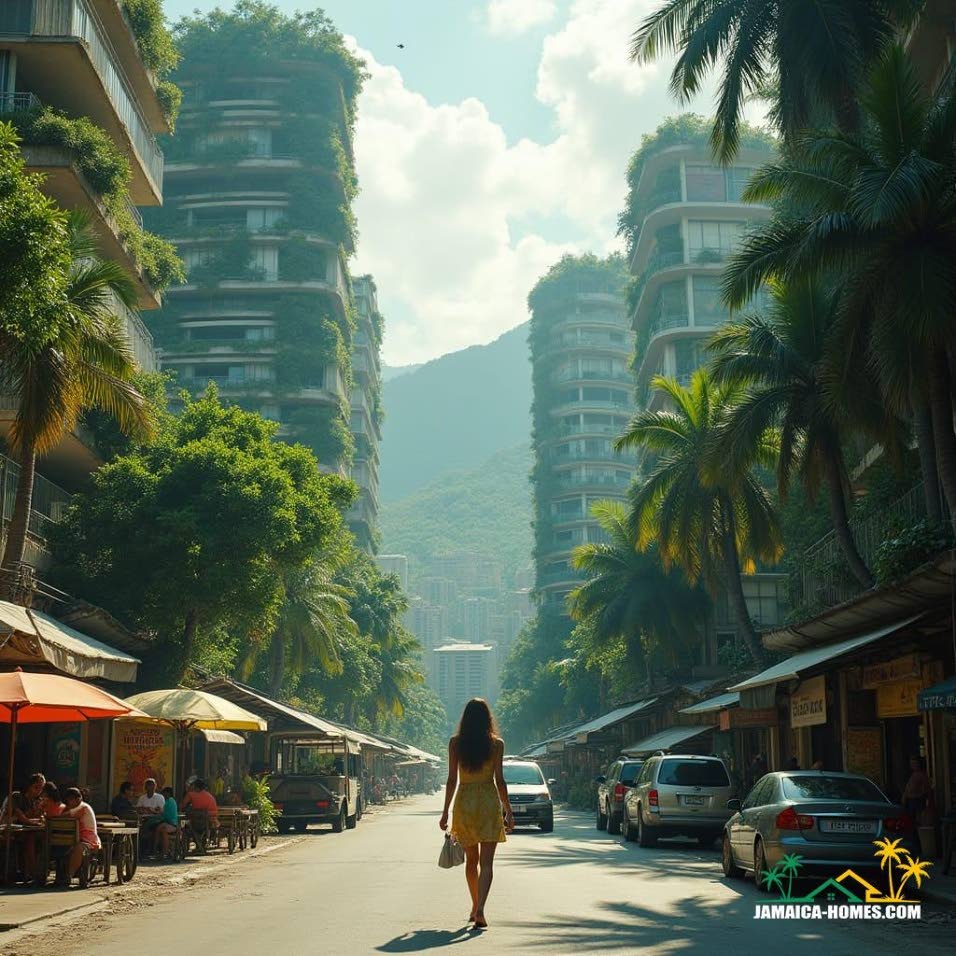
Downtown Kingston’s sleek skyscrapers, wrapped in lush greenery, surrounded by Jamaican vendors in sky-level public plazas, reggae murals on lower levels, amidst modern elevated roads, with a tropical mountain backdrop.(Photo: jamaica-homes.com)
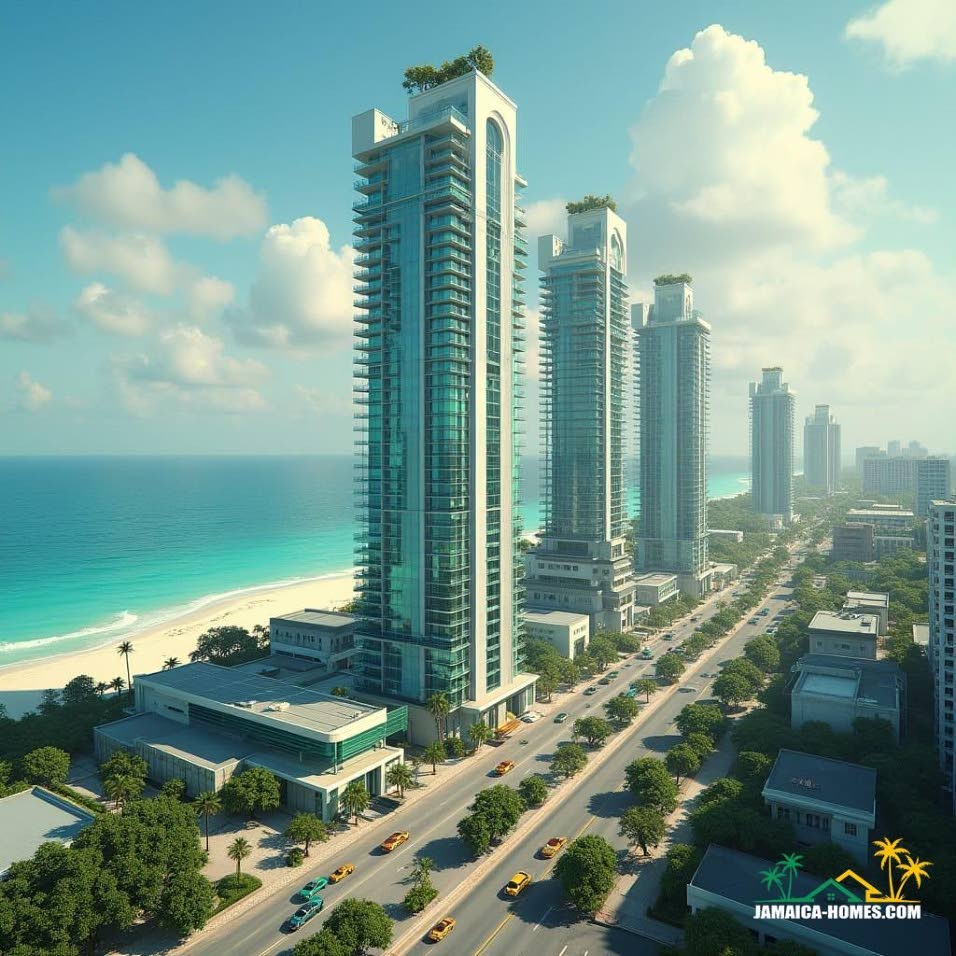
Port Maria, St. Mary imagined in 2040: A multi-tower complex pushing the limits of vertical and horizontal living, sky parks and rooftop solar and wind tech integrated into façades. (Photo: jamaica-homes.com)
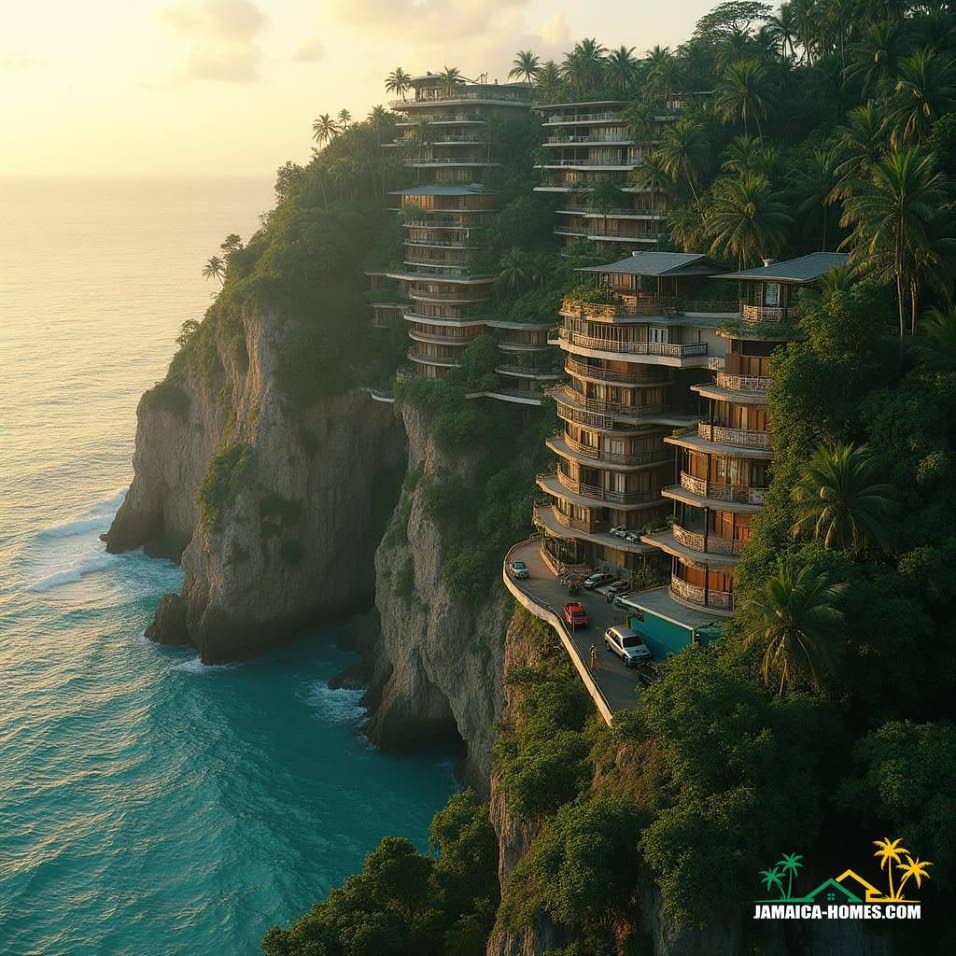
A cliff side vertical city. (Photo: jamaica-homes.com)