



$30-m matching grant targets production expansion at Parnassus Agro Park
A $30-million Government-backed matching grant initiative is now being deployed at the Parnassus Agro Park in Clarendon, aimed at expanding crop production, strengthening farm infrastructure, and pushing small farmers towards commercially viable agriculture under the Southern Plains Agricultural Development (SPAD) Project.
Thirty-three farmers are receiving support under Phase One of the Matching Grant Scheme, with funding directed primarily towards irrigation systems, production inputs, and land preparation, all aimed at stabilising yields and expanding structured cultivation.
The programme forms part of a wider push to transition small farmers into commercially viable producers and is being financed through support from the United Kingdom Government under the UK Caribbean Infrastructure Fund, with the Caribbean Development Bank playing a central role in implementing and supporting the broader SPAD Project.
Speaking at the event last week, Agriculture Minister Floyd Green said the intervention is designed to strengthen the productive base of the sector.
“This programme represents more than the distribution of supplies. It is about equipping our farmers with the tools, knowledge, and confidence to operate as competitive agribusiness entrepreneurs. Through initiatives like the Matching Grant Scheme we are strengthening food security, expanding rural economic opportunity, and positioning Jamaican agriculture to compete locally and internationally,” the minister said.
Irrigation accounts for the largest share of funding under the scheme, targeting one of the most persistent constraints facing domestic agriculture — climate-driven production instability.
Agro-Investment Corporation CEO Vivion Scully said reliable water access has already begun reshaping the production model at Parnassus.
“Water security moves farming from hope to planning, from survival to scale,” he said, noting that the objective is to support structured, business-driven farming rather than seasonal output.
In addition to irrigation, farmers are receiving seeds, fertilisers, crop protection inputs, and technical training in financial management, climate resilience, and market access — areas widely identified as limiting productivity among small and medium-scale producers.
“Success in agriculture isn’t just about what comes out of the ground. It’s about whether farmers have real opportunities to grow, earn, and build something sustainable for themselves and their families. This programme isn’t about equipment alone — it’s about confidence, resilience, and giving farmers the backing they need to operate as real businesses, not just producers hoping for a good season,” Scully said.
Under the Matching Grant Scheme, the Government shares the cost of key on-farm investments — including irrigation, inputs, and production infrastructure — reducing the capital burden on farmers while requiring them to commit to structured production and commercial output.
Ministry officials say the cost-sharing model is intended to remove one of the biggest barriers facing small farmers — access to financing — while ensuring beneficiaries build sustainable, income-generating farm operations rather than relying on short-term assistance.
Farmers under the scheme will produce a strategic mix of priority crops aligned with national food security and market demand, including hot pepper, sweet pepper, pumpkin, sweet potato, and watermelon across the largest acreage, supported by leafy vegetables such as callaloo, along with sweet corn, cucumber, okra, onion, and pak choi on smaller plots.
The diversified crop mix allows for staggered harvesting cycles, helping to smooth farmer cash flow while increasing the consistency of supply to local markets — a factor policymakers say is important in reducing price volatility and import reliance.
The Matching Grant Scheme operates within the broader SPAD Project, which is transforming previously underutilised lands into irrigated, commercially oriented farms through investment in water infrastructure, technical support and production systems.
The ministry expects the combined interventions to increase agricultural output, strengthen rural income generation, and improve the reliability of domestic food supply.
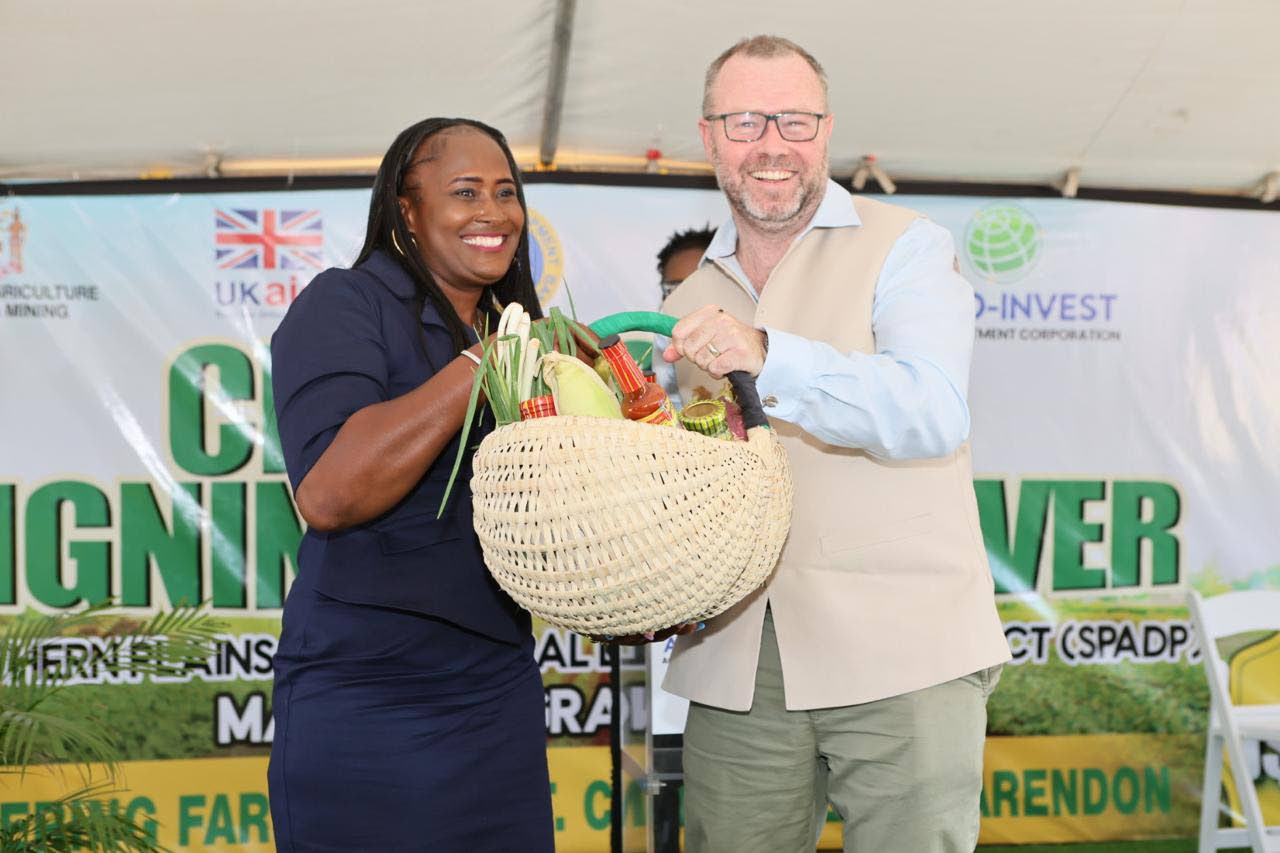
Caleen Walker (left), farmer-investor and member of the Parnassus Farmers’ Group presents a basket of locally grown produce to Andrew Bowden, Development representative for Jamaica and Caribbean regional counsellor for the United Kingdom, during the Matching Grant Scheme handover at the Parnassus Agro Park in Clarendon. The initiative, supported by the UK Caribbean Infrastructure Fund and the Caribbean Development Bank, is aimed at strengthening commercial farming and boosting domestic food production.
SCULLY…this programme isn’t about equipment alone — it’s about confidence, resilience and giving farmers the backing they need to operate as real businesses.


