



Children prefer the buses with lewd music
Stakeholders admit to challenges with rural school transport programme
STAKEHOLDERS in education and transportation say they are not enthused by the response of parents and students to the National Rural School Bus Programme which the Government spent more than a billion dollars to implement.
On Tuesday, at the Ministry of Energy, Transport and Telecommunications in St Andrew, Minister Daryl Vaz announced that the 110 used buses that he promised would be acquired for usage under the programme have been handed over to the Jamaica Urban Transit Company (JUTC). According to the minister, between 70 and 80 per cent of the buses are deployed each day, transporting roughly 16,000 students. He said there has not been a constant roll-out of the full complement of buses due to mechanical and other problems.
The cost for students to travel on the buses is $50 when using their electronic bus cards, which the parents fail to top up even if they sign up for their child to receive cards.
Even while there were numerous positives highlighted with the programme, Richard Troupe, the director of safety and security in the Ministry of Education, highlighted some of the problems causing a lower-than-expected take up of the services, including the fact that many students prefer to take transportation with lewd music and other things they aren’t supposed to be exposed to as children.
“I want to speak now to students. What we are seeing in the rural parishes should not come to you as a surprise, because even in the Kingston Metropolitan Area you still have children making the choice to take the ‘shotta’ vehicles, still making the decision to take the buses with the lewd music,” Troupe said.
“As children, you also have a responsibility for your own personal safety. The Government of Jamaica [has] invested in the buses to provide affordable, reliable, and safe transportation services. Even if parents and guardians are struggling to buy into the programme, the children have a responsibility to go to their parents and say it is a good programme,” he said.
Troupe added that he felt there was not enough public relations done to sensitise parents and students.
In reference to some of the buses experiencing challenges, Minister Vaz said some of them shut down for the slightest reason.
“Truth be told is that the buses that we bought are performing. Yes, there are some issues in terms of road conditions, but all in all we are rolling out over 80 buses [per day]. The bottom line is that there were technological challenges in terms of the computer and the process used; there is a safety mechanism that shuts it down for the slightest little thing. Ideally, we are where we are in terms of new buses; we are well advanced in that, and as we move along you will be kept abreast as to the stages where we are. It is a learning curve,” the minister said, highlighting that more than $2 billion will be spent this fiscal year to acquire 100 brand new buses to be deployed under the programme.
“There is a very lackadaisical tendency in relation to the parents and the interaction with the schools and the students — and it is not limited to school but it is a mindset,” Vaz said.
“The fact of the matter is that it is very difficult to get the cooperation of the majority of parents when it comes to activities at the school that benefit the children, and pretty much the children at the school are left on their own in terms of the cooperation,” he added.
Vaz also highlighted that the 74 routes that have been activated serve more than 340 schools.
“That is almost 50 per cent of rural schools. These routes were selected based on students’ geographic need and accessibility challenges in rural communities. Buses operate from 5:30 am to 8:30 am in the mornings and 3:30 pm to 8:30 pm in the evenings. You would have seen the post on social media by the ministry and JUTC showing the technology that is being used which is showing clearly that parents can actually see when their child boards the bus, disembarks the bus in the morning, and same in the evening,” he said.
The minister also acknowledged that some buses have been involved in accidents, but said “thankfully” there were no fatalities.
“[There was] one serious injury of a passenger vehicle that collided with the bus, and we were able to get immediate footage of the bus — using the technology — and the bus with the cameras on the outside of the bus and on the inside, which obviously helps the police to be able to do their investigation much quicker. And hopefully sooner than later we will be able to have the app working so that parents can actually go on the app and get all the details they would want in terms of routes, et cetera,” he added.
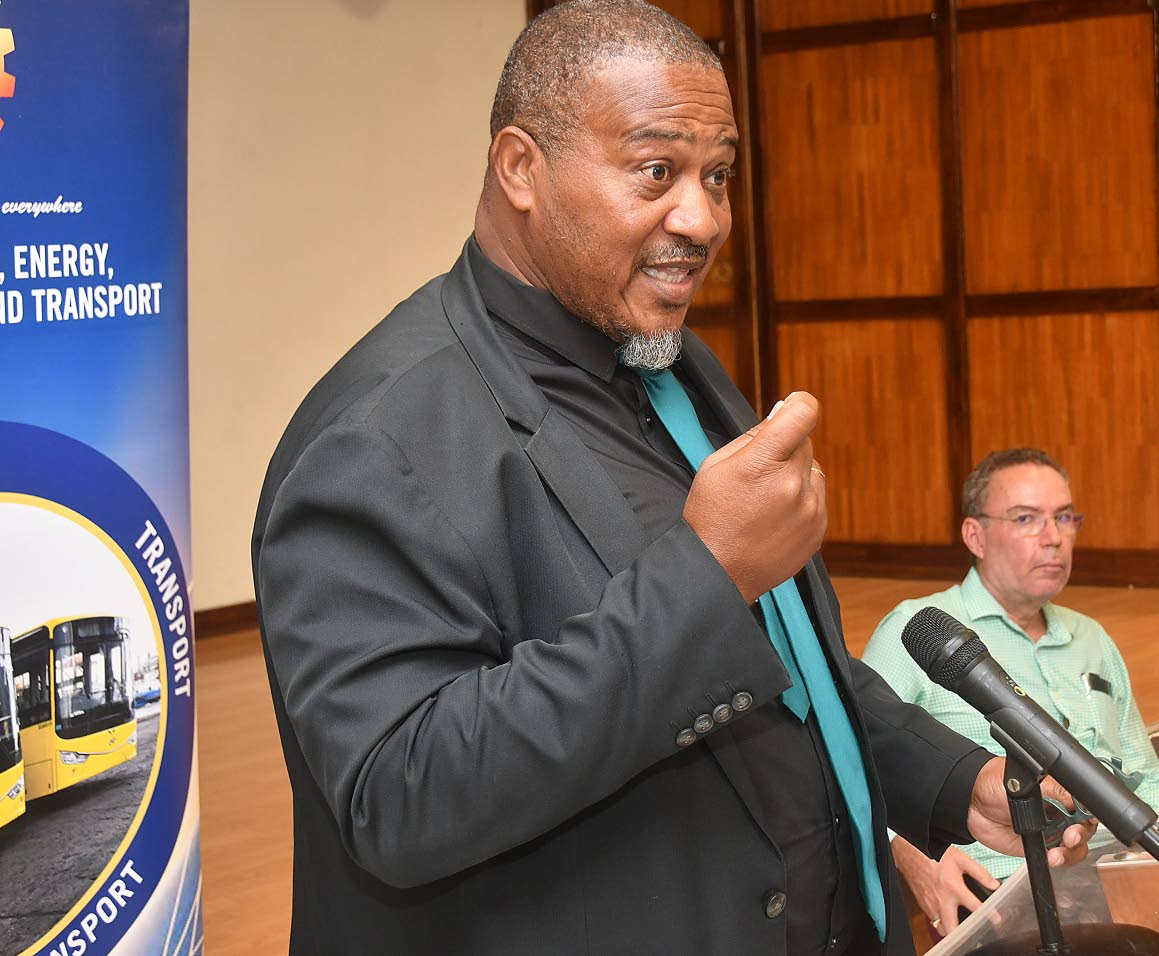
Richard Troupe, director of safety and security in the Ministry of Education, speaking at a press conference on Tuesday at which Transport Minister Daryl Vaz gave an update on the National Rural School Bus Programme.


