



After years under pressure NCB says cash will drive its next phase
AFTER several years under pressure, NCB Financial Group is placing less emphasis on profit and more on cash — a shift management says will determine how quickly the company can reduce debt and rebuild shareholder returns.
Chief executive Robert Almeida told shareholders at Friday’s annual general meeting that the group is moving beyond its restructuring phase, with free cash flow now at the centre of its strategy.
“As debt continues to decline and dividends from our operating subsidiaries increase, the free cash flow available to the holding company will grow, and that gives us the ability to reduce debt while increasing dividends over time,” he said.
The approach reflects a company still working to restore performance after a period of weaker returns, rising leverage, and reduced dividends.
“The interest burden is the friction in this business. As we pay down debt, interest costs fall, earnings rise, and more cash begins to accumulate at the parent company. That is the engine that allows dividends to grow again,” Almeida said in responding to repeated questions from shareholders about when dividend payments would meaningfully improve.
The group recently approved an interim dividend of $0.50 per share, reflecting what management described as a still-cautious approach while balance sheet repair continues. The group paid aggregate dividends of $1.50 per share during the 2025 financial year, after skipping one quarterly payment during the restructuring period, underscoring the gradual pace of dividend normalisation.
But the pace of dividend recovery ultimately depends on the strength of the core business, which remains a work in progress.
Last year’s improvement in profit was lifted by a large one-off gain from an asset sale, boosting headline earnings but masking the slower recovery taking place in core operations. The gain arose from the sale of Thoma Exploitatie B.V. within the Guardian subgroup, which generated gross proceeds of approximately $21 billion and a gain of about $15.1 billion. The most recent quarter offers a clearer picture of that underlying performance.
For the three months to December, NCB reported flat net profit of $5.1 billion, with $2.5 billion attributable to shareholders even as operating income fell five per cent to $33.5 billion amid fair-value losses and a more challenging operating environment.
Annualised return on equity for the December quarter was 5.11 per cent, down from 6.17 per cent a year earlier and still well below the mid-teen performance NCB produced before the pandemic. Asset tax charges totalled roughly $2.7 billion in the quarter, adding to cost pressures.
Almeida argued, however, that the broader direction looks different when measured annually rather than quarter to quarter. In the group’s annual results, return on average equity rose to 12.46 per cent in 2025 from 8.49 per cent in 2024 and 1.94 per cent in 2023, though 2025’s figure was supported by that one-off disposal gain.
“We are not yet back to the 15 to 20 per cent return on equity range where this business historically operated but over the last three years you can see a steady rise, and we are moving back toward that level,” he said.
Almeida pointed to what he described as the group’s core run rate, arguing that once temporary effects such as hurricane disruption and asset tax charges are stripped out, the underlying business is stabilising.
Despite improving earnings, NCB’s balance sheet still carries the weight of its restructuring years. Total borrowings were about $198.9 billion at the end of the last financial year, roughly double pre-pandemic levels, leaving interest costs as a persistent drag on profitability and dividend growth. Interest expense for the 2025 financial year totalled approximately $46.6 billion, underscoring the scale of the group’s funding burden.
Liquidity across the group remains strong, with cash and cash equivalents rising to roughly $232.7 billion from $201.2 billion five years earlier. But cash available at the holding company fluctuates with debt service and financing activity.
Updates from the group’s main operating arms added more colour to management’s outlook and pointed to where stronger cash generation is expected to come from.
Guardian Holdings President Ian Chinapoo told shareholders the insurance group continues to benefit from disciplined underwriting, improved claims management, and tighter expense control, which together are helping to stabilise earnings and sustain dividend flows to the parent company. Dividend income recognised at the group level totalled roughly $3.1 billion in 2025, highlighting the importance of subsidiary upstreaming to holding company liquidity.
He noted that performance across key markets remains resilient despite a more volatile operating environment, with the focus now on improving efficiency and preserving margin rather than chasing aggressive growth. Those steady inflows remain an important pillar supporting cash generation at the holding company.
From the banking side, interim CEO of NCB Jamaica Sheree Martin said the priority remains strengthening the core franchise while maintaining tight risk discipline. She pointed to improving portfolio stability, more targeted lending, and continued investment in data and customer analytics as helping to rebuild consistency in performance. Martin said the bank is placing greater emphasis on service delivery, operational efficiency and deeper customer engagement as it works to improve earnings quality and support the wider group recovery.
“Growth for us is not pursued at the expense of discipline. It is pursued within defined risk parameters supported by improved analytics, stronger customer engagement and consistent service delivery. We are equipping our teams with better tools and training so that every customer touch point reflects the standard of care and professionalism that NCB stands for,” Martin said during her presentation.
At Clarien Bank, chief executive Ian Truran said the Bermudian operation is continuing to sharpen its focus on client retention, balance sheet discipline, and selective growth in its core wealth and private banking segments. He said the bank has been working to improve profitability through cost management and more efficient deployment of capital, positioning the business to deliver steady earnings contribution to the group while maintaining a conservative capital posture.
Almeida said converting those gains into usable cash ultimately determines how quickly the group can change its financial position.
“Profit is important, but cash is what changes the trajectory of this company. Cash allows us to reduce leverage, strengthen the balance sheet, and ultimately deliver better returns to shareholders,” he said.
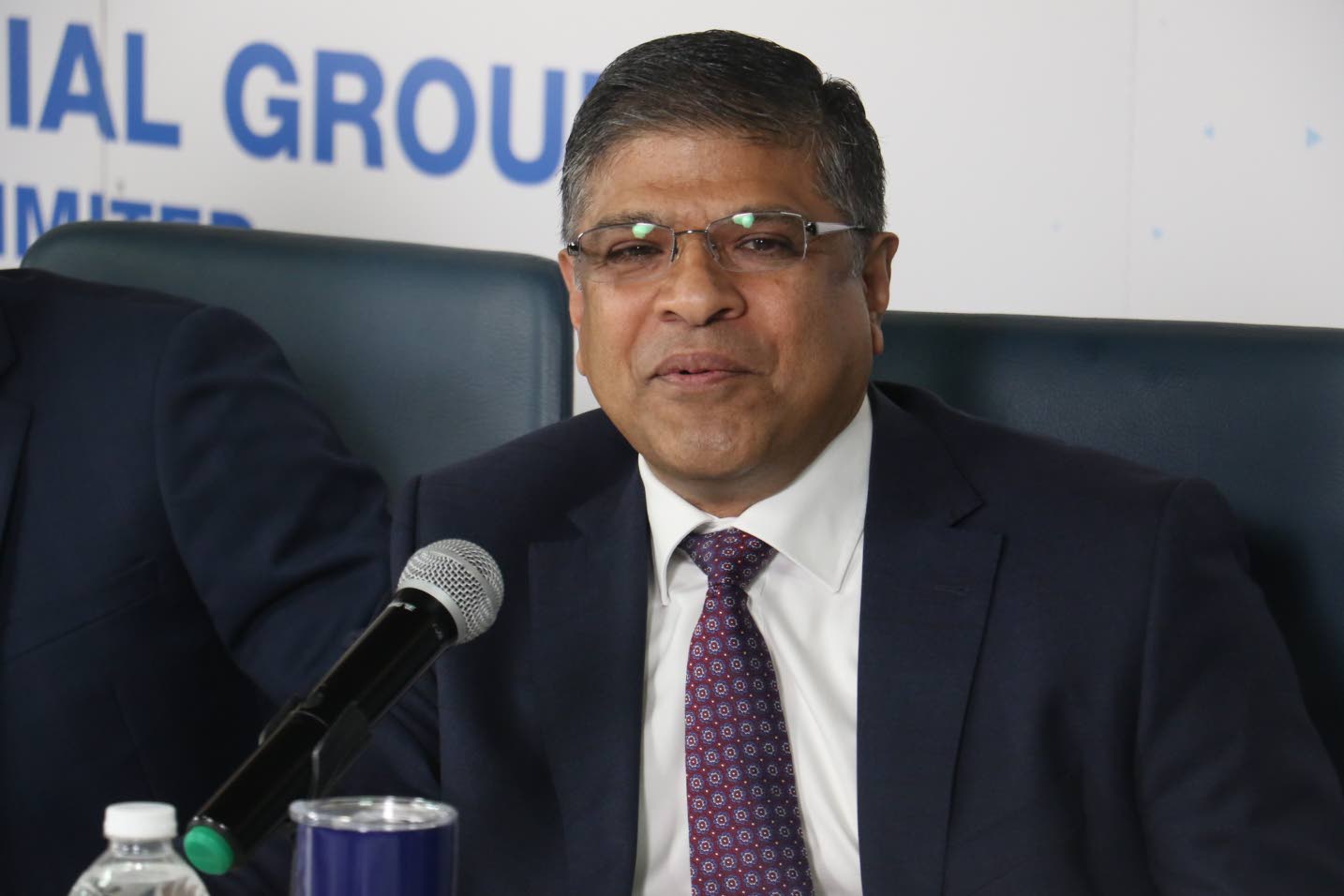
Robert Almeida, chief executive of NCB Financial Group, says improving free cash flow is central to reducing debt and restoring dividend growth.


