Split over shared community Bill
Calls for public input; some residents embrace proposed legislation
THE recently tabled Bill that seeks to put guardrails in place for what are commonly referred to as gated communities has elicited a strong reaction from some residents who live in these shared spaces.
There has been a call, for example, the 20-plus communities-strong Citizens Rights to the City (CRC) out of Kingston for the establishment of a joint select committee that will foster public discussion. But there are others who see the Registration (Shared Community) Act, 2026 as the answer to problems that have plagued them for years.
Speaking with the Jamaica Observer’s Real Estate on the Rock last Thursday, CRC spokesperson Diana McCaulay stressed that there is need for “assistance for communities with shared spaces who are not strata communities”, but she is convinced the Bill, as proposed, will result in increased maintenance fees for residents already struggling to pay.
“What we’re faced with at this point is a Bill which…instead of providing help, is providing a lot of hurdles; and they are all going to have cost implications.
“Speaking for myself, I live in a small, shared community and the work is done by volunteers. If the problem we’re trying to fix is people’s unwillingness to pay the maintenance fees for shared areas, and I have to raise the maintenance fees to cover all these various requirements, I don’t think [that] is going to help the situation,” she said.
McCaulay anticipates that there will be challenges affording the fees of already-in-high-demand accountants who will need to go over the books of individual communities. She is also worried about the impact of what appears to be a new requirement to insure shared spaces.
“I have an insurance background. If insurance is going to be required of shared areas — that would be things like pathways, walls, fences, facilities, like a swimming pool — those kinds of things, that’s very likely to be a large sum of money,” she said.
However, CRC’s major concern is that there was not adequate consultation before the Bill was tabled in Parliament on January 27. “When the Bill was announced, it said that stakeholders were consulted. We didn’t find any community group who said they had been consulted. That is why we’re calling for the joint select committee so that submissions and concerns can be put to this committee and have the concerns of people in those communities answered. The call really is for some genuine consultation and to allow us to ask questions,” McCaulay told the Sunday Observer.
However, in stark contrast to the stance taken by CRC, the Ironshore Citizens Association, Neighbourhood Watch Benevolent Society (ICAN-B ) in Montego Bay thinks the Bill will bring positive change.
“This ensures that structures have to be put in place, which clearly set out how, when, and who may use community property. This means that arbitrary rules or unfair treatment of lot owners can be challenged through an established body [The Real Estate Board] rather than having to take the matter to court.
The need to pay fees for maintenance of common property will be clearly established in law and, therefore, the community can, through its executive, enforce payment by all lot owners and have recourse against those who refuse to pay,” said Daine Thomas on behalf of the ICAN-B management committee.
He said their community is far advanced in putting the structures in place, as outlined in the Bill.
“Ironshore is ready for dealing with the new legislation, as it already has a legally constituted body with an executive which handles the affairs of the community. What will now be required is to ensure that the existing body gets registered to meet the requirements of the new legal framework when enacted,” Thomas explained.
For the high-priced community on the outskirts of Montego Bay, it appears that costs such as taxes and insurance on shared property will not be an issue.
“Our common property is currently vested in the St James Municipal Corporation, which acts as trustee on behalf of the community. The municipal corporation, therefore, handles the matter of property taxes as the owner on record on behalf of the community.
“We currently have land and an incomplete community centre. Ironshore will ensure that the common facilities are insured and that the insurance cost be a part of the expenses to be borne collectively by lot owners,” Thomas outlined.
Resident of Berkely House in Kingston, David Ebanks, is equally optimistic about the Bill. He is among residents who want to see their community at the foot of Beverley Hills benefit from some of the points addressed by the legislation. There is very little shared space among the 26 apartments, but they do share a water bill and pay fees that go towards maintenance of a shared parking area. But there has been tension at Berkely House for years; they recently elected new leaders during a December 14 annual general meeting (AGM). It was the first AGM in about a decade,” Ebanks said.
“The problem with the existing laws is that they give the executive too much autonomy to make executive decisions without consultation,” he told the Sunday Observer.
He is hoping the Bill, which he said he has not read, will address that.
Ebanks agreed with CRC that more public discussion on the Bill would be helpful.
For CRC spokesperson McCaulay, it is inconceivable that the Government will not heed their call for dialogue.
“The Government has made all these commitments to openness and transparency and the need for good public consultation. So we just have to hope that a reasonable call like this [will get a positive response]. Come on, guys, we’ve never heard of this thing. Let us have an ability to make submissions to a joint select committee, which can then perhaps review and revise this law that you’re proposing before it’s actually done. I would hope a reasonable request like that would be honoured,” she said.
She suggested that there could be some level of flexibility in areas such as the time frame for implementation of any required changes, as well as a tiered approach that factors in community size and the composition of residents. She cautioned, for example, that the same approach could not be taken for smaller communities largely made up of retirees on fixed incomes versus communities with more affluent residents.
“I would ask about some kind of grandfathering provision, some period of time to allow older schemes to adapt. I would probably ask for some consideration regarding size because, obviously, if you are collecting many millions of dollars on behalf of people, there needs to be a greater level of formality. But, if it’s four townhouses at the bottom of the garden, maybe we don’t need all of this bureaucracy thrown at it,” said McCaulay.
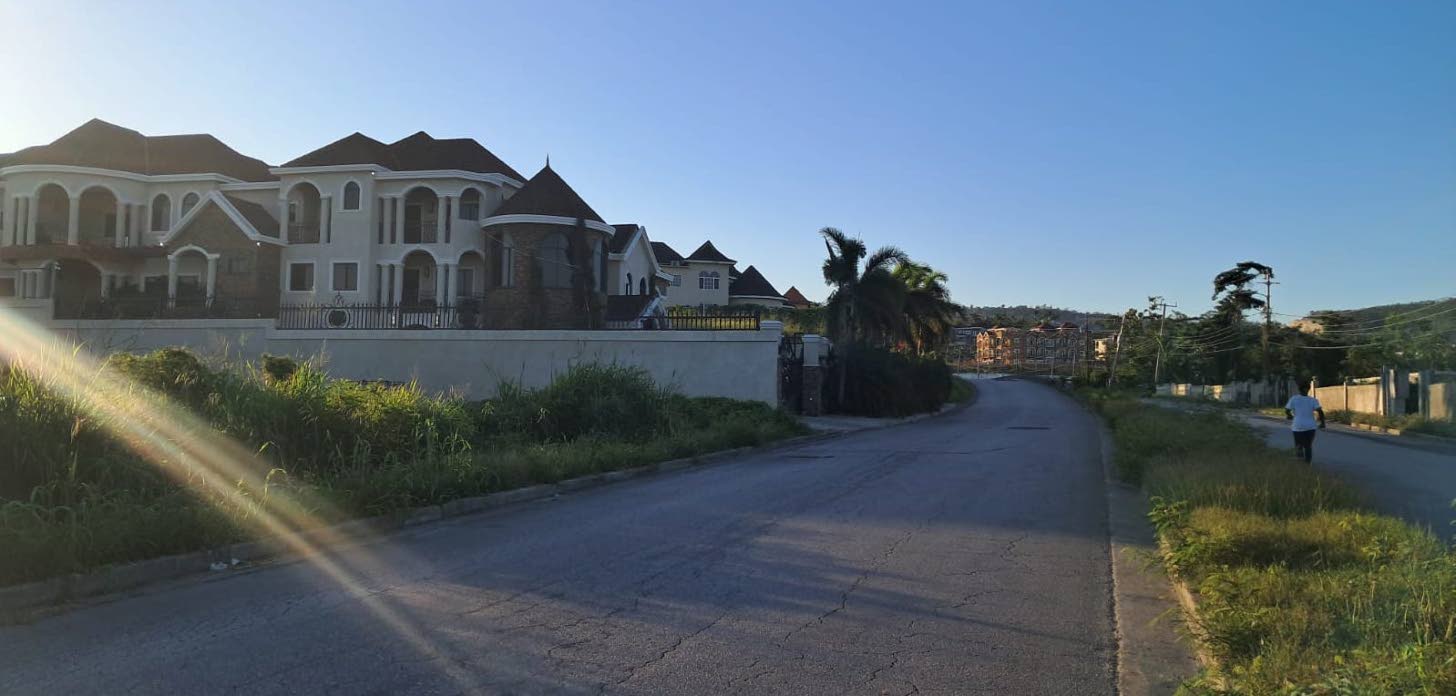
A jogger runs along the streets of the upscale gated Ironshore community in Montego Bay.