



Deaf and thriving in faith
As we arrived at the Montego Bay Campus of the Caribbean Christian Centre for the Deaf (CCCD) last Thursday, we saw gatherings of students communicating soundlessly with lively hands and expressions. This was the 67th annual general meeting (AGM) of the organisation, founded in 1958 by Reverend Willis Ethridge and his wife, Mildred, from Ontario, Canada. CCCD Chair Carol Robertson shared that the couple was joined by Paula Montgomery, the first deaf American missionary, and they set up a school for the deaf in Manchester with eight students.
Now CCCD has four campuses: in Kingston at Cassia Park Road; the over 100-acre Jamaica Deaf Village in Manchester; Knockpatrick, also in Manchester; and Granville, Montego Bay. There is a staff of 105, serving 140 students. Acting Executive Director John Meeks noted that with approximately 54,000 Deaf individuals in Jamaica, it was important that more deaf children be enrolled at the three teaching campuses which offer boarding facilities.
The Montego Bay and Manchester campuses were hard hit by Hurricane Melissa. Thanks to CCCD USA, led by Ben Buekema and volunteers, operations resumed within weeks. Meeks noted: increased enrolment, increased job and internship placement — 86 per cent success rate; 4H participation and achievement, high rate of certification in skill training courses/areas; continuation of spiritual focus — students and staff lead devotional exercises.
The meeting welcomed the news that a deaf police youth club would be established at the Montego Bay campus, and there is already one senior student who hopes to become a police officer. Last year, Jamaica’s first deaf justice of the peace was commissioned.
The education of our deaf children cannot be over-emphasised. This column has related the life story of Jamaica-born Claudia Gordon who became the first black deaf attorney-at-law in the USA. She said there was a deaf woman in her Cascade district of St Mary who was called Dummy, and her mother moved to New York to access deaf education.
We have written about the rise of DeafCan Coffee Company from the Cassia Park campus, piloted by Blake Widmer. Their mentor, Kent Mogler observed that of the 45 full-time employees, only two are hearing, showing the potential of our deaf once they are educated and guided by strong faith.
Every single presentation at the AGM acknowledged the guidance of Christian beliefs which undergird the work of the CCCD. Financial executive Claudia Morgan-Senior spoke of God’s providence which had pulled them through both hurricanes — Beryl and Melissa. Board directors channel this faith in CCCD’s leadership.
The Jamaica Deaf Village (JDV) was established by CCCD in 1984 to “serve as a safe place where deaf adults and their families could live in community, attend worship, and find meaningful employment.” Their website notes, “The three school campuses continued to run smoothly, and graduated class after class — but the deaf graduating from high school still struggled to find employment. Employers did not have the time or resources to devote to learning to communicate with the deaf, and did not hire them.”
“No job means no money, and no money means that, despite their education and potential, the deaf graduates were unable to provide for their own basic needs. Many turned to desperate means to obtain food, clothing, and shelter.”
Now, with farming, sewing, and other projects, the JDV is self-sustaining. There has been ongoing training in tractor operation and the raising of small ruminants, though there have been setbacks due to praedial larceny. A HEART NSTA/Trust Incubator project for crop production and rabbit rearing is now in progress.
John Meeks noted, “Statistics state that 90 per cent of all deaf children have hearing parents. Of those hearing parents, 80 per cent have a very limited sign vocabulary or never learn to sign at all. Sadly, a large percentage of deaf children do not have access to ASL/JSL and have very poor language models at home and in some cases, at school.”
If you have a deaf child or know of any in your community, please visit the CCCD website at https://www.cccdjamaica.org/ to give him/her a chance to achieve his/her full potential.
Gail Abraham’s fine book
We gathered recently for the launch of Gail Abraham’s book, Heels, Hustle, Heart. Claiming Your Seat Without Losing Yourself.
Gail explained to us the genesis of the book, “…[A]t executive tables where I had a voice but somehow felt unseen…from the silent negotiations women make every day, how much of myself do I really show, how strong is strong.”
“The title is intentional,” she said. “The heels represent presence, how you stand, how you show up, how you carry authority…The hustle represents discipline, the preparation, the excellence, the three to four jobs that we do every day and we still have to show up and pretend we are good. The heart represents your humanity, your values, your compassion. Too often women are told to choose to be strong, but not soft, be ambitious but not emotional, be visible but not too visible. I wrote this book to say clearly: You do not have to abdicate parts of yourself to succeed.”
What wise advice from this still-young professional! We were moved by her acknowledgement of Fae Ellington’s mentorship when she worked at
Television Jamaica (
TVJ), explaining that on her days off, Ellington offered invaluable coaching. She acknowledged the support of husband, Dr Michael Abrahams, who launched the event with his poignant poem on domestic abuse; her mother; other family members; and her housekeeper. Congratulations to her publishing consultant, Latoya West-Blackwood, cultural strategist, who has been a champion for literacy.
I recommend this book for up-and-coming professionals as an insightful guide on how to navigate the expected challenges on the path to success.
PROFESSOR ELDEMIRE SHEARER’S GUIDE
Professor Denise Eldemire Shearer and the Mona Ageing and Wellness team have produced an all-important caregiver’s manual,
Caring for Older Adults. The introduction addresses popular misconceptions about ageing such as older people do not lose interest in life; they are not often sick; they are not usually dependent; they are still interested in companionship; and they do not usually have dementia.
“Ageing is not a disease and does not itself cause disease,” she writes in the introduction. “However, ageing reduces the reserves of the body and its ability to respond to stress. Also, longer exposure to risk factors (including lifestyle choices such as exposure to smoking, excessive use of alcohol, poor diet, and low levels of physical activity), which come with increasing age, is what causes illness.”
This is fair warning for those who wish to enjoy active ageing.
Jamaica at Winter Olympics
Congratulations to Nelson “Chris” Stokes and the board of the Jamaica Bobsleigh Federation for keeping our Winter Olympics dreams alive for 2026. We are writing before Sunday’s Bobsleigh round three and hoping for some good news. Our team members have been celebrated from the start, singled out for an interview with Snoop Dogg on
NBC, affirmed by Lewis Hamilton and Usain Bolt, and featured in the latest
Fiat TV ad.
We salute Mica Moore who recorded her best time (59.92 seconds) in the fourth round in the women’s monobob.
Jean Lowrie-Chin is an author and executive chair of PROComm, PRODEV, and CCRP. Send comments to lowriechin@aim.com.
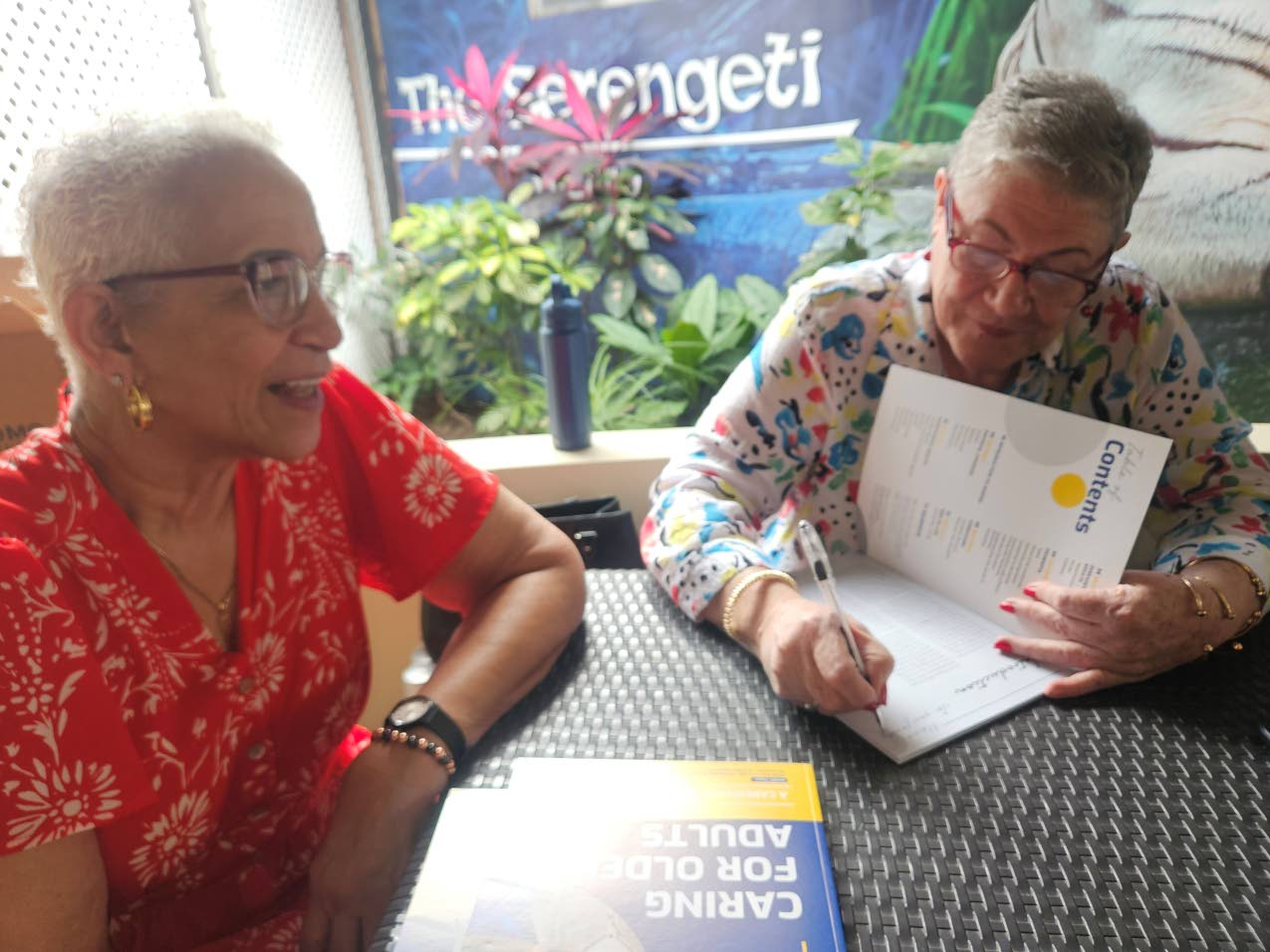
Professor Denise Eldemire Shearer (right) autographs her book for Marcia Emmanuel at the CCRP Valentine Mingle at Hope Zoo.


