



New warriors against illicit wealth
First cohort completes ground-breaking financial crime course at The UWI
TWENTY-FIVE professionals drawn from law enforcement and related sectors have completed the inaugural ‘Fundamentals of Countering Financial Crime’ short-term course delivered through a partnership between the Financial Investigations Division (FID) and The University of the West Indies (The UWI), Mona.
The six-week professional certificate programme, which began on January 6, 2026, concluded on February 19, 2026 with a brief graduation ceremony held immediately after the participants delivered final case-study presentations.
The course forms part of a wider national and regional effort to strengthen the investigation, disruption, and deterrence of financial crime.
The programme was delivered by a mix of The UWI faculty and senior practitioners from key law enforcement and anti-corruption agencies. Academic delivery was led by the Faculty of Law, Faculty of Social Sciences, and the Faculty of Science and Technology, while technical and operational perspectives were provided by experts from the Independent Commission of Investigations (Indecom), the Integrity Commission, Jamaica Constabulary Force (JCF) Staff College, the JCF’s Specialised Investigations Branch (SIB) (formerly C-TOC), the Major Organised Crime & Anti-Corruption Agency (MOCA), Jamaica Customs Agency, and the FID.
The course was marketed and executed by the UWI STAR (Short-Term Advancement and Research Centre), building on the successful launch announcement made in December 2025.
It is funded through support from the Inter-American Development Bank (IDB) and the British High Commission, Jamaica, reflecting strong confidence in Jamaica’s efforts to further strengthen its anti-financial crime framework and maintain its reputation following removal from international watch lists.
At the closing ceremony, FID’s Chief Technical Director Dennis Chung applauded the strong partnership and rapid turnaround from concept to delivery, noting that the collaboration between the FID and The UWI had moved from discussion to implementation in a matter of months.
“When I spoke with the principal [Professor Densil Williams] he put me on immediately to [Dr] Olivene [Burke] and said that we can make this happen. That was in August 2025, and by December 2025 we were launching this programme and now, in February 2026, we have the first set of graduands,” a release from the FID quotes Chung.
Dr Burke, director of UWI STAR, highlighted the importance of international partners in making the inaugural cohort possible.
“The IDB is extremely special to us, because at the end of the day IDB is the sponsor why all of you could be sitting here with the fee fully funded — the IDB in collaboration with the British High Commission,” Dr Burke said.
Speaking on behalf of the British High Commission, Gary Dickson, senior UK consultant at the FID, underscored the value of the initiative and commended the graduates for their engagement.
“It was a pleasure for the British High Commission to get involved in this, albeit on a very minor scale when it comes to funding, but it’s something that we believed in and that’s why the money was made available to assist with the marketing as we’re going forward,” he said.
Emphasising the regional significance of the programme, Jason Wilks, senior sector specialist with the IDB, reminded participants that their work contributes to a wider Caribbean response to illicit financial flows.
“You are the first of a regional effort to stem the tide of illicit financial crime, not just for Jamaica, but for the entire Caribbean region…We work on development finance, we work on development problems, but we know that those are solved by the people who work at the ground level on the front lines — persons like yourselves. So from our perspective as a development institution as the IDB, we’re wholly honoured to be supporting your capacity-building, your own ambitions, and your personal perspective of how you can serve your organisation, your country, and, yes, the wider Caribbean,” Dickson said.
The first cohort included participants with experience across several agencies involved in combating financial crime.
Among them was Shelly Brown, who has worked with both the FID and MOCA. She spoke to the depth and relevance of the material, stressing the need for continuous upskilling to outpace criminals who are increasingly using sophisticated methods and technology.
“When we just started, based on the comprehensive course outline, it seemed a bit tedious to some of us. But like myself, being from the FID, the information is not totally new, but there are some new developments, new methodologies that we can use to take the proceeds out of crime. And it will also keep us ahead of the brilliant criminals, especially the cyber criminals, because I don’t think that they are what we would call dunce; they are bright people,” Brown said.
“So we have to stay ahead of them. So a course like this, packaged like this, will continue to develop. We just want to say thanks, and thank you to the sponsors and to all the persons. To the next team coming after us, I know that we have set the bar high, so they will have something to rise to.”
The FID and The UWI noted that future cohorts will build on the lessons of this inaugural group, with continued collaboration among academia, law enforcement, regulators, and international partners to expand training opportunities locally and across the region.
Details on upcoming intakes will be shared via The UWI and FID communication channels.
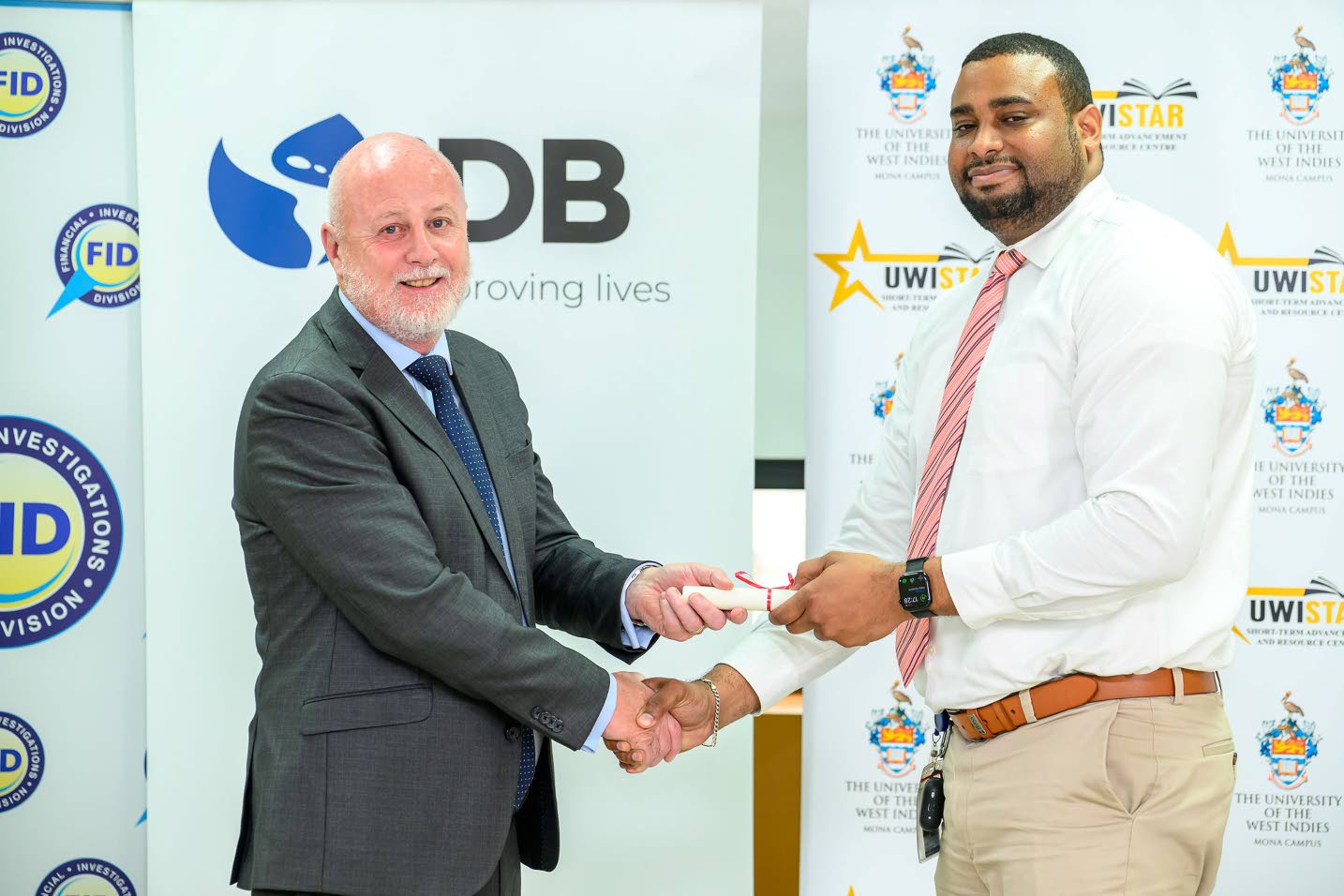
Gary Dickson (left), senior UK consultant at the Financial Investigations Division, presents Lon Parke with his certificate on February 19, 2026. Parke was among the first cohort of the inaugural ‘Fundamentals of Countering Financial Crime’ short-term course at The University of the West Indies.
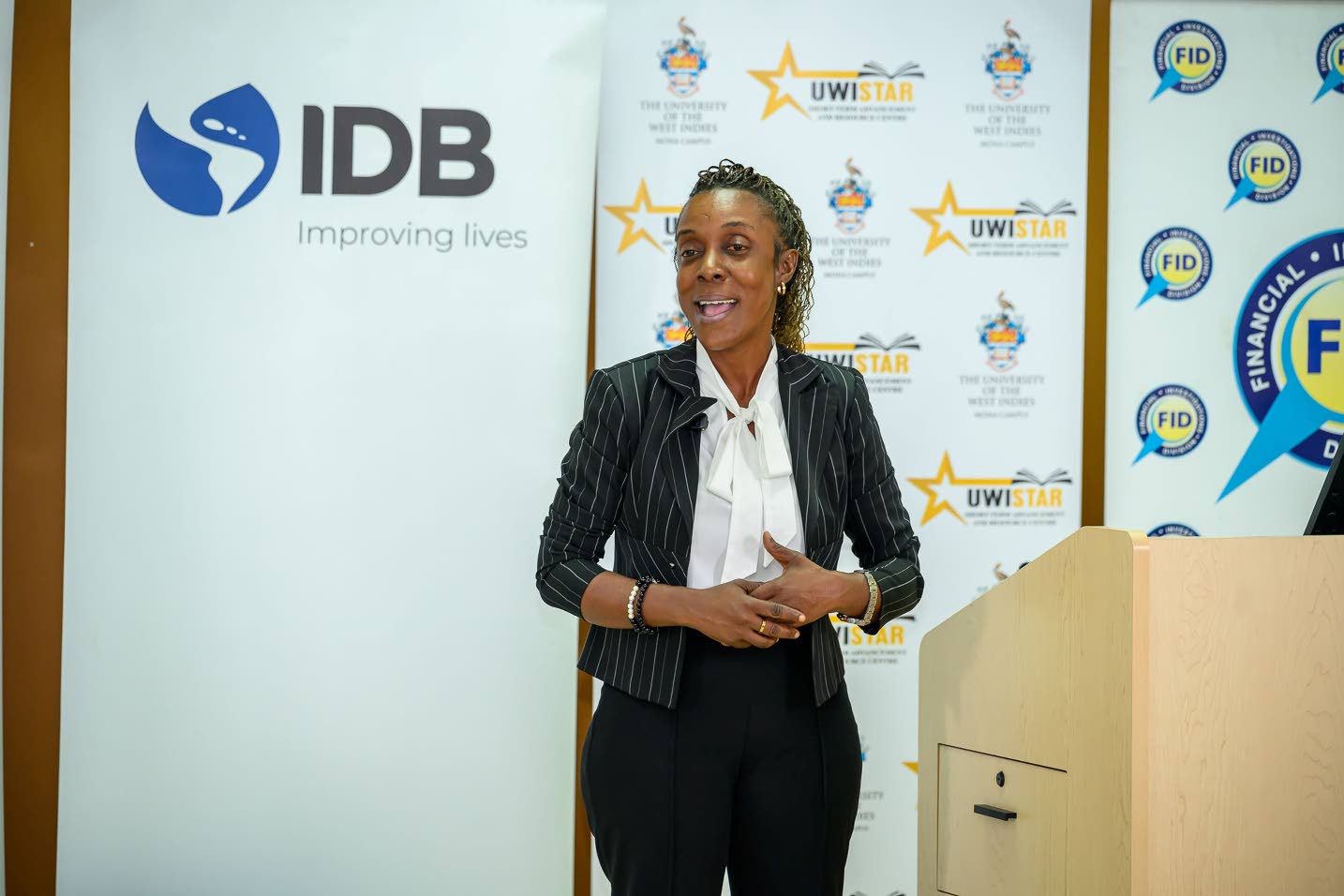
Shelly Brown addresses fellow participants at the end of the inaugural ‘Fundamentals of Countering Financial Crime’ short-term course at The University of the West Indies on February 19, 2026.


