



They trust the Church
Survey says marginalised communities favour faith-based groups; JFJ, Indecom follow closely
THE Church has commanded the highest trust levels amongst residents of 10 marginalised communities across Kingston and St Andrew, with justice-led institutions Jamaicans for Justice (JFJ) and the Independent Commission of Investigations (Indecom) following closely behind.
According to data contained in the 2025 Citizens’ Rights, Roles, Responsibilities and Practices Survey, conducted by The Mico University College with grant funding from the JFJ, “the Church emerged as the most trusted institution across ten communities” (with 63.3 per cent of respondents or 193 of 305 individuals) indicating this. Pastors were described as “mediators, counsellors, and sources of moral guidance”.
The report said Indecom and the JFJ “earned cautious trust” and are “valued but criticised for slow response”. Of the respondents, 42.6 per cent or 130 of 305 individuals indicated that they trusted the JFJ while 39.0 per cent or 119 of 305 of the individuals surveyed said they trusted Indecom.
According to the survey, “in stark contrast, the Government, the political system, and the police recorded the highest proportions of “no trust” responses, contributing to the overall pattern of low trust levels, where low trust stood at 34.8 per cent (106 of 305), moderate trust at 44.6 per cent (136 of 305), and high trust at only 20.7 per cent (63 of 305). It said “disapproval of government performance was particularly stark” with 71.9 per cent of respondents disagreeing that the Government acts in the best interest of all Jamaicans, and 54.7 per cent feeling that Government officials are not held accountable for their actions.
Said the JFJ: “These perceptions reveal deep public scepticism about state responsiveness, reciprocity, and accountability — core pillars of good governance and the rule of law. When citizens believe that government decisions do not serve the broader population or that officials escape consequences for misconduct, it erodes confidence in formal institutions, reinforces reliance on informal community mechanisms, and undermines faith in equitable enforcement of rights and the protective role of the State”.
The survey, which engaged marginalised citizens, including youth, across Tivoli Gardens, Hannah Town, Mountain View, Waterhouse, Rose Town, Whitfield Town, McIntyre Villa/Dunkirk, Trench Town, August Town, and Denham Town, was aimed at assessing the levels of civic awareness, trust in institutions, experiences of human rights violations, and barriers to reporting such incidents.
In further assessing trust in institutions, the surveyors said “across all communities, trust in formal institutions — Government, parliamentarians, police, social services — was low”.
“Participants consistently described politicians as transactional, appearing only during election cycles. As one Mountain View resident put it, “Election time dem come wid food and music — after dat, silence”, researchers said.
According to the survey, “courts were seen as favouring the wealthy”.
“Justice expensive. If yuh nuh have money, yuh lose even if yuh right,” was the sentiment according to the survey. It said further, “trust in the police was scarce across gender and age groups, shaped by repeated experiences of harassment, indifference, and corruption”, with many participants arguing that police involvement often escalated conflict rather than resolving it. Some participants, however, distinguished individual officers from the institution saying: “some police good — but the system bad.”
In the meantime, on a personal basis, surveyors found that “trust in neighbours varied significantly by community”.
“Neighbourhoods with long-term residency [Waterhouse, August Town] reported stronger bonds, whereas Whitfield Town — fragmented by gang lines — expressed extremely low interpersonal trust,” the researchers said noting that Mountain View and Hannah Town participants praised the Restorative Justice Centre for “quelling disputes faster than police”.
“This matrix of trust reflects a nuanced strategy: communities have not abandoned institutional engagement — they engage selectively, cautiously, and often as a last resort,” the researchers pointed out while noting that by gender, patterns are broadly similar, with males however showing a slightly higher share of high trust (21.7 per cent, 34 of 157) compared to females (19.9 per cent, 29 of 146) with low trust marginally more prevalent among males (35.7 per cent vs 34.2 per cent).
The study formed part of the activities supported by an eight-month grant of €15,000 awarded to the Mico Foundation by JFJ under their three-year project, ‘Promotion and Protection of Human Rights in Jamaica through Education, Advocacy, and Legal Support Services’. The initiative, funded by the European Union, commenced in May 2025. A total of 305 participants across 10 communities were engaged through brief street surveys conducted along main thoroughfares. Given the volatility of the communities and general distrust of outsiders, data collection was undertaken by trained community-based data collectors who resided within the respective communities. Survey questions were read aloud by interviewers, with responses recorded directly.
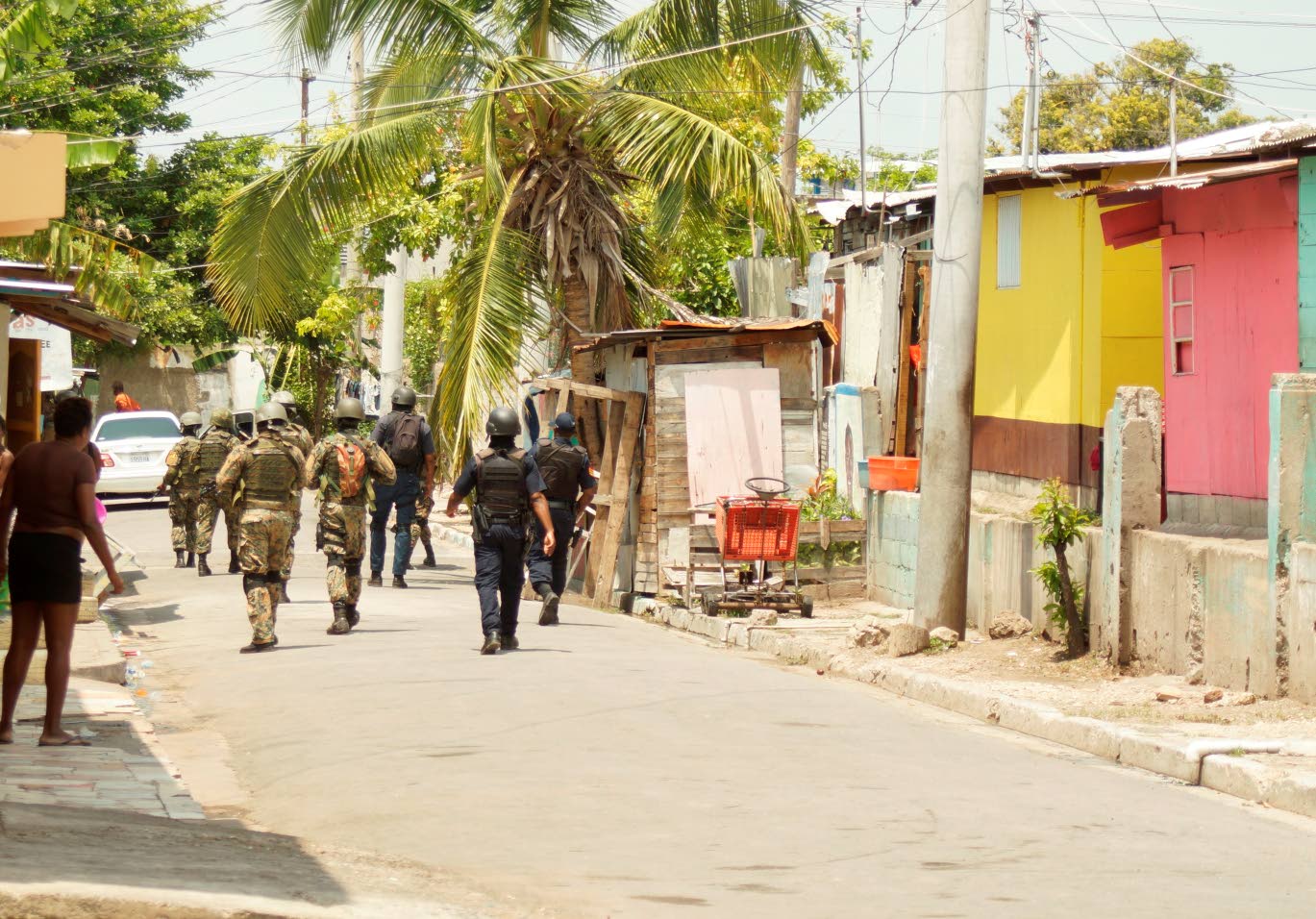
File photo shows a joint security operation in Denham Town, one of the communities surveyed. Respondents said they didn’t trust the Government, the political system or the police.


