



Recovery in sight
Central bank sees rebound in 2026–27 even as reconstruction spending raises inflation concerns
THE Bank of Jamaica (BOJ) says the Government’s new tax package is unlikely to derail economic growth next year, despite widening fiscal deficits and an accelerating reconstruction push.
Governor Richard Byles on Tuesday dismissed concerns that the tax measures, combined with large-scale, post-Hurricane Melissa spending, could choke off the recovery or reignite inflation.
While acknowledging that higher taxes will compress demand, Byles argued that the Government’s parallel, deficit-financed rebuilding programme will inject enough spending into the economy to offset the drag.
“I don’t think that growth is going to be negatively impacted on net terms by the tax package,” he said in response to questions at the central bank’s quarterly monetary policy press conference.
The comments point to growing confidence within the central bank that Jamaica can transition into a recovery phase in 2026–27, despite looser fiscal policy and reconstruction spending. The Government temporarily suspended the fiscal rule in late 2025 following Hurricane Melissa as part of its emergency economic response, allowing higher spending for recovery and reconstruction.
The BOJ expects the economy to contract between one and three per cent this fiscal year, but rebound to growth of between oner and three per cent next year, driven by a recovery in agriculture, mining, tourism and electricity supply.
“Just to clarify, for this fiscal year we are anticipating a contraction… from minus one to minus three. But for next fiscal year… we’ll be seeing a recovery,” Senior Deputy Governor Wayne Robinson said.
Agriculture alone is projected to partially recover by between five and 10 per cent next year, after declining roughly 15 to 20 per cent in the aftermath of the hurricane — making it one of the strongest contributors to the turnaround.
At the same time, Byles acknowledged that reconstruction spending poses a real inflation risk.
The temporary suspension of the fiscal rule will allow wider deficits over the next three years, and if that spending strains productive capacity it could generate second-round price pressures.
Still, the central bank’s internal models suggest Jamaica can navigate the next 12 to 18 months of rebuilding without breaching the four to six per cent inflation target corridor.
“There is a good chance that we will get through the next year, 18 months of rebuilding without inflation exceeding our corridor,” Byles told the Jamaica Observer, explaining why the bank opted for a modest 25-basis-point-rate cut rather than a more aggressive move.
The bank expects inflation to remain within its four to six per cent target corridor, supported by improved agricultural output, moderating hurricane-related price pressures, and a modest appreciation in the exchange rate.
That cut, which lowered the policy rate to 5.50 per cent, signals the start of what could become a gradual easing cycle — though the governor made clear that the bank stands ready to pause or reverse course if inflation expectations begin to rise again.
Despite the policy shift, Byles tempered expectations that commercial banks will immediately lower lending rates.
He explained that major banks continue to hold large portfolios of fixed-rate loans issued during the low-rate pandemic period, limiting the speed at which borrowing costs can adjust downward.
The 25 basis point cut, he said, is more of a directional signal than an immediate trigger for widespread loan-rate reductions.
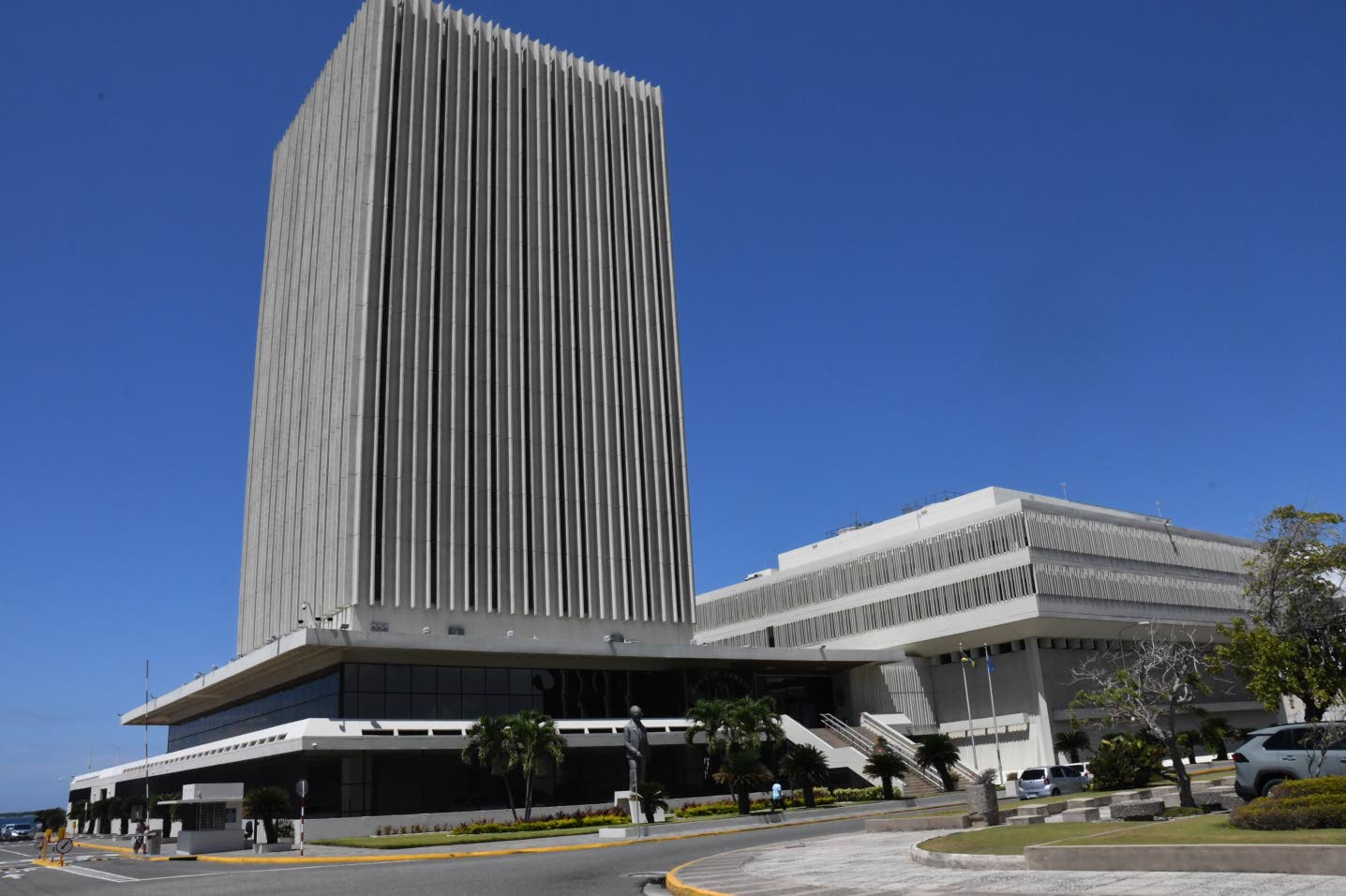
Bank of Jamaica headquarters in Kingston. The central bank expects economic growth to resume in 2026–27, while maintaining a cautious stance to keep inflation within its 4 to 6 per cent target amid rebuilding and fiscal expansion. (Photo: Joseph Wellington)


