



More money for refs?
JFF gen sec signals possible review of referee fees as international reputation grows
Jamaica’s growing reputation in the region as a producer of top-quality referees could soon be matched by improved remuneration on the local scene, as the Jamaica Football Federation’s (JFF) newly-appointed general secretary has signalled that increasing match fees for local officials is firmly on the table.
Gregory Daley, a former referee himself, made his remarks at a time when Jamaican referees continue to enjoy the confidence of international assessors with frequent appointments to Caribbean Football Union, Concacaf and FIFA competitions — a development the administrator believes is not readily appreciated at home.
“It is what we would call the best-kept secret. I’m not sure if it’s because we don’t want to know, or it’s a situation where we are just not interested in these things. It’s always about the Reggae Boyz, and all that stuff… I can say on record that this is one of the departments where football excels in Jamaica. As much as we understand the different, what I would say, descriptive words that we use to describe referees, this is one of the areas internationally that is consistently doing very well for us,” Daley told the Jamaica Observer.
At present, 21 Jamaican referees sit on the FIFA panel, representing one of the largest numbers in the Concacaf region. This group of referees is responsible for officiating in the Jamaica Premier League, earning approximately $10,000 per match in the nation’s top-flight competition, along with benefits such as a $75-per-mile travel allowance.
However, the general secretary suggested that given the preparation, sacrifices and professional standards required at the highest level, broader compensation — including for training and other commitments — should be examined.
“It’s a topic that everybody wants to shy away from, when it comes to money, but it is something that you just have to approach head-on. These referees will travel the length and breadth of the island out of their pockets, so when it’s time for them to be remunerated, they should be. Not only for games, but for training, for everything, and it’s our responsibility to ensure that they are properly renumerated,” Daley said.
He emphasised that reaching the upper tiers of global football officiating demands sustained investment, both individually and collectively.
“It takes a lot to get them there. It takes a lot of preparation, individually, and it takes a lot of preparation, as a group, because they, within themselves, will not get there, but it takes a lot, and it is costing them also,” said Daley, who stopped short of committing to a specific figure.
“I wouldn’t be able to say what is suitable, because there’s a guide and we are guided by it. All I’m saying, if we communicate, keep the channels open to them, let them feel like they’re a part of the process — if we should keep that kind of relationship, it’ll be okay.”
Two Jamaican officials are currently being prepared and are in the running for selection to officiate at the 2026 FIFA World Cup.
Daneon Parchment, who was recently certified in the VAR technology, and Oshane Nation, who is also VAR-certified, have been shortlisted for the 2026 FIFA World Cup. Of note, if Nation is selected, his Assistant Referee Ojay Duhaney will also get selected to officiate at the World Cup.
Owen Powell was the first Jamaican to officiate at a World Cup when he served as assistant referee at the 1998 instalment. Peter Prendergast followed as a referee at the 2002 World Cup in South Korea and Japan.
Assistant Referee Stephanie-Dale Yee Sing (2019 and 2023) and Princess Brown (2019) both served at the Women’s World Cup while the likes of Oshane Nation, Jassett Kerr-Wilson, Ojay Duhaney, Cardella Samuels, Stacy Ann Greyson have all officiated at the age group World Cup level.
“We really don’t pay attention to these things, but to be even considered to be on those panels, it’s a huge achievement. We know there’s only a small number of referees compared to the body itself that will even be considered and the level to which you operate must be at its highest. To see that little Jamaica, we have two persons there [being considered for the 2026 World Cup], it speaks volumes for not only the work that is happening within the referee landscape, but also the quality work that is being put in by the individuals and their trainers as well.”
Besides addressing the fee structure, Daley says the administration is determined to improve the relationship with match officials and prevent disruptions through greater engagement and communication.
“How we communicate with them because most times I can tell you, if communication was spot on, we would have avoided a lot of things that we know had happened in the past. It’s about communicating because they are not that difficult to deal with, they are not monsters, and I really believe that it will be better going forward as we try to keep the communication channels open to them, and we’ll have our discussions, and I think we’ll have a real good future together,” said Daley.
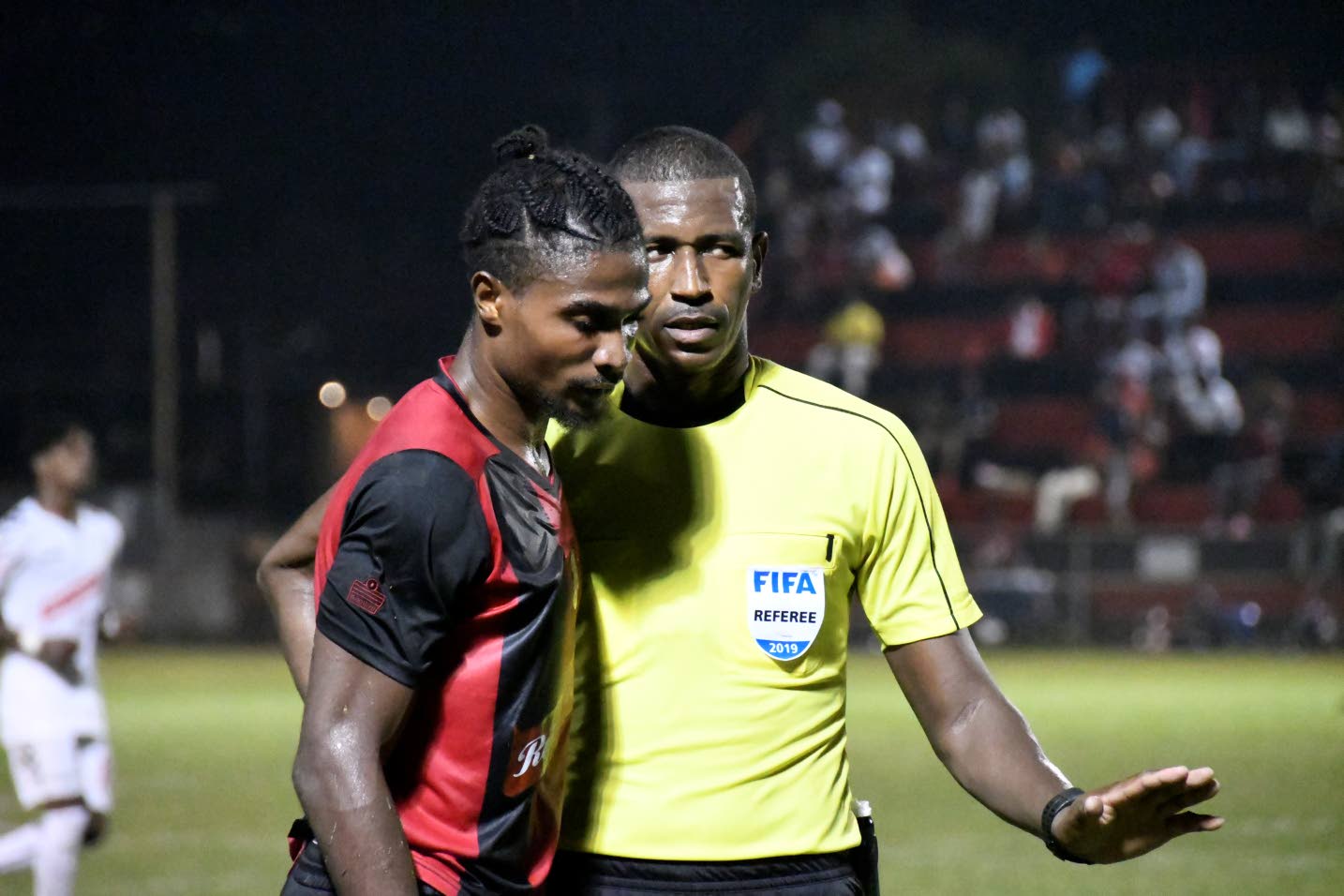
Referee Daneon Parchment (right), one of the most recognised officials in Jamaica, gives Arnett Gardens’ Patrick Brown a warning after the player committed an infringement against University of the West Indies FC in their Red Stripe Premier Legaue game at Anthony Spaulding Sports Complex in this 2019 file photo. (Photo: Naphtali Junior)


