NHT HOUSING SPEND FALLS TO DECADE LOW AS CONTRIBUTIONS HIT RECORD
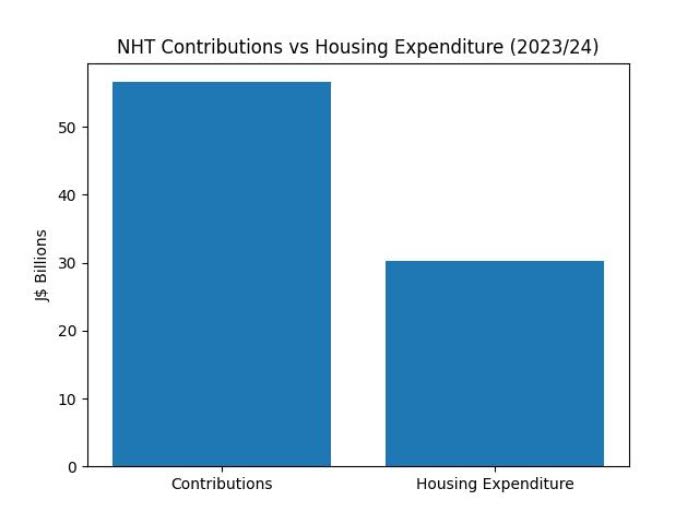
FOR more than a decade, the National Housing Trust (NHT) largely recycled contributor inflows directly into housing programmes. In 2023/24, that relationship shifted sharply, with contributions reaching a record $56.6 billion while housing expenditure fell to $30.2 billion — widening the gap between collections and housing deployment to its widest margin in more than a decade.
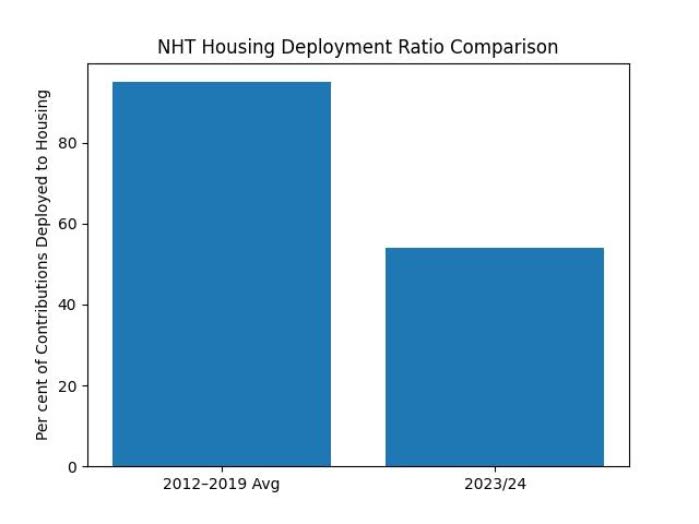
An examination by the Jamaica Observer of more than 12 years of NHT annual reports published on the trust’s website shows that, between 2012 and 2019, housing expenditure typically tracked close to, and in some years, exceeded annual contribution inflows. The 2023/24 outcome marks a clear departure from that historical pattern.
Housing expenditure last year amounted to roughly 54 per cent of contributions, contrasting with earlier years when the trust routinely deployed close to, or more than, its annual inflows on mortgages, construction and related programmes. In several periods, expenditure exceeded collections as the trust accelerated scheme development and loan disbursements.
A widening financial cushion
The divergence coincides with a steady expansion of the trust’s financial position. Total assets climbed to approximately $378.8 billion at the end of the last financial year, reinforcing the NHT’s position as one of Jamaica’s largest financial institutions outside the top-tier banking groups. Based on recent central bank data, an institution of that size would rank third by assets if compared with individual commercial banks — larger than several mid-tier lenders and exceeding the entire building society sector.
The income statement reflects similar strength. Annual financial statements reviewed by the Business Observer show that the NHT has posted consistent multi-billion-dollar surpluses over the past decade, including net surplus in the high-teens billions during the mid-2010s and continued positive outturns in recent years. Those recurring surpluses have compounded into a substantially larger accumulated surplus within equity, strengthening the Trust’s capital base over time.
The investment portfolio has also benefited from the higher interest rate environment. Yield on investments rose to 11.5 per cent in 2023/24, while the average interest charged on NHT mortgages declined to 2.9 per cent, reflecting the Trust’s concessionary lending structure.
The resulting earnings spread — double-digit investment returns alongside below-market mortgage rates, supported by steady contribution inflows — has reinforced annual surpluses and accelerated asset growth even in a year when housing expenditure, relative to collections, declined.
The fiscal dimension
Overlaying the housing ratio is another structural feature of the NHT’s modern evolution: its role in supporting central government finances.
Since amendments to the NHT Act in 2013, the trust has been authorised to transfer up to $11.4 billion annually to the Consolidated Fund. The Business Observer’s review of successive annual reports indicates that cumulative authorised transfers will reach approximately $148.2 billion by March 2026 and could exceed $200 billion if the latest extension runs through 2030/31.
In budget documents, the $11.4 billion annual transfer is treated as recurring revenue. In 2023/24, that transfer equated to roughly 38 per cent of total housing expenditure for the year.
The trust remains legally a statutory housing institution, while also operating within Jamaica’s broader fiscal framework.
Why the gap may have widened
Several factors may explain the divergence between contributions and housing spend.
Supply-side constraints — including land acquisition, infrastructure build-out, procurement timelines and contractor capacity — influence the pace at which projects move from planning to completion.
The trust has also expanded collaboration with private developers and financial partners through external financing arrangements, which can affect the timing and structure of mortgage disbursements.
Macroeconomic volatility in recent years, including pandemic disruption and hurricane recovery efforts, may have influenced project pipelines and cash management decisions.
At the same time, higher contribution inflows — rising from the mid-thirties billions just a few years ago to $56.6 billion last year — provide room to build liquidity buffers while meeting statutory obligations such as refunds and mortgage subsidies.
Housing deployment and capital growth
Taken together, the data point to an institution that is simultaneously financing housing programmes and accumulating capital at a faster pace than in much of the previous decade.
For much of the 2012–2019 period, housing expenditure closely mirrored annual contribution inflows. In 2023/24, contributions reached a record high, assets expanded significantly, investment yields strengthened and annual surpluses remained robust — even as the proportion directed to housing declined.
Collections are at record highs, assets stand near $400 billion and investment returns have strengthened markedly. At the same time, the share of contributor inflows converted into housing stands at its lowest level in more than a decade.
Whether the divergence proves temporary or reflects a longer-term recalibration will become clearer in subsequent financial cycles. For now, the audited data show a measurable shift in how Jamaica’s largest housing financier is deploying — and retaining — the funds it collects.
National Housing Trust head office in New Kingston.