



MELISSA COST CLIMBS TO $1.95T, EQUIVALENT TO 56.7 PER CENT OF GDP
PIOJ says storm damage now four times greater than Hurricane Gilbert
POST-WEATHER assessments confirm that Hurricane Melissa now ranks not only as the strongest storm on record to strike Jamaica, but also the costliest, with the Planning Institute of Jamaica (PIOJ) placing total damage, losses and associated costs at nearly $2 trillion — several billions more than previously projected.
PIOJ Director General Dr Wayne Henry, in his review of economic performance for the October to December 2025 quarter, said updated tabulations show the Category Five system caused losses four times greater than those for Hurricane Gilbert in 1988.
“Damage, losses and additional cost associated with the passage of Hurricane Melissa on October 28, 2025, was estimated at $1.952 trillion (US$12.232 billion). This is equivalent to 56.7 per cent of gross domestic product (GDP) in 2024. This figure represents more than four times that of Hurricane Gilbert — previously the costliest hurricane in Jamaica’s history,” Henry said during a virtual media briefing.
Earlier estimates, including those from the Inter-American Development Bank (IDB), had placed the cost at over US$8 billion, or roughly 41 per cent of GDP. Melissa caused severe damage across six of the most affected parishes —Westmoreland, St Elizabeth, St James, St Ann, Trelawny and Manchester — triggering widespread cross-sector disruption to lives and livelihoods.
The findings were derived from a comprehensive damage and loss assessment (DaLA) the PIOJ said has been prepared by the United Nations Economic Commission for Latin America and the Caribbean in collaboration with the Government of Jamaica. It examined three broad areas spanning the social and productive sectors as well as infrastructure.
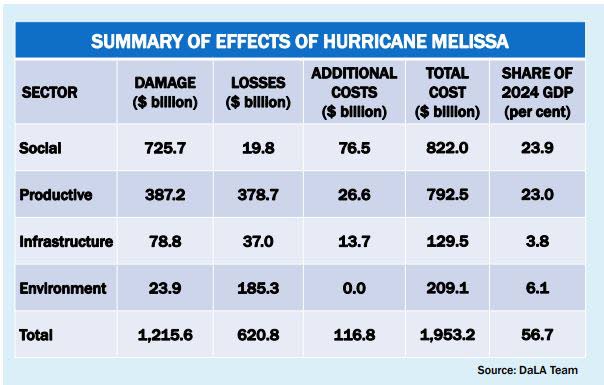
Assessments across the social sector — which focused on aspects of population, education, health, housing and culture — suffered the greatest as damages equated to almost $726 billion and $19.8 billion in losses. This translated to final costs of $822 billion or approximately 23.9 per cent of GDP.
Within the productive sector — which assessed agriculture, fisheries, tourism and commerce — damages amounted to $387 billion, with losses of $378.7 billion. When additional costs were included, total impact reached approximately $792.5 billion, representing 23 per cent of GDP.
Damage to infrastructure including transport, electricity, water and sewage, and telecommunications — along with environmental losses — totalled $102.7 billion in damages and more than $222.3 billion in losses, accounting for nearly 10 per cent of GDP.
Deputy director general of the PIOJ Claire Bernard explained that the revised figures incorporate elements not captured in the initial rapid assessment.
“The initial assessment, using the grade methodology, focused primarily on physical assets; remote sensing technology was used to scan affected areas, capturing houses and visible infrastructure damage. However, it did not account for economic losses or the cost of repairs undertaken by residents to restore their lives, even temporarily,” she said.
The DaLA report, which now includes cross-cutting environmental impacts and broader macroeconomic effects, shows total damages of $1.2 trillion, losses exceeding $620.8 billion, and additional costs of $116.8 billion—pushing overall impact close to the $2 trillion mark.
“Damage and loss is expected to trigger significant short-term slippage. The overall fiscal deficit for FY2025/26 is projected at 3.5 per cent of GDP compared to the balanced budget originally targeted,” Henry said.
Prior to the hurricane, the economy was projected to grow by 2.2 per cent in fiscal year 2025/26 but post-disaster estimates now point to contraction, which is not expected to see a rebound until later this year.
ECONOMY DECLINES 7.5 PER CENT OCT-DEC
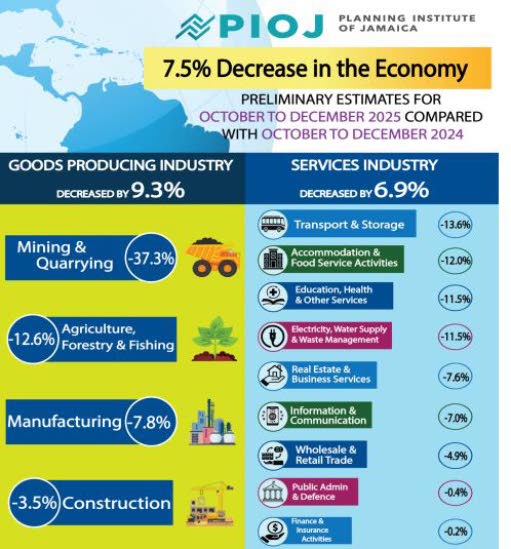
The PIOJ, in further assessments of GDP performance, presented its preliminary estimates which indicated that the economy contracted by 7.5 per cent during the October to December 2025 quarter when compared to the corresponding period in 2024.
Based on the estimates released, this was said to be the steepest quarterly decline seen since July–September 2020, when the economy was severely impacted by the COVID-19 pandemic.
Henry noted the downturn reflected widespread destruction caused by hurricane-force winds, storm surge, intense rainfall, flooding and landslides.
“Combined, these shocks negatively impacted all industries, particularly Agriculture, Forestry & Fishing; Accommodation & Food Services Activities; Transport & Storage; and Electricity, Water Supply & Waste Management,” he said.
The goods-producing sector declined by 9.3 per cent while services contracted by 6.9 per cent.
Despite the sharp fall, the director general said the quarterly out-turn was better than the decline of 11 to 13 per cent previously forecasted — reflecting faster-than-expected recovery in some industries and the resilience of businesses and individuals in the aftermath of the catastrophic hurricane.
For calendar year 2025, real value added was said to have remained flat with output capped at 0.0 per cent. Though economic growth of 2.6 per cent was registered between January and September — driven by recovery from Hurricane Beryl — this was eroded by fourth-quarter contractions caused by Melissa.
With the short- to medium-term outlook remaining generally negative, Henry further said that the expectation is for there to be a contraction in output within the range of 4-6 per cent for the current January-March quarter and 1-2 per cent for FY2025/26.
Pointing to the possibility of a few risks, including emerging geo-political uncertainties arising from the ongoing dispute in the Middle East, he also stressed that these could further weigh on the local economy as oil and trade disruptions are likely to cascade into increased prices for other items such as industrial and agricultural commodities.
“The combination of higher energy costs, disruptions to logistics, and generally lower confidence levels may result in a drag on global trade. The extent of the shock is [however] dependent on the depth and duration of the conflict, and we continue to monitor these developments closely,” Henry said.
The DaLA report, which now includes cross-cutting environmental impacts and broader macroeconomic effects, shows total damages of $1.2 trillion, losses exceeding $620.8 billion, and additional costs of $116.8 billion — pushing overall impact close to the $2-trillion mark.

HENRY…damage, losses and additional cost associated with the passage of Hurricane Melissa on October 28, 2025, was estimated at $1.952 trillion (US$12.232 billion). This is equivalent to 56.7 per cent of gross domestic product (GDP) in 2024. This figure represents more than four times that of Hurricane Gilbert — previously the costliest hurricane in Jamaica’s history (Photo: JIS)


