



Bahamas Government defeated in mega lawsuit against port authority
A multimillion-dollar lawsuit filed by the Bahamian Government against Grand Bahama Port Authority (GBPA) has been dismissed by an international arbitration panel in what has been described as a landmark decision that could significantly shape the country’s economic future.
At the same time, the ruling confirmed that the State maintains regulatory control over the Freeport port area and remains entitled to seek future payments, through to 2054, under the Hawksbill Creek Agreement that, in 1955, established the city of Freeport as a 150,000-acre free trade zone.
The decision was issued in a partial final award on February 27, 2026 by a three-member international tribunal comprising Sir Anthony Smellie, King’s Counsel, former Cayman Islands chief justice; Lord Neuberger of Abbotsbury, former United Kingdom Supreme Court president; and Dame Elizabeth Gloster, a former judge of the Court of Appeal of England and Wales.
The ruling brings closure to the most heated chapter of a protracted legal clash between the Prime Minister Philip Davis-led Government and the GBPA, centred on the financial and governance framework of the Freeport port area.
The Government had sought BSD$357 million in compensation for alleged administrative costs incurred between 2018 and 2022, covering services such as customs, immigration, environmental oversight, and regulatory administration in the Freeport port area. The claim relied heavily on a PwC report, which the Government said detailed the expenses borne on behalf of Freeport.
The tribunal, however, concluded that the Government could not enforce payment using that method. It ruled that the historical reimbursement mechanism cited by the Davis Administration had been replaced in the 1990s by a negotiated arrangement establishing a fixed annual payment from the GBPA, followed by a review process to set future amounts. Because that review process was never implemented after the initial period, the tribunal said the Government could not retroactively claim payments for multiple years.
In short, while a payment structure exists, amounts owed must first be determined through the agreed review mechanism. The tribunal made clear that this process remains active and enforceable for the life of the Hawksbill Creek Agreement, which extends to 2054.
Questions about retroactive payments were left unresolved, with the tribunal noting these could be addressed in a later phase of the arbitration.
The ruling also addressed multiple counter-claims by the GBPA, which had sought more than BSD$1 billion in damages, alleging Government interference in the port area and diversion of investment projects.
The tribunal dismissed nearly all claims, confirming that the Government retains legislative and regulatory authority in Freeport, including over immigration, customs, environmental regulation, development approvals, and utility oversight. Evidence showed this shared arrangement had been practised by both sides for decades.
The GBPA won on a single issue: the tribunal found the Government failed to take timely action on environmental by-laws proposed in 2006 for the port area. While the tribunal recognised this breach, it did not award damages and requested further submissions to determine any potential compensation.
Because several key matters remain unresolved — including retroactive payments and arbitration costs — the award is considered “partial”. The tribunal has directed both parties to propose a procedure for addressing these outstanding issues.
The Government has indicated it will seek determination of sums payable under the review mechanism for historical periods.
The arbitration had drawn close attention across The Bahamas, particularly in Grand Bahama where the Hawksbill Creek Agreement has long granted the GBPA broad powers to develop and administer Freeport as a commercial and industrial hub. Tensions over the balance of authority between the private port operator and the Government have periodically flared, intensifying under the Davis Administration.
The Hawksbill Creek Agreement was signed by the Government of The Commonwealth of The Bahamas and Wallace Groves on behalf of the Grand Bahama Port Authority Limited on August, 4, 1955. It granted a 99-year exclusive right to develop some 50,000 acres of undeveloped land in the centre of the island of Grand Bahama. In return, the port authority agreed to provide infrastructure, which included dredging of a deep-water harbour, construction of an airport, hospital, schools, and other amenities.
As an added incentive the Government granted the port authority control of the administration and issuance of business licences.
Shortly after the ruling, both the Government and GBPA claimed victory.
In a national address, Prime Minister Davis described the decision as “a historic victory” for the country that confirmed the GBPA must make payments to the Government and solidified the Administration’s authority over Freeport.
“For the first time, an independent tribunal has ruled that the Grand Bahama Port Authority is liable and must make payments to the Government and the people of The Bahamas until the year 2054,” Davis said.
“The tribunal confirmed that Freeport is part of The Bahamas, under Bahamian law — not a separate island governed by private rule,” he added.
Davis also said that most of the GBPA’s counter-claims against the Government had failed and the next phase of the arbitration would determine how much the GBPA must pay.
“It could be more than the BSD$357 million in our initial claim – or it could be less,” he said.
However, the GBPA, in its response, said the decision was a victory for it.
“A landmark arbitration victory for the Grand Bahama Port Authority, its licensees, and the people of Grand Bahama has seen the Government’s BSD$357 million so-called ‘reimbursement’ claim under Clause 1(5)d of the Hawksbill Creek Agreement (HCA) dismissed in full and the GBPA’s position under the HCA clearly reaffirmed,” the port authority said.
“The arbitration tribunal fully rejected the Government’s argument that it was owed hundreds of millions of dollars by GBPA under Clause 1(5)d in a decision that provides much-needed clarity and confidence in the future of Freeport, following the prolonged shadow of uncertainty cast by this sweeping claim,” the authority said.
“In addition, the tribunal upheld the GBPA’s counter-claim in respect of the Government’s sustained failure to approve environmental by-laws proposed by GBPA which were intended to strengthen health, safety, sanitation, and environmental governance within the port area. The Government was declared in breach of the HCA for this failure and the tribunal directed the parties to make submissions on a damages award to the GBPA arising from those breaches,” the authority stated in its news release.
“This is more than a legal victory, it is a stabilising moment for Freeport,” the GBPA said, adding, “We trust the ruling will give licensees, investors, stakeholders, and Grand Bahama residents renewed assurance and optimism for the future.”
The authority also said it had, since June 2016, repeatedly advised the Government that the claim was wrong and would fail.
“It was not a good use of time or public resources,” the GBPA said.
The port authority also said genuine collaboration between it and the Government “aimed at ensuring both parties meet their moral and legal obligations for the benefit of all stakeholders and the people of Grand Bahama is essential”.
The possibility of mending fences was also signalled by Davis who said the ruling was an opportunity to move beyond an outdated status quo in Freeport.
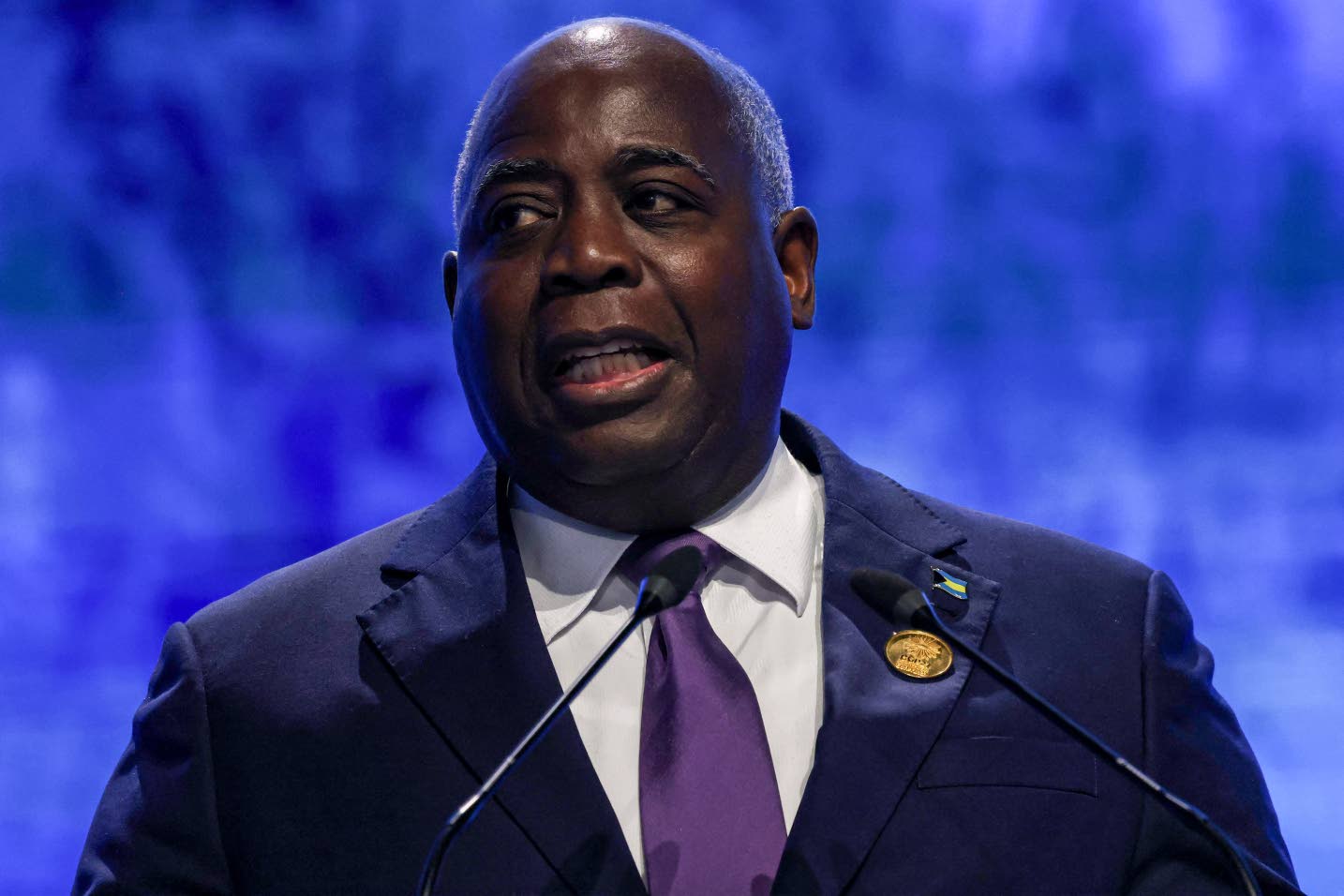
DAVIS… his Government had sought BSD$357 million in compensation for alleged administrative costs incurred between 2018 and 2022 (Photo: AFP)


